
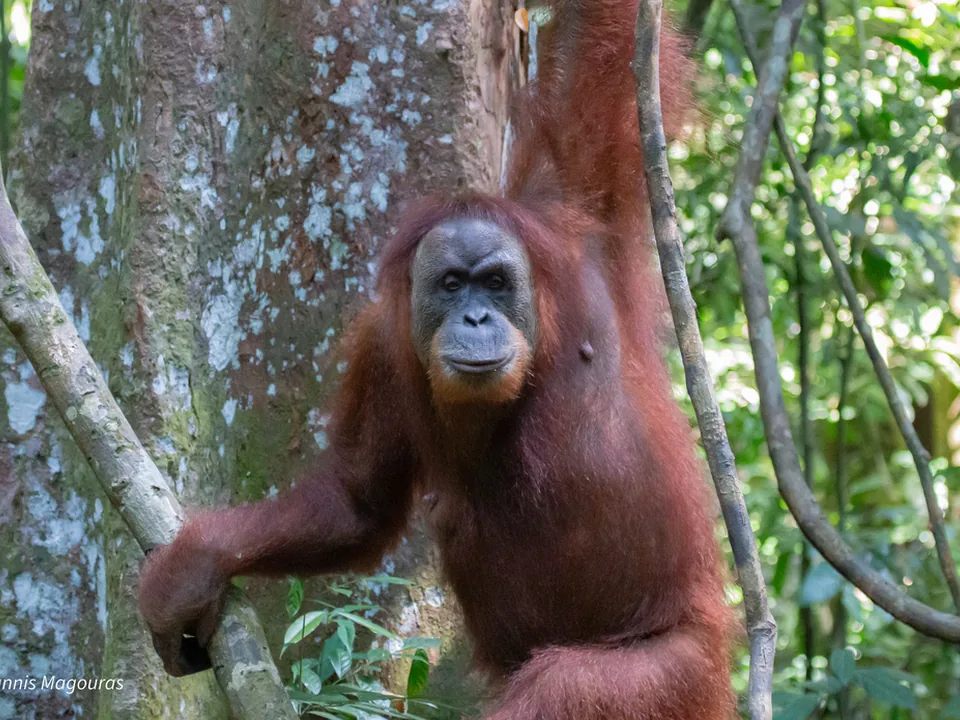
Restricted to northern Sumatra, especially Aceh and North Sumatra; uses lowland rainforest, peat swamp forest and riparian forest. [1,2]
ADW summarises females at about 30–50 kg and males at about 50–90 kg; adult males are markedly larger and may develop cheek pads. [1]
Long reddish-orange hair, very long arms and powerful grasping hands and feet for canopy travel; adult males may have broad cheek pads and a throat sac. [1,3]
Long arms, flexible joints and grasping hands and feet distribute weight during climbing; learning and tool use support food acquisition. [1,3]
Behaviour and ecology
Diurnal, mostly solitary and arboreal. It commonly builds a fresh branch-and-leaf sleeping nest each night; the male long call carries through forest. [1,3]
Diet
Primarily frugivorous, also eating young leaves, bark, flowers and insects; proportions vary by season and locality. [1,3]
Reproduction and life cycle
Usually bears one infant, which remains dependent on its mother for years. WWF reports an interbirth interval of roughly 8–9 years—among the slowest reproductive rates in mammals. [2]
Ecosystem role
Consumes diverse fruit and disperses seeds, supporting forest regeneration. Its decline can remove an important large-bodied seed-transport pathway. [1,3]
Threats & conservation
Forest loss and fragmentation, fire, land conversion, hunting and illegal trade are major threats. Slow reproduction constrains population recovery. [2]
Reviewed 17 September 2026: CR was cross-checked through WWF and species records; Appendix I follows the CITES Appendices effective 5 March 2026. These labels do not replace permit, origin or national-law checks.5 sourced facts
Species in five facts
The species is endemic to northern Sumatra. [1,2]
It commonly builds a new sleeping nest each night. [1,3]
The male long call transmits signals through forest. [1]
Interbirth intervals may reach 8–9 years. [2]
It is an important seed disperser. [1,3]
Sources
[1] Animal Diversity Web — Pongo abelii[2] WWF — Sumatran orangutan[3] Smithsonian’s National Zoo — Orangutan[4] CITES Appendices — effective 5 March 2026[Ảnh] iNaturalist observation 255071917 — Ioannis Magouras, CC BY