
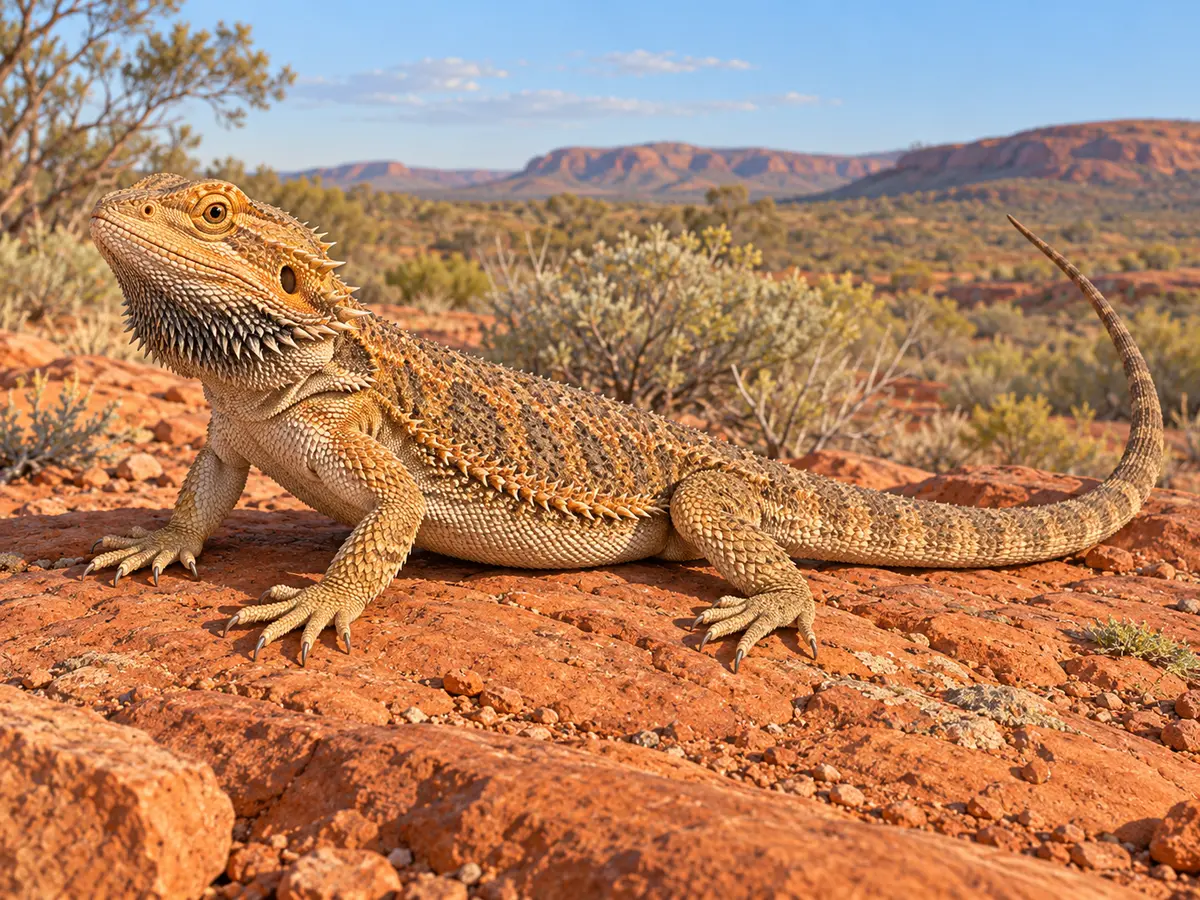
Endemic to Australia, mainly the central and eastern interior. It occupies open woodland, dry scrub, spinifex grassland and semi-desert with basking sites, refuges and diggable substrate. [1,2]
Total length can reach about 55 cm, with the tail making up nearly half; males often have broader heads and thicker tail bases. Captive size reflects genetics, heat, UVB, nutrition and disease, so length alone should not assign age. [1,3]
A broad triangular head, visible ear openings and flexible spines along the jaw, throat and flanks identify the species; the flattened body bears a long tail that is not routinely shed like many geckos. Wild colours range through grey, brown, yellow and earthy red; captive morphs do not represent wild populations. [1,3]
Body flattening and posture regulate heat-gain area, while skin colour shifts partly with temperature and signalling. An expanded beard and flexible spines create a larger silhouette without rigid sharp armour; strong limbs support running and lookout climbing. [1,3]
Behaviour and ecology
Basks to raise body temperature and alternates with shade or burrows; in hot weather activity may shift to morning and late afternoon. Head-bobbing, forelimb waving, flattening and beard expansion communicate; a dark beard may signal threat, arousal or stress rather than one emotion. [1,3]
Diet
Omnivorous, eating invertebrates, leaves, flowers and fruit and occasionally very small vertebrates. Juveniles generally take more animal prey, while adults increase plant intake; captive diets must balance calcium, energy, water and UVB by life stage. [1,3]
Reproduction and life cycle
Eggs are laid in an excavated nest; females can store sperm and produce multiple clutches after mating. Compiled accounts report clutches up to about 24 eggs; incubation temperature affects development, but targets require evidence and veterinary oversight rather than simple sex assumptions. [3]
Ecosystem role
Consumes many insects and plants while supporting native raptors, snakes and mammals as prey. Its use of both ground and elevated perches links microhabitats within Australia's dry-country food web. [1,2]
Threats & conservation
IUCN identifies no major global threat, but fire, land change, roads and illegal collection can matter locally. Most pets are captive-bred; DinoJura still requires breeding, veterinary, quarantine and export/import records and must not equate non-CITES status with unrestricted trade. [2,4]
IUCN lists the species as Least Concern (LC) in an assessment dated 15 June 2017 and published in 2018; population trend is recorded as unknown. Pogona vitticeps was not located in the CITES Appendices effective 5 March 2026; this is not permission to possess or trade it. [2,4]5 sourced facts
Species in five facts
Total length can reach about 55 cm. [1]
The sharp-looking spines are largely flexible skin structures. [1]
The species is diurnal and behaviourally thermoregulates. [1]
Females can store sperm after mating. [3]
IUCN assesses the species as LC with an unknown trend. [2]
Sources
[1] Australian Museum — Central Bearded Dragon[2] IUCN Red List — Pogona vitticeps[3] Animal Diversity Web — Pogona vitticeps[4] CITES Appendices effective 5 March 2026