
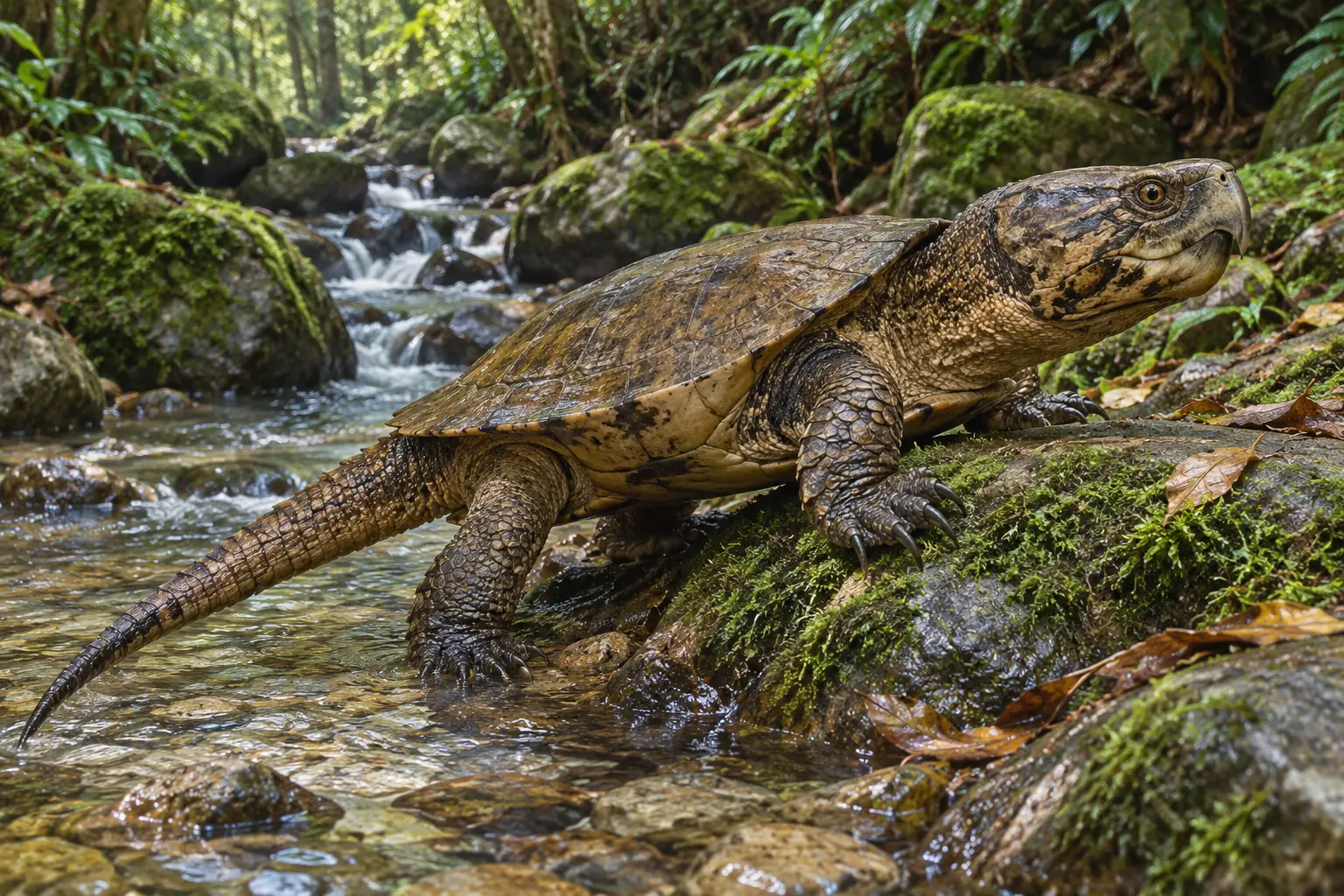
The big-headed-turtle complex occurs from southern China into northern Indochina in cool, clear, oxygen-rich forest streams. Following the 2025 taxonomic change, a P. megacephalum record should include locality, morphology and ideally genetic evidence; older maps are not firm boundaries. [1]
The shell is commonly about 15–20 cm long and can be larger in some individuals; the head and tail make total length far greater than shell length. Historical measurements may combine newly separated lineages, so straight carapace length and locality should both be recorded. [1]
A very large triangular head with horny shields, hooked upper jaw, low brown shell and long scaled tail form the characteristic combination. The head cannot retract fully; this is a biological feature, not a reason to test a bite response. [1]
An armoured head and powerful beak partly compensate for lost head retraction, while strong limbs, curved claws and the long tail stabilise the body in current. A relatively flat shell fits rock crevices but does not make it a powerful open-water swimmer. [1,4]
Behaviour and ecology
Mostly crepuscular to nocturnal, gripping rocks and crevices rather than swimming continuously. Strong claws, the tail as a brace and sometimes the beak help climb small cascades, steep banks or low branches; individuals may defend refuges. [1,4]
Diet
Diet analysis records an omnivorous diet including aquatic and terrestrial invertebrates, crustaceans, molluscs, small fish or amphibians, together with plant material and fruit. Composition changes with season and locality. [4]
Reproduction and life cycle
Research in Hong Kong found breeding synchronised with the wet season and small clutches; one or two eggs are common, although clutches of four have been recorded. Incubation and seasonality elsewhere should not be inferred from one locality. [5]
Ecosystem role
It consumes stream-bottom prey as well as fruit and plant material entering the water, linking riparian forest with aquatic food webs. Protecting the turtle therefore also protects clean headwaters and continuous forest corridors. [4]
Threats & conservation
Illegal trapping and trade, headwater forest loss, pollution and stream fragmentation are major threats. CR and Appendix-I status require strict conservation management: do not publish coordinates, acquire unknown-origin animals or treat isolated breeding as a substitute for habitat protection. [2,3]
Reviewed 23 September 2026: IUCN records CR; Platysternon megacephalum is in CITES Appendix I. The Reptile Database notes that P. peguense was elevated to species in 2025, so older range records may mix evolutionary lineages and require locality-level review. [1–3]5 sourced facts
Species in five facts
The head is too large to retract fully into the shell. [1]
The long tail acts as a brace while climbing stream rocks. [1]
It can climb steep banks and low branches despite being a freshwater turtle. [1]
Diet analysis shows omnivory rather than strict carnivory. [4]
Reproductive research has recorded clutches of one to four eggs. [5]
Sources
[1] The Reptile Database — Platysternon megacephalum[2] IUCN Red List species search[3] CITES Appendices effective 5 March 2026[4] Peer-reviewed diet study — PMC[5] Reproduction of the endangered big-headed turtle