
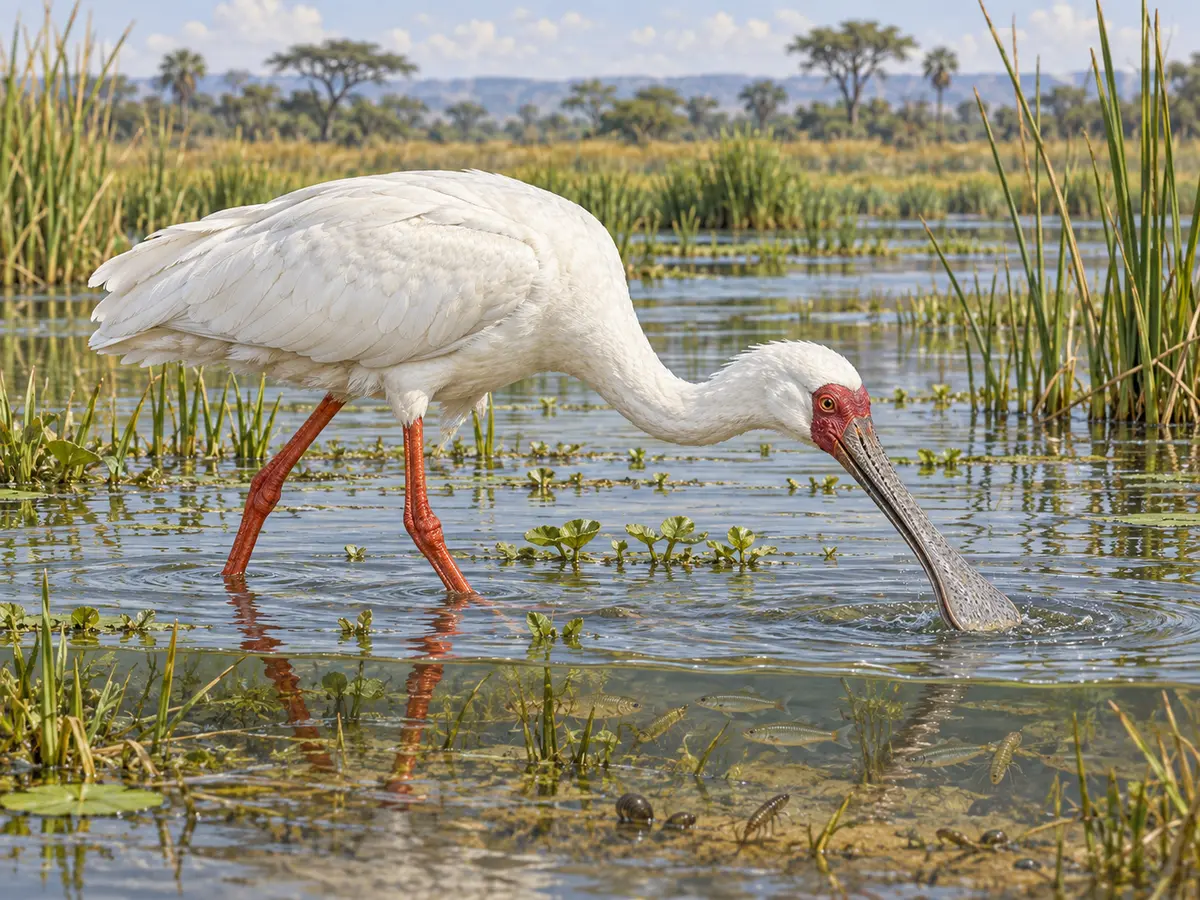
Widespread in sub-Saharan Africa and Madagascar, using lakes, marshes, floodplains, slow rivers, estuaries and shallow brackish water. Nests are commonly placed in trees, reeds or other vegetation close to or above water. [1–4]
Oregon Zoo reports a height of about 0.9 m and a mass of roughly 1.4–2.0 kg. These are species-level references; mass alone should not determine condition without age, sex and clinical assessment. [2]
Adults have white plumage, a long grey bill with a broadened tip, red legs and red facial skin, and fly with the neck extended. Juveniles have shorter bills without a fully developed spoon tip and duller bare parts. [1,2]
The broad, sensitive bill tip and regular sweep locate prey below the surface, while long legs keep the body and plumage above water. Its extended neck in flight helps distinguish it from many herons that retract the neck. [1,2]
Behaviour and ecology
It wades through shallow water while sweeping a partly open bill in horizontal arcs, snapping shut on contact with prey. Birds may forage alone or in groups and nest colonially, sometimes alongside other waterbirds. [1,2]
Diet
Takes small fish, crustaceans, aquatic insects, molluscs and other invertebrates. The bill and sweeping action detect prey by touch in turbid water rather than relying only on vision. [1,2]
Reproduction and life cycle
Lincoln Park Zoo reports colonies of up to 250 pairs; clutches commonly contain three to four eggs, incubated by both parents for about 23 days. Both parents feed the young, which fledge at around 50 days and attain adult plumage near age three. [1]
Ecosystem role
A shallow-water predator and useful indicator of wetland integrity. Nesting colonies also move nutrients among water, vegetation and soil, although the magnitude varies with colony size and habitat. [1–4]
Threats & conservation
The species is not globally threatened but depends on wetlands vulnerable to drainage, pollution, disturbance and altered hydrology. DinoJura should verify lawful origin, veterinary status and import requirements; LC status or no located CITES listing does not mean unrestricted collection. [1,3–5]
BirdLife lists the species as Least Concern (LC). Platalea alba was not located in the CITES Appendices effective 5 March 2026; this is not trade permission and does not waive bird-protection, veterinary, quarantine, transport or national rules. [3–5]5 sourced facts
Species in five facts
Adults stand about 0.9 m tall. [2]
Reference mass is roughly 1.4–2.0 kg. [2]
A clutch commonly contains three to four eggs. [1]
Both parents incubate for about 23 days. [1]
Young commonly fledge at around 50 days. [1]
Sources
[1] Lincoln Park Zoo — African Spoonbill[2] Oregon Zoo — African spoonbill[3] BirdLife DataZone — Platalea alba[4] Convention on Migratory Species — Platalea alba[5] CITES Appendices effective 5 March 2026