
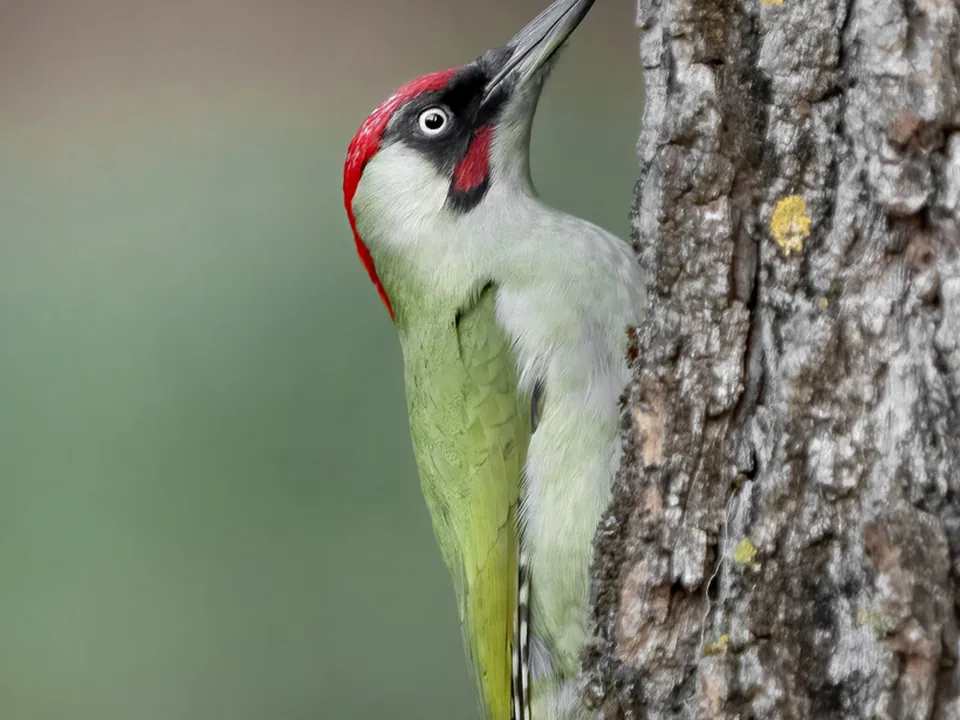
Distributed across much of Europe into western Asia, using broadleaf woodland, wooded grassland, parks, gardens and forest edges. The combination of mature nesting trees and short turf rich in ants is especially important. [1–4]
RSPB reports a length of about 30–34 cm and a 40–42 cm wingspan; BTO gives an average mass near 189 g. It is the largest regularly breeding woodpecker in Britain, not the largest woodpecker across all Europe. [2,3]
Olive-green body, pale underparts, bright yellow rump, red crown and black facial area are key marks. Males have a red centre to the black moustachial stripe; females lack this red centre. The undulating flight and yellow rump are conspicuous as the bird leaves the ground. [2–4]
The very long tongue coils behind the skull when retracted and has a surface suited to retaining ants. Opposing toes, a stiff tail and a strong bill support climbing and excavation even though much feeding occurs on the ground. [3,4]
Behaviour and ecology
Usually forages alone or in pairs on turf, opening ant nests with the bill and using a long tongue to collect ants and larvae. Loud calls maintain contact and advertise territory; it drums less often than many other woodpeckers. [2–4]
Diet
Adult ants, larvae and pupae dominate the diet, with other insects or fruit taken occasionally. This reliance makes short, pesticide-free turf and ground containing ant nests essential foraging resources. [2–4]
Reproduction and life cycle
Pairs excavate a cavity in decaying or soft wood, usually without nest lining. BTO reports 4–6 eggs, incubation by both parents for about 18–20 days and fledging at roughly 20.5–23.5 days. [3]
Ecosystem role
It is a specialised ant predator and a primary cavity excavator. Once abandoned, its holes may be reused by other cavity nesters, making mature trees and decaying wood resources for both the woodpecker and the wider woodland bird community. [3,4]
Threats & conservation
Global LC status does not exclude regional decline; RSPB reports a 33% decrease in the UK population during 2013–2023. Loss of mature trees, sealed turf and pesticides reduce nest sites or ant prey. The UK figure should not be generalised as a global trend. [1–3]
The 2024 IUCN assessment lists Picus viridis as Least Concern (LC). The name was not located in the CITES Appendices effective 5 March 2026; this does not waive native-bird protection, nest and egg laws, veterinary rules or quarantine. [1,5]5 sourced facts
Species in five facts
The long tongue retracts around the back of the skull. [4]
Males have a red centre to the black moustache; females do not. [2]
Ants are the species' principal food. [2–4]
A typical clutch contains 4–6 eggs. [3]
The oldest bird in BTO ringing data exceeded 15 years. [3]
Sources
[1] IUCN Red List 2024 — Picus viridis[2] RSPB — Green woodpecker[3] British Trust for Ornithology — Green Woodpecker[4] Woodland Trust — Green woodpecker[5] CITES Appendices effective 5 March 2026Photo record — Andrea Poggi, iNaturalist 141624066, CC BY