
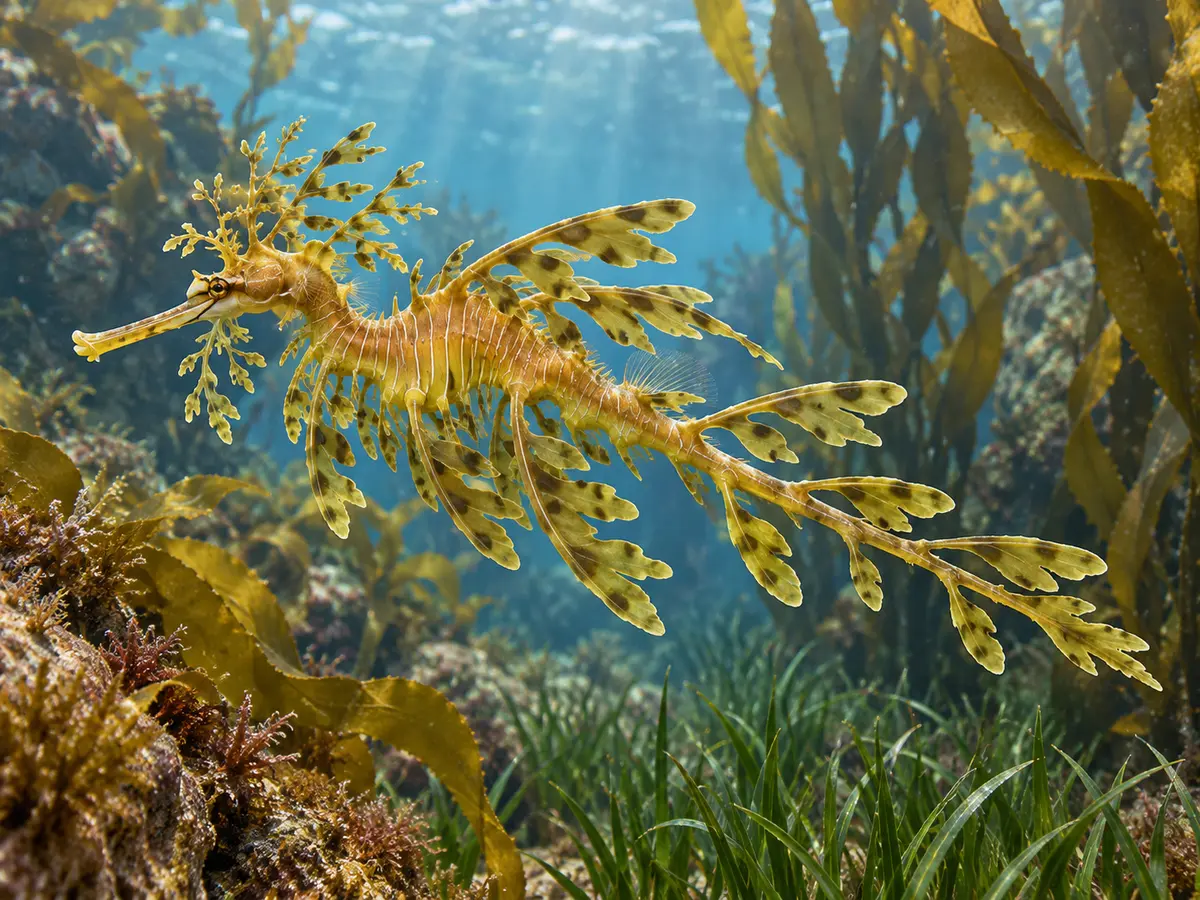
Occurs along southern Australia from Kangaroo Island, South Australia to south-western Western Australia according to the Australian Museum. Usually seen on kelp-covered rocky reefs at roughly 3–50 m, with seagrass and macroalgal habitat. [1]
Specialist sources commonly report a maximum length around 35 cm; figures vary with measurement method and population. The rigid, slender body means length alone does not represent mass or swimming-space needs. [2,3]
A long tubular snout, bony-plated body and many branching leaf-like appendages on head, neck, body and tail. Pectoral fins sit by the 'neck' and the dorsal fin near the rear body; unlike a seahorse, the tail is not prehensile. [1,2]
Leaf-like appendages merge the body outline with kelp, while rapidly beating transparent fins provide discreet propulsion. The eyes survey the surroundings and the tube snout focuses suction; the appendages are not propulsive fins. [1,2]
Behaviour and ecology
A slow swimmer that often aligns with currents to resemble drifting vegetation. It sucks prey through the tubular snout; camouflage aids both feeding and predator avoidance but creates strong dependence on habitat structure. [1–3]
Diet
Feeds on mysids, amphipods and other small crustaceans, drawing them whole into the mouth with rapid suction. It lacks crushing teeth; prey size, density and live-food quality are central specialist-care considerations. [2,3]
Reproduction and life cycle
The female transfers fertilised eggs to the underside of the male's tail; the Australian Museum confirms male egg carrying, while FishBase reports about 250 eggs. Incubation is commonly four to six weeks and young are independent after hatching. [1–3]
Ecosystem role
A predator of small crustaceans in temperate algal reefs and prey for larger fishes. Its dependence on kelp makes it an educational flagship for marine heatwaves, kelp loss and coastal habitat change. [1,4]
Threats & conservation
Kelp and seagrass decline, pollution, temperature change and illegal collection are risks; research highlights gaps in distribution and trend data. DinoJura should not treat an older LC status as sourcing evidence: conservation or specialist-care collaboration requires Australian permits, provenance and appropriate marine life-support capacity. [3–5]
IUCN lists the species as Least Concern (LC) in an assessment dated 12 May 2016; the assessment's age matters when interpreting it. Phycodurus eques was not located in the CITES Appendices effective 5 March 2026, but absence is not permission to collect, keep or move it: Australian and local permit rules still apply. [2,3,5]5 sourced facts
Species in five facts
Leaf-like appendages provide camouflage, not propulsion. [1,2]
Dorsal and pectoral fins are nearly transparent. [1,2]
The tail is not prehensile like a seahorse's. [2]
The male carries eggs beneath the tail. [1]
The species is endemic to temperate southern Australia. [1]
Sources
[1] Australian Museum — Leafy Seadragon (updated 4 June 2026)[2] FishBase — Phycodurus eques[3] SeaWorld — Leafy Sea Dragon[4] PubMed — Leafy seadragon population genomics and habitat change[5] CITES Appendices effective 5 March 2026