
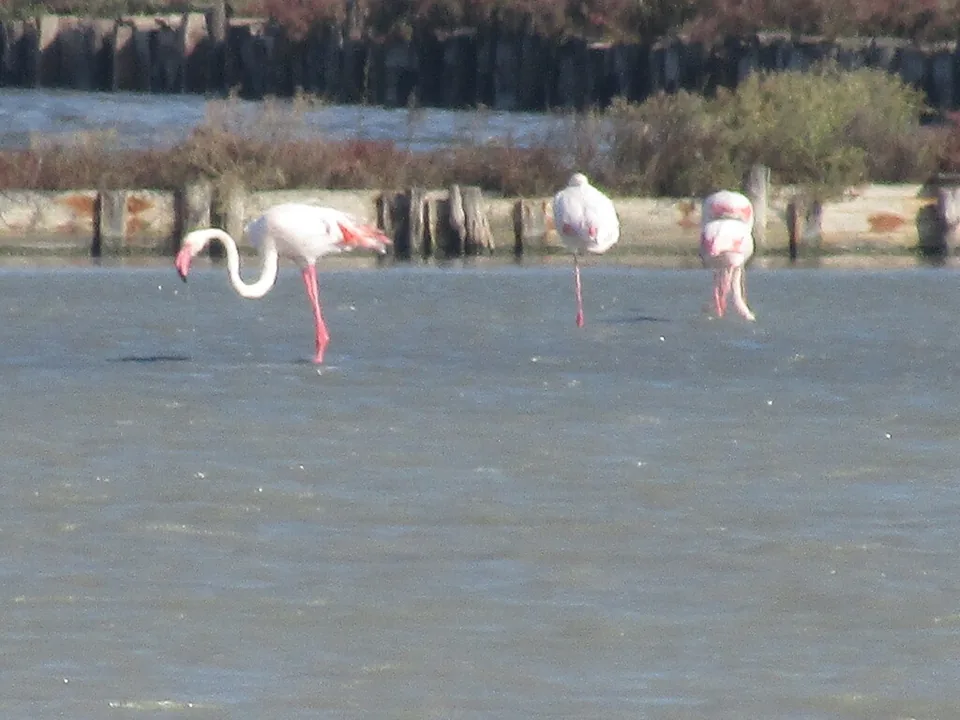
Patchily distributed across Africa, the Mediterranean, the Middle East and south-western to southern Asia. Habitats include saline lagoons, alkaline lakes, estuaries, mudflats and shallow salt pans; populations may move with water levels and food availability. [1,2]
Adults commonly stand about 110–150 cm tall, span roughly 140–170 cm and weigh about 2–4 kg; males average larger than females. Long legs and neck account for much of the height rather than a massive torso. [2,3]
The body is pale pink-white, with reddish-pink wing coverts and black flight feathers most visible in flight. The pink bill bends downward to a black tip; long pink legs end in webbed feet. Juveniles are grey-brown and become pink as dietary carotenoids accumulate. [2,3]
Horny bill lamellae retain food as the tongue expels water, long legs permit feeding at different depths and salt glands help regulate ions in saline habitats. Group living improves vigilance but concentrates breeding into a limited number of sites. [2,3]
Behaviour and ecology
Highly social, feeding and nesting colonially, sometimes in colonies of thousands to tens of thousands of pairs. Birds walk or swim in shallows, invert the head and sweep the bill; synchronised head-and-wing displays help form pairs before breeding. [1–3]
Diet
Filters algae, cyanobacteria, small crustaceans, molluscs, aquatic insects, worms and plant seeds according to the wetland. Pink colour comes from dietary carotenoids; pale plumage can reflect pigment intake but is not a stand-alone health diagnosis. [2,3]
Reproduction and life cycle
Pairs build a conical mud mound and usually lay one egg. Both incubate for about four weeks, then feed the chick nutrient-rich crop secretion; young leave the nest early and join large crèches while still being recognised and fed by their parents. [1–3]
Ecosystem role
Flamingos convert microbial and invertebrate production into biomass available to higher trophic levels; walking and filter-feeding disturb shallow sediments. Large flocks are also conspicuous indicators of changing water, salinity and wetland productivity. [1–3]
Threats & conservation
Water abstraction, salinity change, pollution, colony disturbance, power-line collision and nesting-site loss can drive local declines despite the LC category. DinoJura requires traceable origin, Appendix-II documentation, veterinary and quarantine screening, and social space with suitable shallow-water substrate. [1,4]
BirdLife/IUCN lists the greater flamingo as Least Concern (LC). The family Phoenicopteridae is included in CITES Appendix II; international transactions require specimen-, origin-, permit-, veterinary- and country-specific review. [1,4]5 sourced facts
Species in five facts
A clutch usually contains one egg laid on a mud mound. [2,3]
Both parents produce crop secretion to feed the chick. [2,3]
Black flight feathers are mostly hidden when the wings are folded. [2]
Pink plumage is produced from carotenoids in the diet. [2,3]
The flamingo family is included in CITES Appendix II. [4]
Sources
[1] BirdLife DataZone — Greater Flamingo[2] San Diego Zoo Wildlife Alliance — Flamingo[3] Animal Diversity Web — Phoenicopterus roseus[4] CITES Appendices effective 5 March 2026Photo record — SteveM4560 / iNaturalist 313297928