
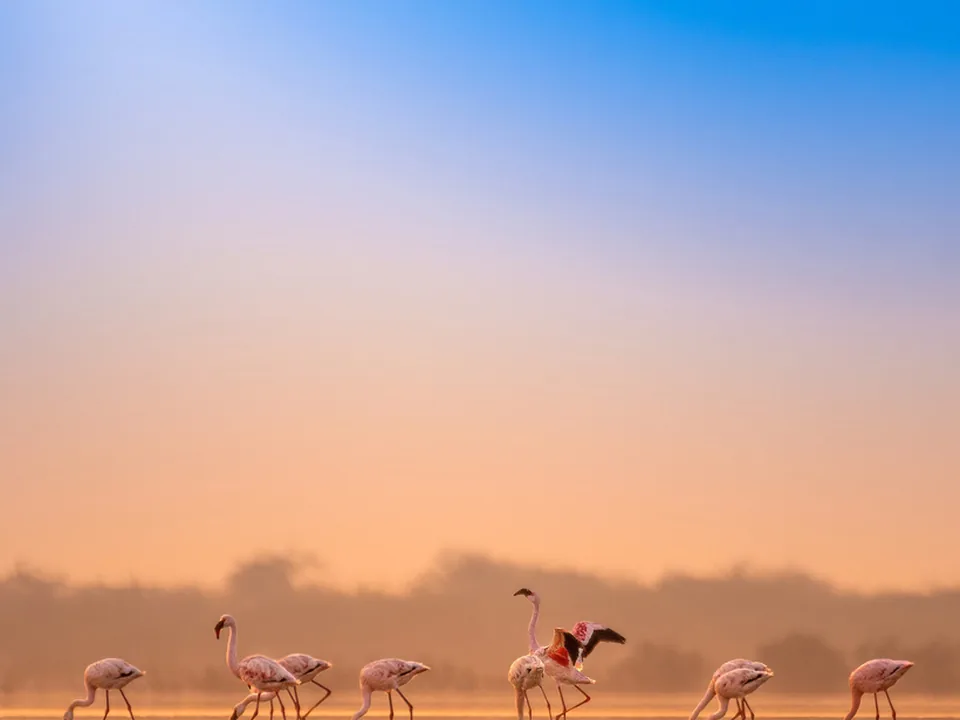
Concentrated mainly in eastern and southern Africa, with populations in western Africa and the India–Pakistan region. It uses soda lakes, salt pans, coastal lagoons and shallow waters rich in microorganisms. [1,2]
About 80–90 cm tall, with a wingspan around 90–100 cm and mass commonly about 1.2–2.7 kg. It is smaller and more delicate than the greater flamingo, with a conspicuously darker bill. [1]
Pale pink plumage, deep pink to red wing coverts, black flight feathers, red eyes and a curved deep-red to near-black bill identify adults. Juveniles are grey-brown and acquire pink pigments gradually from food. [1]
A deep bill, fine lamellae and piston-like tongue retain exceptionally small food particles. Long legs and webbed toes support wading on soft mud, while salt handling supports life in saline–alkaline water. [1]
Behaviour and ecology
Highly colonial, travelling long distances—often at night—among roosting, feeding and breeding sites. While feeding it inverts the head and sweeps the bill, using the tongue to pump water through filter lamellae. [1]
Diet
Specialised on cyanobacteria such as Arthrospira, together with microscopic algae and tiny organisms. Dietary carotenoids are metabolised and deposited in feathers; pink colour is not independent of nutrition. [1]
Reproduction and life cycle
Breeds synchronously in colonies; each pair usually builds a conical mud mound and lays one egg. Both parents incubate and feed nutrient-rich crop milk, while chicks gather in large crèches. [1]
Ecosystem role
It harvests microbial production and moves nutrients among water, shores and nesting areas. Guano and sediment disturbance influence nutrient cycling, and colonies provide prey for several predators. [1]
Threats & conservation
Water-level change, water and soda-ash extraction, pollution, disturbance at breeding sites and loss of algal food can rapidly affect entire flocks. Conservation must manage whole catchments, not only the spot where birds are standing. [1–3]
Reviewed 22 September 2026: BirdLife/IUCN records NT; Phoenicopteridae spp., including Phoeniconaias minor, are in CITES Appendix II. Very large flocks do not imply security because breeding is concentrated at very few suitable sites.5 sourced facts
Species in five facts
It is the smallest of the six living flamingo species. [1]
The bill is used upside down to filter extremely small food particles from water. [1]
Both parents produce crop milk to feed the chick. [1]
A nest typically holds one egg atop a conical mud mound. [1]
Pink colour comes from dietary carotenoids and is not fully present at hatching. [1]
Sources
[1] Animal Diversity Web — Lesser flamingo (legacy combination Phoenicopterus minor)[2] BirdLife DataZone — Lesser Flamingo[3] CITES Appendices effective 5 March 2026[Ảnh] iNaturalist observation 138952027 — Parth Kansara, CC BY