
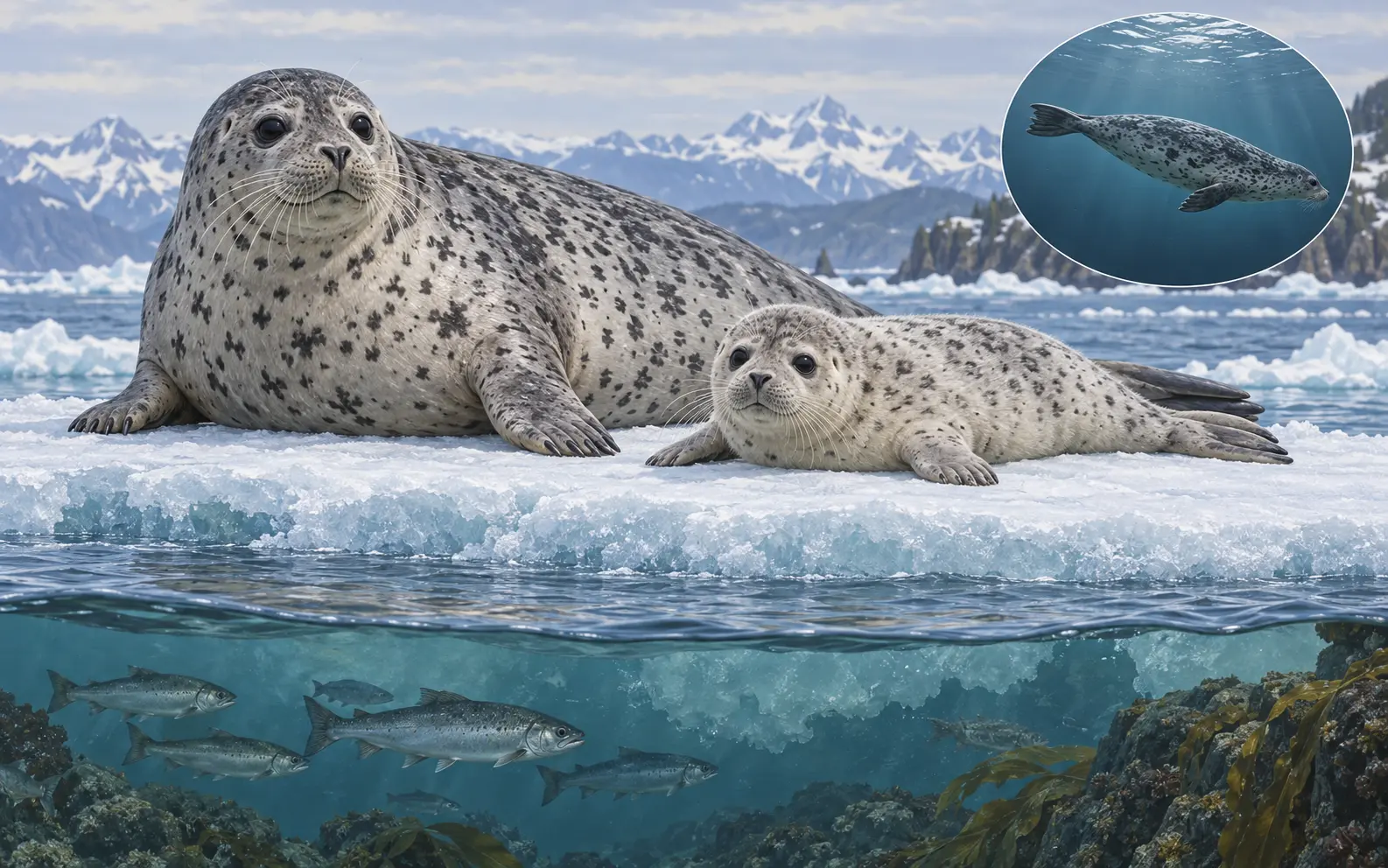
Beaufort, Chukchi, East Siberian, Bering and Okhotsk Seas, south to the Sea of Japan and northern Yellow Sea. In ice-free months many forage from coastal haul-outs.
Adults are commonly about 1.5–1.7 m long and 82–123 kg, similar in size to harbour seals.
Pale coat with irregular dark spots, rounded head, no external ear flaps, and hind flippers that cannot rotate under the body. It can be confused with harbour seals where ranges overlap.
A streamlined body, thick blubber and counter-current heat exchange reduce heat loss. Seasonal ice provides temporary pupping platforms near feeding grounds.
Behaviour and ecology
Often wary and dispersed while foraging, but aggregates on ice or shore during breeding and moulting. NOAA records seasonal family triads of male, female and pup.
Diet
Juveniles take more krill and small crustaceans; adults eat herring, Arctic cod, pollock, capelin, molluscs and crustaceans.
Reproduction and life cycle
A single pup is born on ice in late winter to early spring after about ten months' gestation; pups wean after several weeks and rapidly learn to swim.
Ecosystem role
Predates fish and invertebrates while serving as prey for polar bears, killer whales and sometimes humans, linking sea-ice and marine food webs.
Threats & conservation
IUCN lists the species as LC globally; NOAA separately monitors the southern population under climate risk. It was not CITES-listed on the verification date, but movement remains subject to strict marine-mammal, veterinary, welfare and national laws.
IUCN/CITES status was checked on the profile date; re-verify before any legal or transaction decision.5 sourced facts
Species in five facts
The common name comes from irregular dark coat spots.
It is a true seal without external ear flaps.
Seasonal male-female-pup triads are unusual among true seals.
The species moves with seasonal sea ice.
Juveniles and adults differ in prey emphasis.
Sources
NOAA Fisheries — Spotted sealNOAA status reviewIUCN Red List searchCITES Checklist