
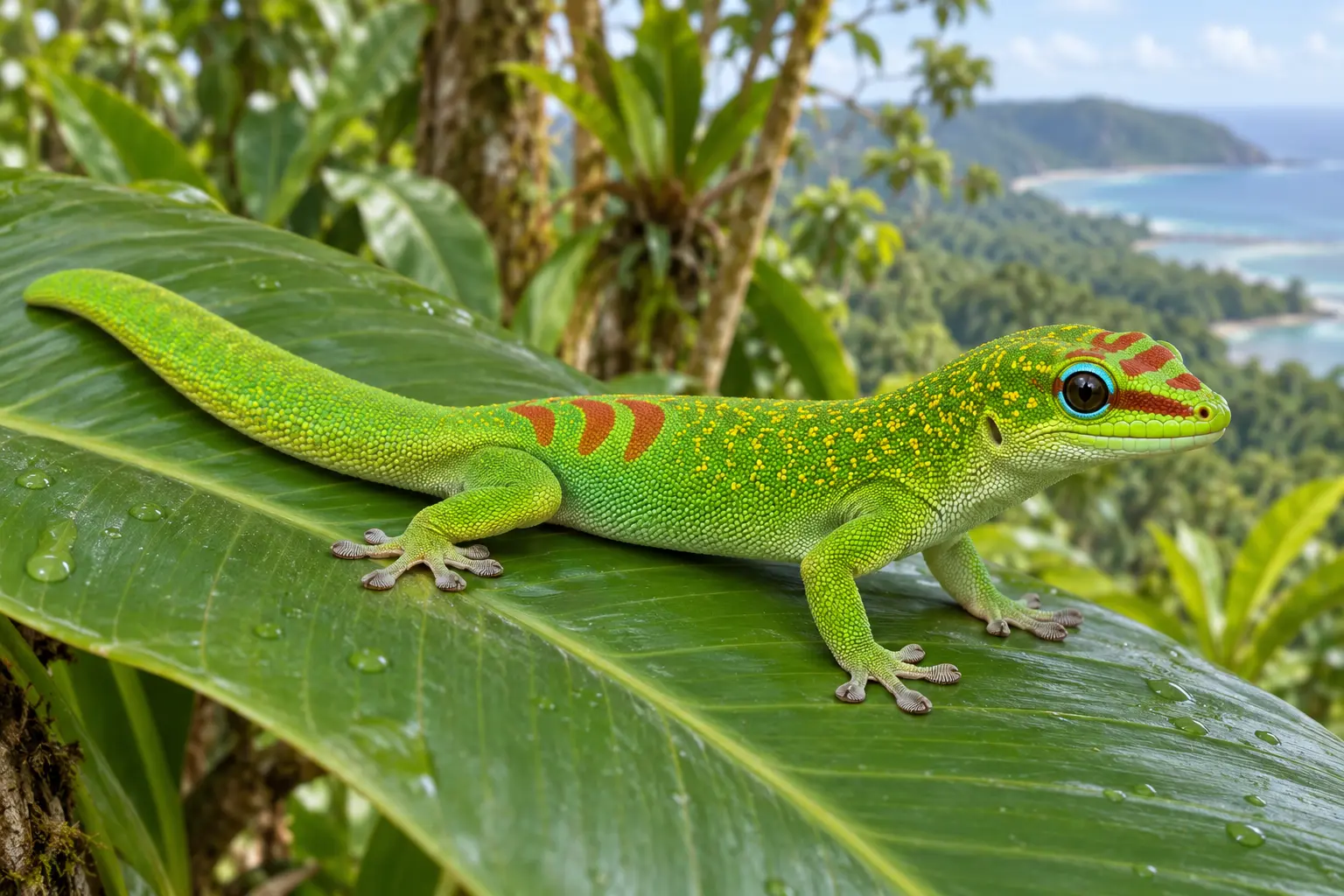
Native to northern Madagascar, the Comoros, Mayotte and Seychelles, and introduced to Hawaii and several Pacific islands. It uses forest, scrub, gardens and trees around buildings, but occurrence in an introduced range does not establish legal provenance for an animal. [1,2,5]
Total length is commonly about 10–13 cm, with the tail contributing close to half. Measurements vary with sex, age and subspecies, so a single length is not a body-condition standard. [1,2]
Bright green with gold dorsal speckling, three red-brown bars across the snout, blue around the eyes and a slightly flattened tail. Colour may dull with cold, stress or shedding, so scalation, pattern and geography should supplement colour. [1,2]
Microscopic structures on the toe pads generate surface adhesion; large eyes support daytime hunting and the tail aids balance. Green-gold patterning breaks up the outline in dappled foliage and also contributes to signalling. [1,2]
Behaviour and ecology
Diurnal and arboreal, with variable territorial defence around feeding areas. Adhesive toe pads allow movement over leaves and smooth surfaces; the delicate skin means animals should never be restrained by the tail or rubbed. [1,2]
Diet
Consumes insects and small invertebrates and also licks nectar, pollen and soft fruit. In managed care, animal prey and sweet foods both require size, quantity and mineral-vitamin control under veterinary guidance. [2,3]
Reproduction and life cycle
Oviparous. Taxonomic references confirm egg laying, but online clutch, temperature and incubation values are inconsistent, so no single incubation formula is assigned to every population or subspecies. [1]
Ecosystem role
It preys on small arthropods, may carry pollen while feeding on nectar, and is itself prey for birds, snakes and other predators. In introduced ranges, effects on native lizards and insects require island-specific assessment. [2,5]
Threats & conservation
The species is not globally threatened, but habitat degradation, collection and undocumented trade remain local risks. Every animal requires provenance evidence and must never be released, especially where Phelsuma is regulated as injurious or non-native wildlife. [3–5]
Reviewed 3 October 2026: the current IUCN page lists the species as Least Concern (LC); CITES regulates Phelsuma spp. under Appendix II. LC does not allow unrestricted collection or movement, and introduced populations may also be subject to local invasive-species controls. [1,3–5]5 sourced facts
Species in five facts
The name laticauda means ‘broad tail’. [1]
It is active by day, unlike many familiar nocturnal geckos. [2]
Three red-brown snout bars are a useful identification feature. [1,2]
Populations have been introduced to Hawaii and several Pacific islands. [1,5]
International trade is controlled under CITES Appendix II. [4]
Sources
[1] The Reptile Database — Phelsuma laticauda[2] Animal Diversity Web — Phelsuma laticauda[3] IUCN Red List search — Phelsuma laticauda[4] CITES Appendices effective 5 March 2026[5] Hawai‘i DLNR — Injurious wildlife