
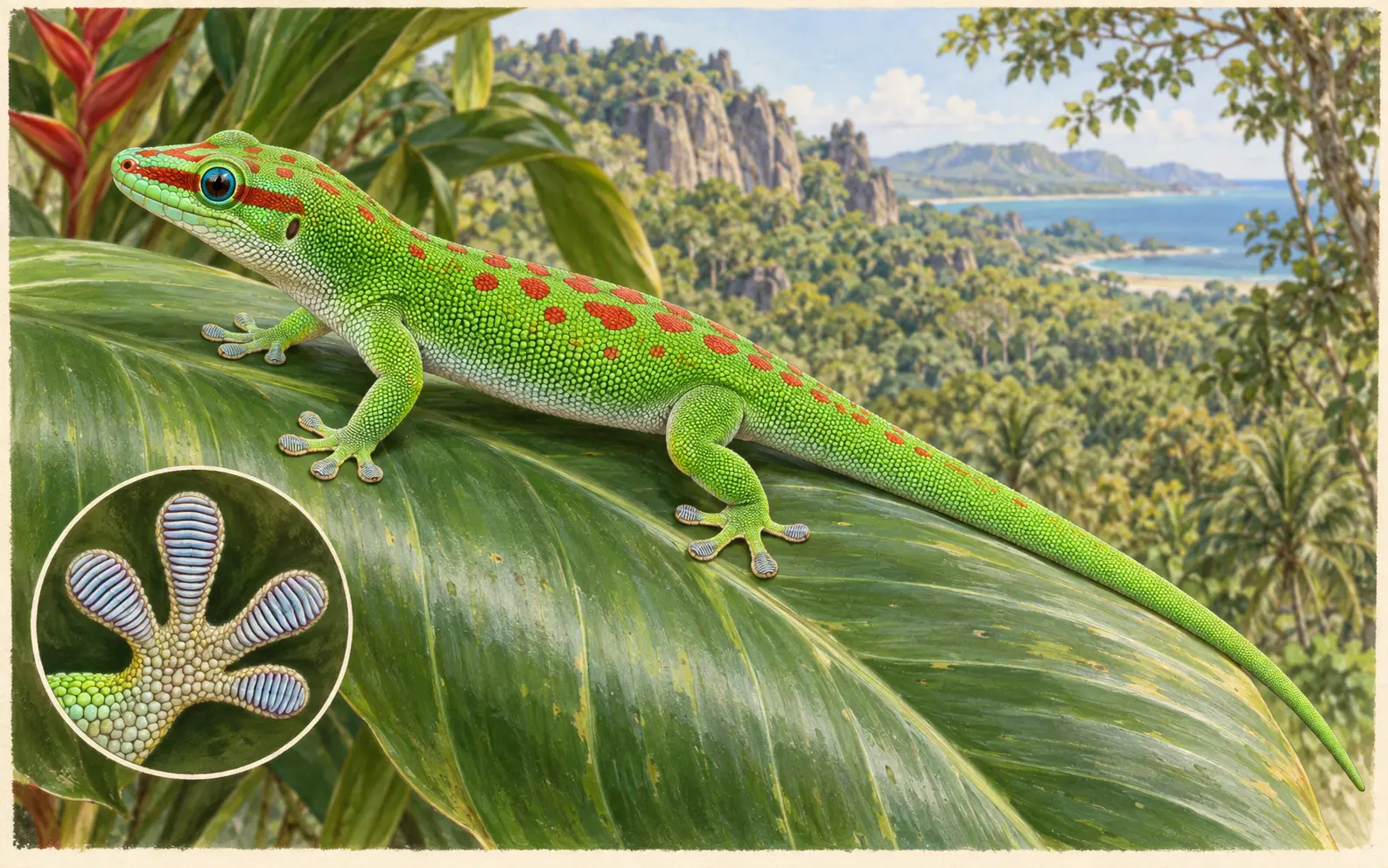
Native to northern and north-western Madagascar, including Nosy Be; inhabits humid forest, edges, plantations and treed settlements. It has been introduced beyond its native range.
Among the largest Phelsuma, commonly reaching about 25–30 cm total length, with the tail contributing close to half.
Green body with variable red dorsal marks and a red line from snout through the eye. Round pupils and toe lamellae are characteristic; delicate skin can tear under rough handling.
Millions of microscopic structures on the toe pads create molecular adhesion to surfaces. Diurnality is paired with conspicuous visual colour, unlike most nocturnal geckos.
Behaviour and ecology
Diurnal, fast-climbing and territorial. It communicates through posture, colour and sound, often resting or nesting around leaves and tree cavities.
Diet
Takes insects and other invertebrates, while also licking nectar, fruit juices and ripe fruit. Captive diets should not rely only on sweet foods.
Reproduction and life cycle
Oviparous, often producing two hard-shelled eggs per clutch. Eggs may be hidden in cavities or behind leaves; hatchlings are independent.
Ecosystem role
Controls insects and may pollinate or disperse seeds while feeding on nectar and fruit; it is prey for snakes, birds and small mammals.
Threats & conservation
IUCN lists it as LC, while CITES Appendix II regulates trade. Habitat loss and over-collection can have local impacts; captive-bred origin should be documented.
IUCN/CITES status was checked on the profile date; re-verify before any legal or transaction decision.5 sourced facts
Species in five facts
It is genuinely diurnal, as the name 'day gecko' suggests.
Toe pads permit climbing on smooth surfaces.
Eggs are often laid as an adhered pair.
Adult males usually have more evident femoral pores.
It uses both animal prey and plant-derived sugars.
Sources
Smithsonian National ZooDublin Zoo species profileIUCN Red List searchCITES Checklist