
Torquatus is native to eastern China and adjacent areas; ring-necked pheasant stocks have been introduced widely. The species uses farmland, grassland, scrub, ditch margins and woodland edges with cover. [3,4]
Public standard measurements are generally species-level and vary strongly with sex, subspecies and tail length. ADW reports average mass around 1.26 kg; males are larger and longer-tailed than females. [3]
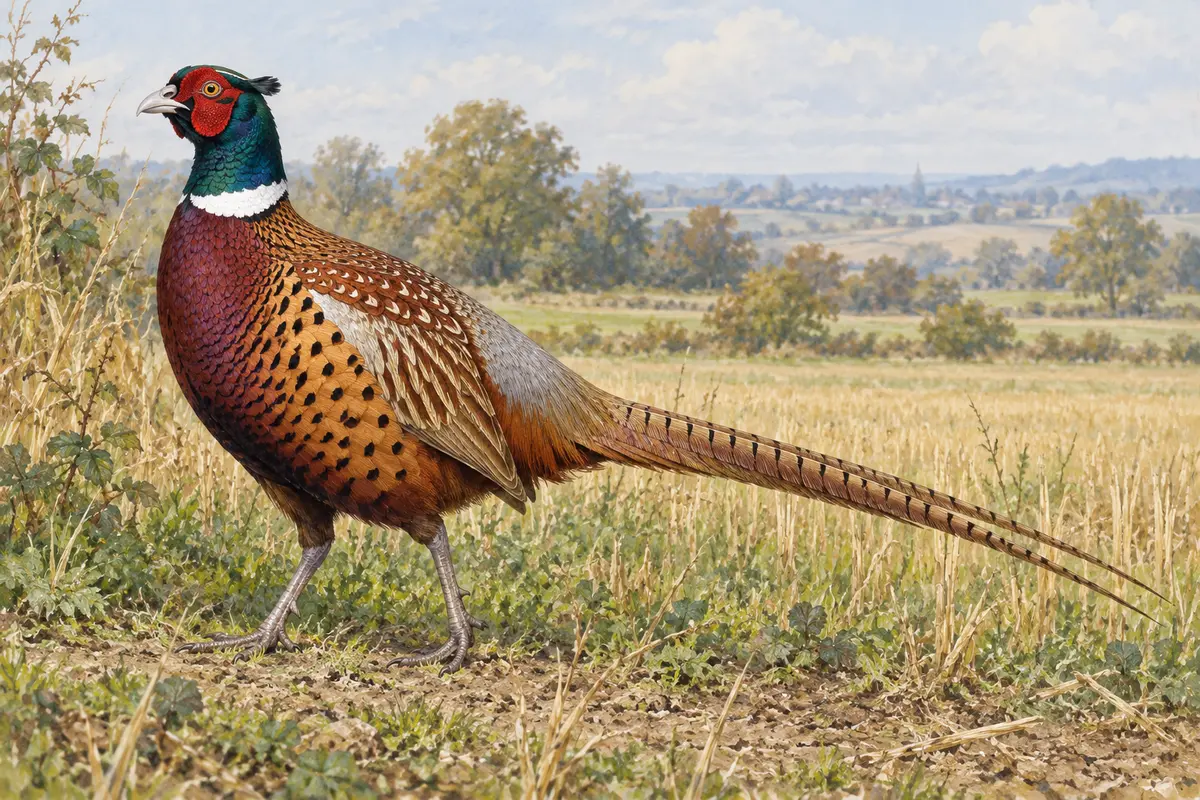
The torquatus male has a glossy dark-green head, clear white neck ring, red facial patch, copper-brown barred body and long pointed tail. The female is mottled buff-brown and cryptic on the ground. [3,4]
Strong legs support running and scratching, female brown plumage conceals the nest, and broad wings power steep take-off. The male's neck ring and long tail are display signals. [3]
Behaviour and ecology
Mostly terrestrial, running quickly and using explosive flight when threatened; it may roost in trees at night. Breeding males hold territories and may pair with several females. [3]
Diet
An omnivorous diet includes seeds, grain, shoots, fruit, leaves and insects; chicks rely more heavily on protein-rich invertebrates. [3]
Reproduction and life cycle
Species-level data: the female scrapes a concealed ground nest, usually lays 7–15 eggs and incubates for 23–28 days. Chicks hatch open-eyed, follow the hen and feed themselves. [3]
Ecosystem role
Consumes insects and seeds, disperses some seeds and is prey for many mammals and raptors. Where introduced, high densities and releases can affect local communities. [3,5]
Threats & conservation
The species is widespread, but pure torquatus stocks can be genetically mixed with released birds; intensive farming removes hedges and cover. Records should retain origin and not assign subspecies from plumage alone. [3,4]
Reviewed 22 October 2026: IUCN/BirdLife lists Phasianus colchicus as LC; torquatus has no separate global assessment. The species/subspecies name was not located in current CITES Appendices; this does not authorise import or keeping. [1,2]5 sourced facts
Species in five facts
The white neck ring is a prominent male torquatus feature. [3,4]
The female incubates and tends the brood. [3]
Chicks can walk and feed soon after hatching. [3]
Species-level incubation is 23–28 days. [3]
Many introduced populations have admixed subspecies ancestry. [4]
Sources
[1] BirdLife DataZone — Phasianus colchicus[2] CITES — Appendices valid from 5 March 2026[3] University of Michigan ADW — Phasianus colchicus[4] Avibase — Phasianus colchicus taxonomy[5] IUCN SSC Galliformes Specialist Group — Guidelines