
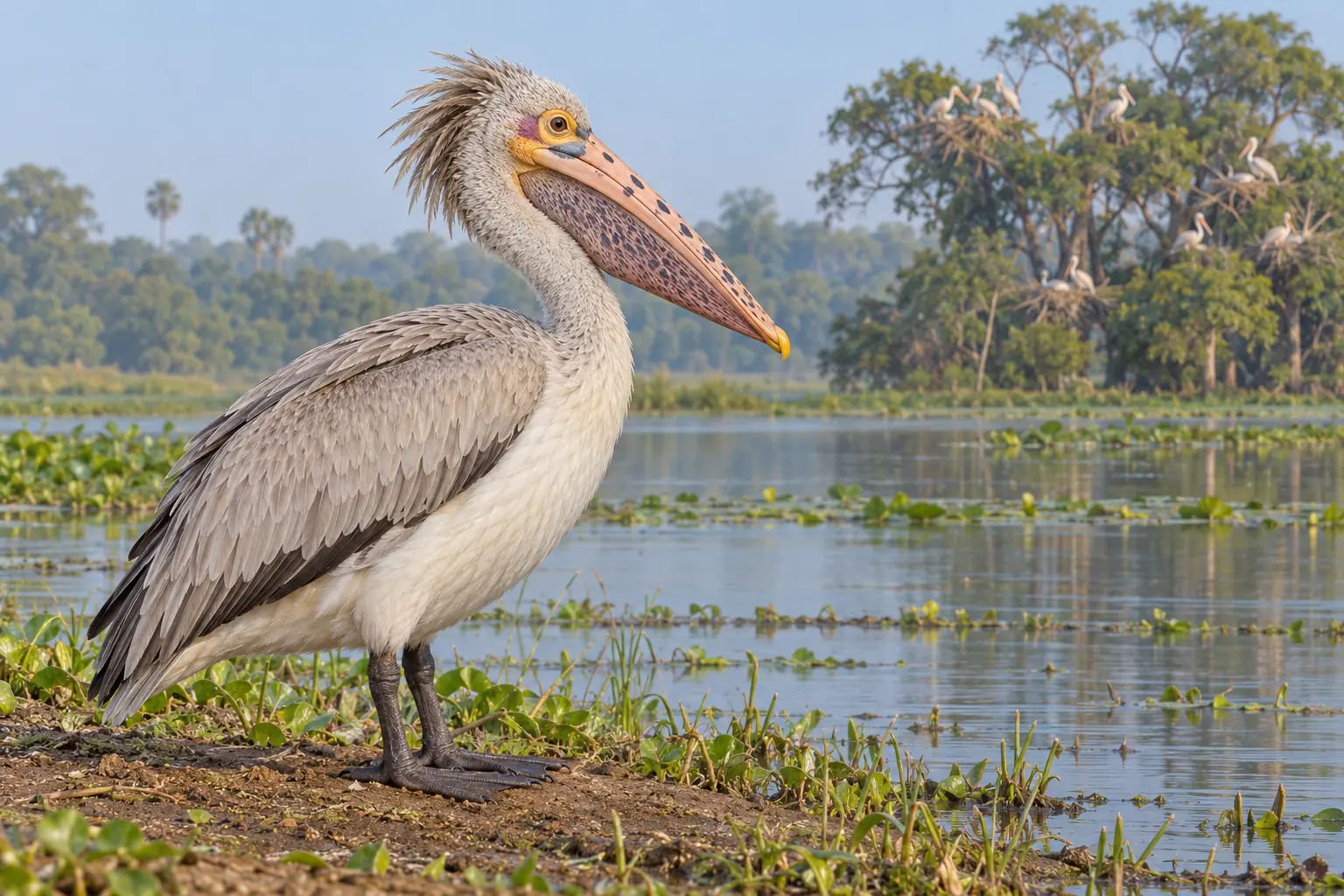
Patchily distributed from the Indian subcontinent and Sri Lanka into Southeast Asia. It uses lakes, marshes, slow rivers, reservoirs, brackish water and sometimes coasts; breeding colonies require tall trees near water. [1–3]
Animal Diversity Web reports about 1.25–1.52 m in length, 4.1–5.7 kg in mass and a wingspan near 2.5 m. These are reference ranges rather than standards for every sex and population. [2]
Grey-white body, curled hind-neck feathers, grey legs, a long bill with dark upper-mandible spots and a mottled pink-grey pouch. Juveniles are browner; bill, pouch, leg colour and range help separate it from other large pelicans. [1,2]
An extensible pouch, long bill and neck muscles work together to scoop prey; webbing joins all four toes for swimming. Broad wings permit energy-saving soaring between feeding areas and nesting colonies. [2,3]
Behaviour and ecology
Feeds alone or in groups, scooping fish with the bill and pouch and draining water before swallowing. Birds may cooperate to herd fish, although not every flock uses the same tactic; many pairs gather in tree colonies to breed. [2,3]
Diet
Primarily takes small to medium fish, with amphibians, crustaceans or other aquatic animals also recorded. The throat pouch is a temporary capture net, not a long-term food-storage bag. [2]
Reproduction and life cycle
Seasonally monogamous and a colonial tree nester. Compiled accounts report a typical clutch of three eggs, about 30 days of incubation and fledging around 60–90 days; timing and success vary with site, rainfall and food. [2]
Ecosystem role
A high-level fish predator in wetlands, it transfers aquatic nutrients to nesting trees through guano and prey remains. Large colonies can alter local soil chemistry, so protecting nest trees also protects a nutrient-transfer site. [2,3]
Threats & conservation
Wetland drainage and degradation, loss of nest trees, colony disturbance, fishing-gear entanglement and pollution reduce breeding sites and fish resources. Management must protect feeding waters, nesting trees and flight corridors together rather than merely counting birds at one site. [1–3]
Reviewed 3 October 2026: BirdLife/IUCN currently lists the species as Near Threatened (NT). Its name was not found in the CITES Appendices effective 5 March 2026; absence from CITES is not permission to possess, transport or trade it, and national law still applies. [1,3,4]5 sourced facts
Species in five facts
The wingspan may approach 2.5 m. [2]
Spots on the upper bill give the species its English name. [1,2]
It commonly nests colonially in tall trees near water. [1–3]
The throat pouch scoops prey and drains water; it is not a storage chamber. [2]
Its current global category is Near Threatened (NT). [1,3]
Sources
[1] BirdLife DataZone — Spot-billed Pelican[2] Animal Diversity Web — Pelecanus philippensis[3] IUCN Red List search — Pelecanus philippensis[4] CITES Appendices effective 5 March 2026