
Breeds patchily in south-eastern Europe, western and central Asia and much of Africa; uses large shallow lakes, marshes, deltas and lagoons, often needing safe islands or banks for nesting. [1]
ADW reports about 137–168 cm in length, a 274–335 cm wingspan and 9.07–11.79 kg in mass; males are larger than females. [3]
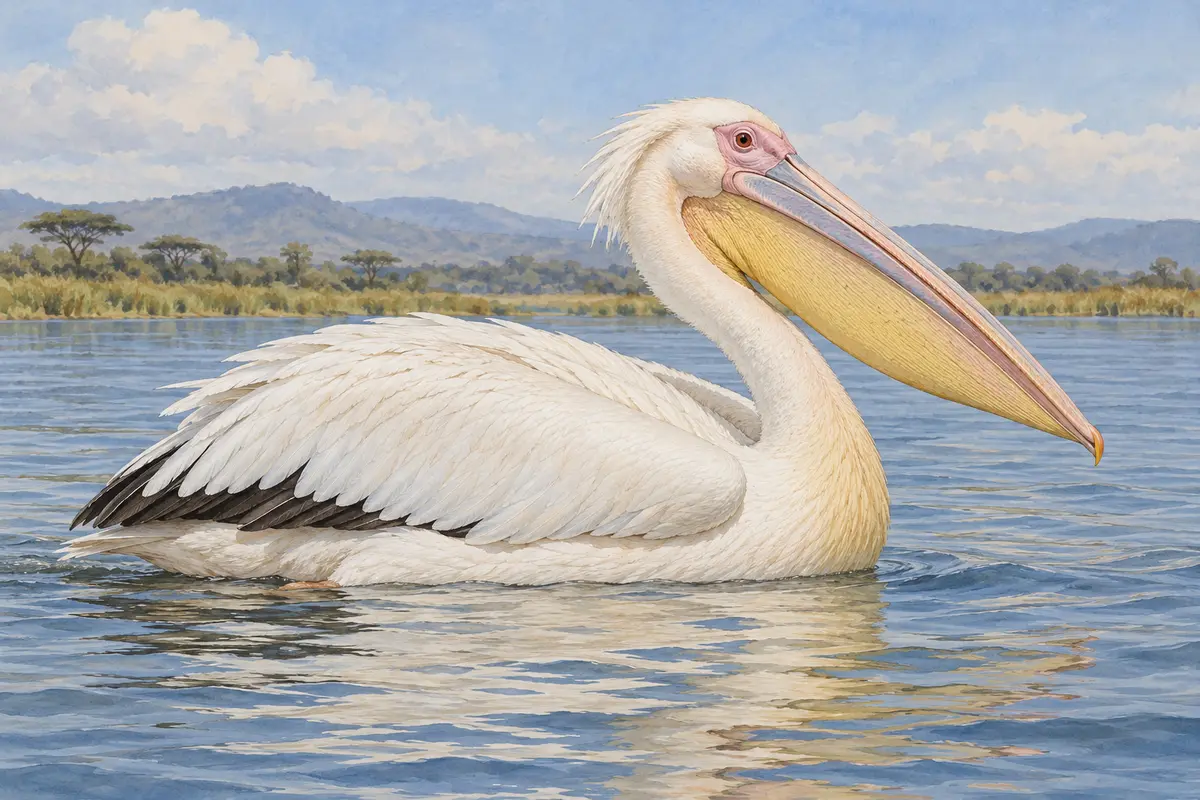
Adults are mainly white, with black flight feathers obvious in spread wings, a very long pale bill and yellow throat pouch; short pink-yellow legs have four webbed toes. Breeding plumage takes a rosy wash. [3]
An elastic pouch, light skeleton, very broad wings and fully webbed feet support fishing, long-distance soaring and swimming. Thermals let large flocks travel with little flapping. [3]
Behaviour and ecology
Travels long distances by soaring on rising air and often feeds cooperatively; birds swim in lines or arcs to drive fish into shallows before scooping together. [1,3]
Diet
Mainly takes fish in warm shallow water, with occasional crustaceans, amphibians or small birds. The throat pouch is a scoop-and-drain net, not a long-term storage bag. [3]
Reproduction and life cycle
Nests in dense ground or reedbed colonies; usually 1–3 eggs, incubated for 29–36 days. Chicks form crèches and begin flying at about 9–10 weeks. [3,4]
Ecosystem role
A large fish predator in lakes and lagoons; colonies concentrate nutrients, while eggs and chicks support predators and scavengers. [1,3]
Threats & conservation
Risks include loss and disturbance of colonies, changing water levels, net entanglement, fishery conflict, pollution and disease in dense colonies. Conservation requires flyway and hydrological management. [1,4]
Reviewed 22 October 2026: BirdLife/IUCN lists the species LC, with an uncertain global trend. The name was not located in the CITES Appendices effective 5 March 2026; migratory-bird and transport rules still apply. [1,2]5 sourced facts
Species in five facts
Wingspan can exceed 3 m. [3]
Black flight feathers are most obvious when the wings are spread. [3]
The pouch scoops fish and drains water before swallowing. [3]
Chicks gather in crèches after the earliest nest stage. [4]
BirdLife/IUCN lists LC but the global trend is uncertain. [1]
Sources
[1] BirdLife DataZone — Pelecanus onocrotalus[2] CITES — Appendices valid from 5 March 2026[3] University of Michigan ADW — Pelecanus onocrotalus[4] PeerJ — Great white pelican breeding biology