
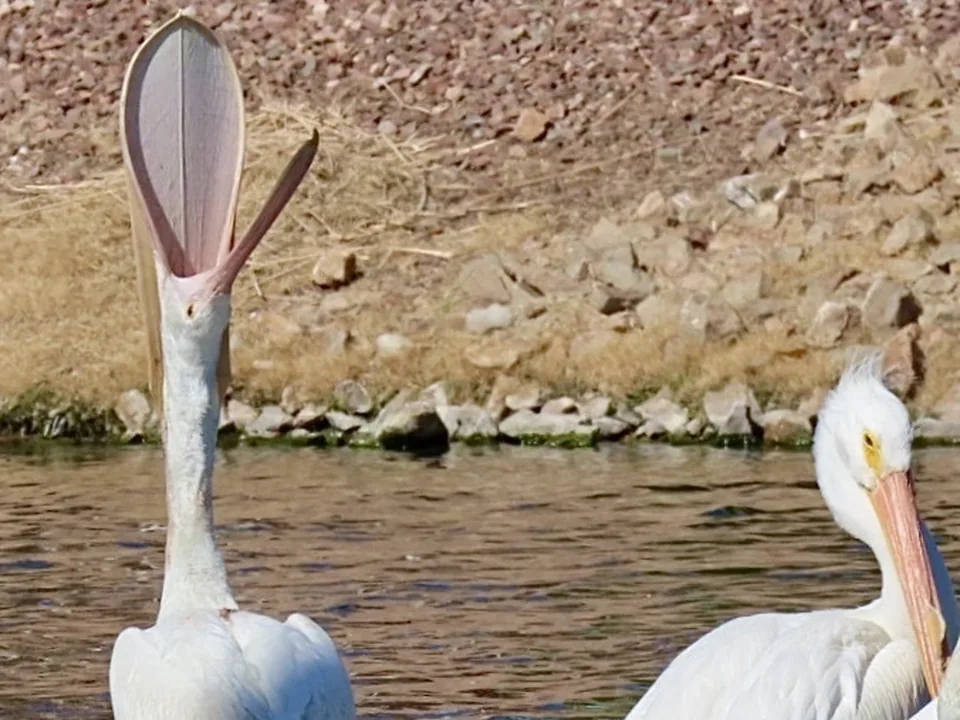
Breeds colonially on inland lakes and marshes in North America; many populations migrate to the Pacific coast, Gulf of Mexico, southern United States and Mexico. Undisturbed nesting islands and fish-rich shallow water are key habitats. [1–3]
About 127–165 cm long, with a 244–290 cm wingspan and typically 4.5–9 kg according to Cornell. Males average larger than females; the long bill is a scooping tool, not a long-term fish-storage container. [2]
White-bodied with orange legs, a long flattened bill and a large throat pouch; black flight feathers form a contrasting wing panel. Breeding adults grow a flat bill plate that is shed after the season; juveniles are greyer-brown. [2]
An extensible throat pouch and long bill form a prey scoop; webbed feet support swimming and incubation. Very broad wings exploit thermals during migration, reducing the cost of long-distance flight. [2,3]
Behaviour and ecology
It soars efficiently in formations or thermal circles. While feeding, several birds may line up or form an arc to drive fish into shallow water; it rarely plunge-dives from height like a brown pelican. [2,3]
Diet
Mainly eats fish, with crayfish, salamanders and other aquatic prey taken opportunistically. It scoops water and prey, drains the water, then swallows; the pouch is not a permanent food-carrying bag. [2,3]
Reproduction and life cycle
Ground-nests in large colonies, usually laying 1–3 eggs; both parents incubate with their webbed feet. Eggs hatch after roughly a month, and young may later gather in crèches before fledging. [3]
Ecosystem role
As a predator of fish and medium aquatic prey, it also transports nutrients from feeding areas to nesting islands through guano and chick provisioning. Dense colonies are sensitive to water-level change and disturbance. [1–3]
Threats & conservation
Nest flooding or drying, colony disturbance, fishing-gear entanglement, pollution and conflict at aquaculture sites can cause local mortality. Managed care must prioritise water area, water quality, healthy feet and safe spacing for the large bill. [1–3]
BirdLife/IUCN lists the species as Least Concern (LC) with an increasing trend. Pelecanus erythrorhynchos was not located in the CITES Appendices effective 5 March 2026; this is not trade permission and does not replace national law, migratory-bird protection, quarantine or transport permits. [1,4]5 sourced facts
Species in five facts
Black flight feathers are usually most visible in flight. [2]
Several birds often cooperate to corral fish in shallow water. [2,3]
The breeding bill plate is shed after the season. [2]
Both parents incubate eggs with their webbed feet. [3]
It is an inland breeder although many populations winter on coasts. [1]
Sources
[1] BirdLife DataZone — American White Pelican[2] Cornell Lab — American White Pelican identification[3] Cornell Lab — American White Pelican life history[4] CITES Appendices effective 5 March 2026Photo record — iNaturalist 336732944, CC0