
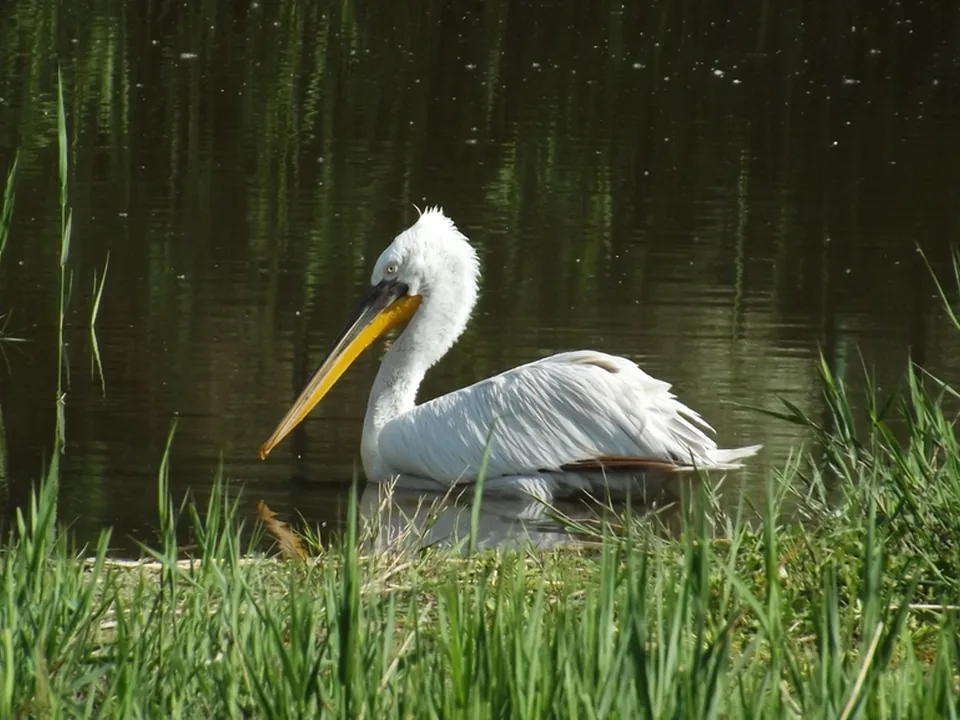
Patchily distributed from the Balkans, Black and Caspian Sea regions through Central Asia to Mongolia and western China; uses shallow lakes, marshes, deltas and coastal waters, with migration varying among populations. [1,2]
Roughly 160–183 cm long, commonly 7–15 kg, with a wingspan of about 245–351 cm; it ranks among the heaviest and widest-winged living birds. [1,2]
Silvery-white plumage, curly nape feathers, grey legs and dark flight feathers; the throat pouch becomes orange-red in breeding condition. It differs from the great white pelican in bulk, curled nape and leg colour. [1,2]
An elastic throat pouch and long bill specialise in catching fish; pneumatic bones and broad wings permit efficient flight despite very large size. Webbing joins all four toes for swimming. [2]
Behaviour and ecology
Swims and scoops fish near the surface, often feeding alone or in small groups; in flight it exploits rising air and may travel in formation. Many populations migrate or disperse seasonally. [1,2]
Diet
The diet is dominated by fish, with occasional crustaceans or other aquatic animals. The throat pouch acts as a scoop and drains water before swallowing; it is not long-term fish storage. [2]
Reproduction and life cycle
Colonial nesting occurs on islands, floating vegetation or reedbeds; two eggs are typical and both parents incubate for about a month. Older chicks may gather into crèches. [1,2]
Ecosystem role
A large wetland fish predator that transfers nutrients between water and nesting sites; breeding colonies reflect habitat scale, fish supply and low disturbance. [1; ecological interpretation]
Threats & conservation
Pressures include wetland drainage, water-level change, nest disturbance, collision or electrocution, fishing-gear entanglement and conflict with fisheries. Site protection and artificial nesting rafts have helped some populations. [1,2]
Reviewed 19 September 2026: BirdLife/IUCN records NT. Pelecanus crispus was not found in the CITES Appendices effective 5 March 2026; this does not establish a right to trade or displace national law, veterinary rules or migratory-bird protection.5 sourced facts
Species in five facts
Large individuals may exceed a three-metre wingspan. [1,2]
The epithet crispus refers to the curled nape feathers. [2]
The throat pouch is mainly a capture tool, not a fish-storage bag. [2]
Both parents incubate and feed the young. [1,2]
The throat pouch becomes much more intensely coloured in breeding season. [1,2]
Sources
[1] BirdLife DataZone — Dalmatian Pelican[2] Phoenix Zoo — Dalmatian pelican[3] CITES Checklist[Ảnh] iNaturalist observation 39940031 — Gergely Nigg, CC BY