
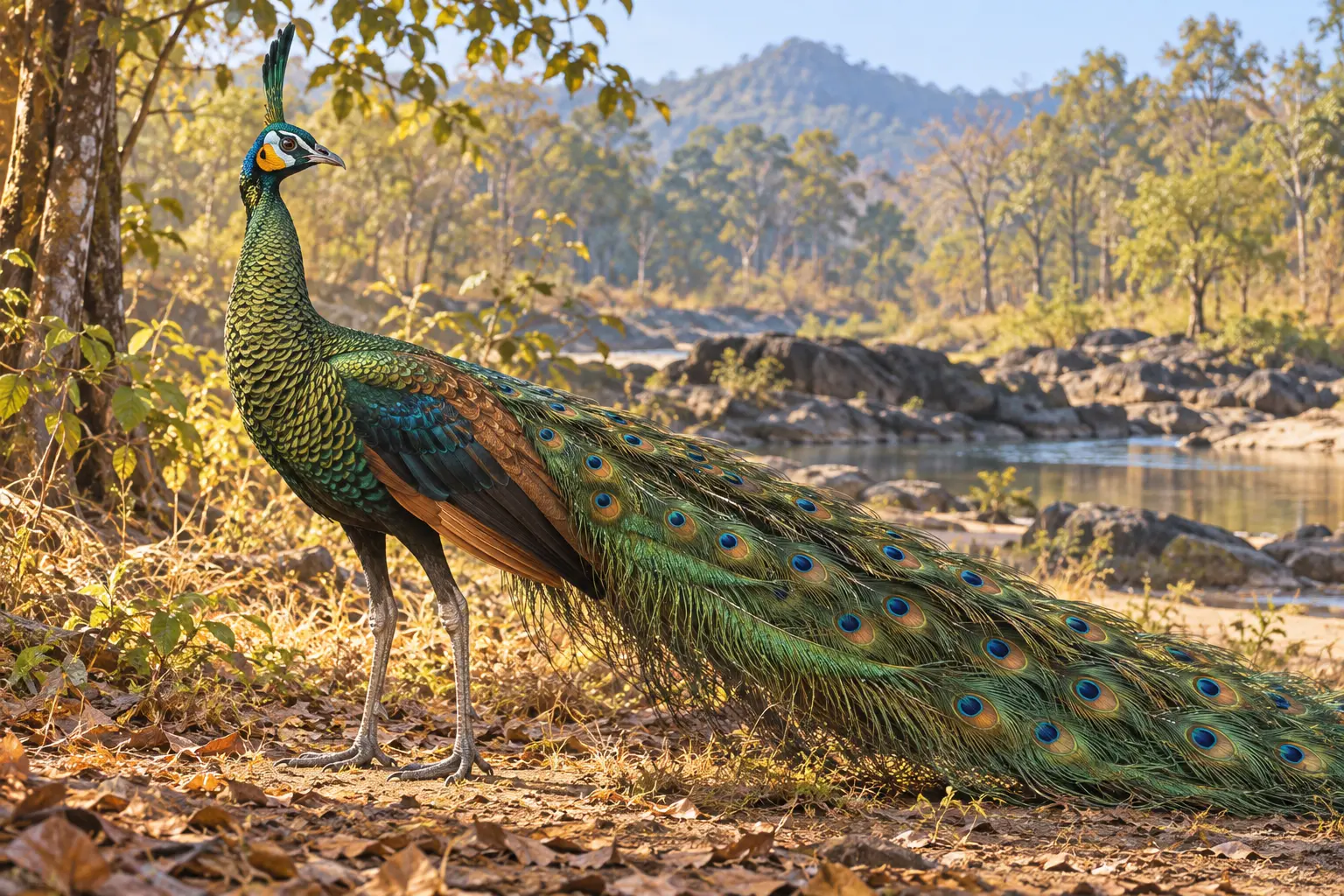
Formerly widespread from northeastern India and Myanmar through Indochina to Java, it now survives in fragmented populations. It uses dry deciduous forest, open woodland, grass-scrub mosaics, farmland edges and river corridors, typically needing tall roost trees and open feeding ground. [1–3]
San Diego Zoo gives males about 180–250 cm long when the train is included and females about 90–110 cm. The display ‘tail’ is mainly elongated upper-tail coverts, not the true tail feathers. [1]
Both sexes have scale-like iridescent green neck feathers, an upright tufted crest and long legs; adult males possess an ocellated train. Unlike Indian peafowl, the neck is predominantly green rather than deep blue, although hybrids can complicate visual identification. [1,2]
Strong legs and broad visual awareness support ground foraging and predator detection, while powerful short flight reaches elevated roosts. Ocelli and train-rattling create combined visual and acoustic courtship signals. [1,3]
Behaviour and ecology
Forages on the ground in early morning and late afternoon and roosts high in trees at night. Males fan and vibrate the train while calling during display; wary birds often run before taking a short flight. [1,3]
Diet
Omnivorous, taking seeds, fruit, shoots, young leaves, insects and small animals seasonally. Managed diets should support ground-foraging behaviour and combine plant material with appropriate protein rather than relying only on energy-dense grain. [1,3]
Reproduction and life cycle
The female makes a shallow ground nest and commonly lays about 3–8 eggs, with incubation reported at roughly 26–30 days. Chicks are precocial and follow the hen, while the male is not the primary carer. [1]
Ecosystem role
Green peafowl consume seeds, fruit and invertebrates and serve as prey and indicators of structurally intact dry-forest and grassland mosaics. Protecting roosts, water access and feeding grounds benefits many co-occurring species. [2,3]
Threats & conservation
Hunting, egg collection, live capture, fire, agriculture and loss of riverside forest have reduced populations; hybridisation with released Indian peafowl can also erode genetic integrity. Birds must not be released, pedigrees require management and CITES must be verified before international transfer. [2–5]
Reviewed 30 September 2026: BirdLife/IUCN lists green peafowl as Endangered (EN); CITES includes it in Appendix II. The global category does not fully describe each subspecies or population, so geographic provenance must remain in the records. [2–5]5 sourced facts
Species in five facts
Both males and females have iridescent green necks. [1]
The male's display ‘tail’ is mainly elongated upper-tail coverts. [1]
It roosts in tall trees despite doing much of its foraging on the ground. [1,3]
The female commonly incubates for about 26–30 days. [1]
CITES regulates the species under Appendix II. [5]
Sources
[1] San Diego Zoo Wildlife Alliance — Peafowl[2] BirdLife DataZone — Green Peafowl[3] WWF-Cambodia — Green peafowl[4] IUCN Red List species search[5] CITES Appendices effective 5 March 2026