
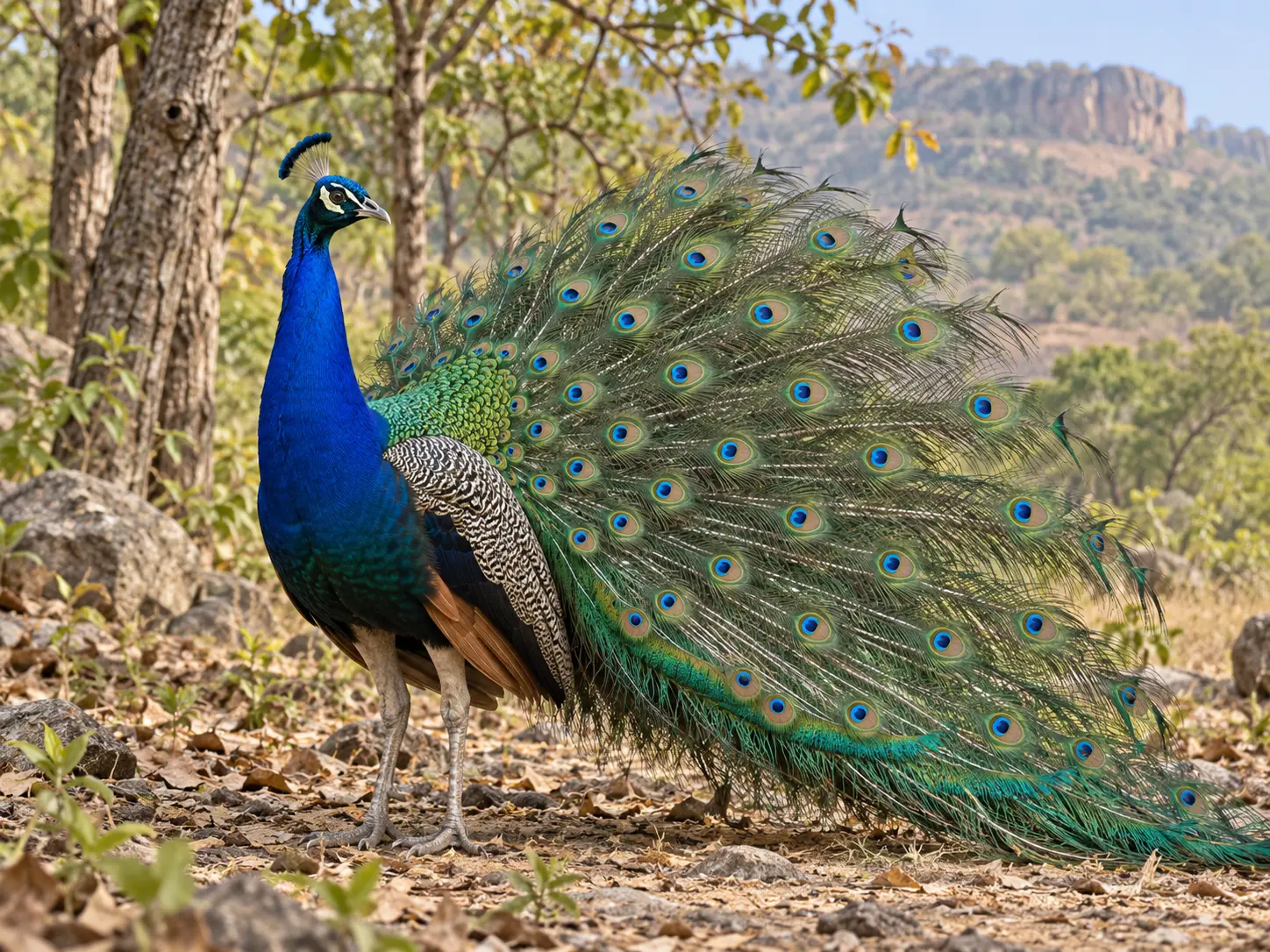
Native to India, Pakistan, Nepal, Bhutan, Bangladesh and Sri Lanka; inhabits open woodland, scrub, farmland, watersides and settlements. It has been introduced widely.
Males are about 100–115 cm long excluding the train, which may add more than a metre. Females are smaller and lack the elongated display train.
Males show a cobalt iridescent head and neck, fan-shaped crest and ocellated train; females are brown-grey with a green neck, providing camouflage while nesting.
Ocelli and train vibration create complex visual-acoustic courtship signals; strong legs support running and scratching, while short powerful flight reaches high roosts.
Behaviour and ecology
Forages on the ground by day but flies into trees to roost. Males display by fanning and vibrating the train; loud calls also help signal danger.
Diet
Omnivorous, taking seeds, shoots, fruit, insects, other arthropods and small vertebrates such as lizards or young snakes.
Reproduction and life cycle
A displaying male may court several females; the female makes a shallow ground nest, incubates the eggs and leads precocial chicks.
Ecosystem role
Consumes seeds and small animals, disperses some seeds and provides prey for large carnivores. Dense introduced populations may conflict with agriculture.
Threats & conservation
BirdLife/IUCN lists it as LC with a stable global trend; hunting and habitat change still cause local impacts. The species was not CITES-listed on the verification date.
IUCN/CITES status was checked on the profile date; re-verify before any legal or transaction decision.5 sourced facts
Species in five facts
The train consists mainly of elongated upper-tail coverts, not the true tail feathers.
The Indian peafowl is India's national bird.
Both sexes carry a head crest.
Chicks can walk and forage soon after hatching.
It roosts in trees despite feeding mostly on the ground.
Sources
BirdLife DataZoneAnimal Diversity WebIUCN Red List searchCITES Checklist