
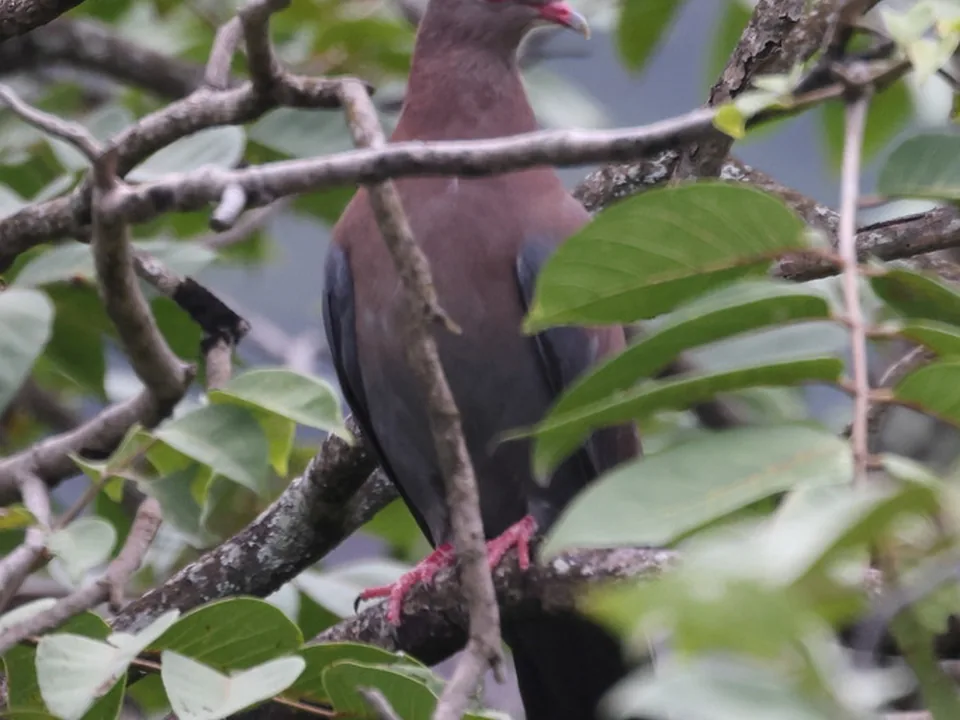
Occurs in far south-eastern Ecuador and northern Peru, centred on the Marañón drainage. It uses riparian, dry and foothill forest; observations suggest seasonal movement between riverine habitat and drier upslope areas. [1,2]
Body length is about 31–34 cm; Birds of the World reports a mass around 276 g. These are species- and specimen-level measurements, not condition targets for every individual. [2]
The head, neck and breast are brick-red to reddish-purple, with dark blue-grey back and wings and a dark bill. Orange-blue eye rings and blue-grey bare skin surround the eye; the sexes are similar enough that colour alone is not a reliable sexing method. [2]
A muscular gizzard processes seeds, while broad wings and developed breast muscles support movement among tree patches. Reddish-purple and grey plumage softens the outline in dappled dry and riparian forest light. [2]
Behaviour and ecology
Usually recorded singly, in pairs or small groups, feeding in trees and moving among forest patches. Behavioural data remain limited; activity and social requirements should not be inferred from more familiar pigeon species. [1,2]
Diet
A fruit- and seed-eater; compiled observations include Cordia lutea fruit and ripe coca seeds. The documented wild food list is short, so managed diets should not be based on a handful of isolated records. [2]
Reproduction and life cycle
Wild reproductive biology is not adequately described in the reviewed sources. Clutch size, incubation or breeding season from another pigeon species should not be assigned to P. oenops. [1,2]
Ecosystem role
By eating fruit and moving among forest patches, the species may disperse some seeds, although its quantitative contribution is unknown. Protection also retains wooded corridors in the Marañón drainage. [1,2]
Threats & conservation
Forest loss, degradation and fragmentation from agriculture, grazing, logging and infrastructure are major risks; a small range increases vulnerability. DinoJura does not treat NT status or the absence of a located CITES listing as a sourcing basis. [1,3,4]
BirdLife/IUCN lists the species as Near Threatened (NT). Patagioenas oenops was not located in the CITES Appendices effective 5 March 2026; this is not permission to collect or trade and does not replace national law, veterinary controls or transport permits. [1,3,4]5 sourced facts
Species in five facts
The species is tied to the Marañón drainage in Peru and Ecuador. [1,2]
Reported length is about 34 cm for males and 31 cm for females. [2]
Blue-grey bare skin surrounds the eye alongside coloured orbital rings. [2]
Some records suggest seasonal movement among forest types. [2]
Wild breeding data remain scarce. [1,2]
Sources
[1] BirdLife DataZone — Peruvian Pigeon[2] Cornell Birds of the World — Peruvian Pigeon[3] Avibase — Patagioenas oenops[4] CITES Appendices effective 5 March 2026Photo record — iNaturalist 202018983, CC0