
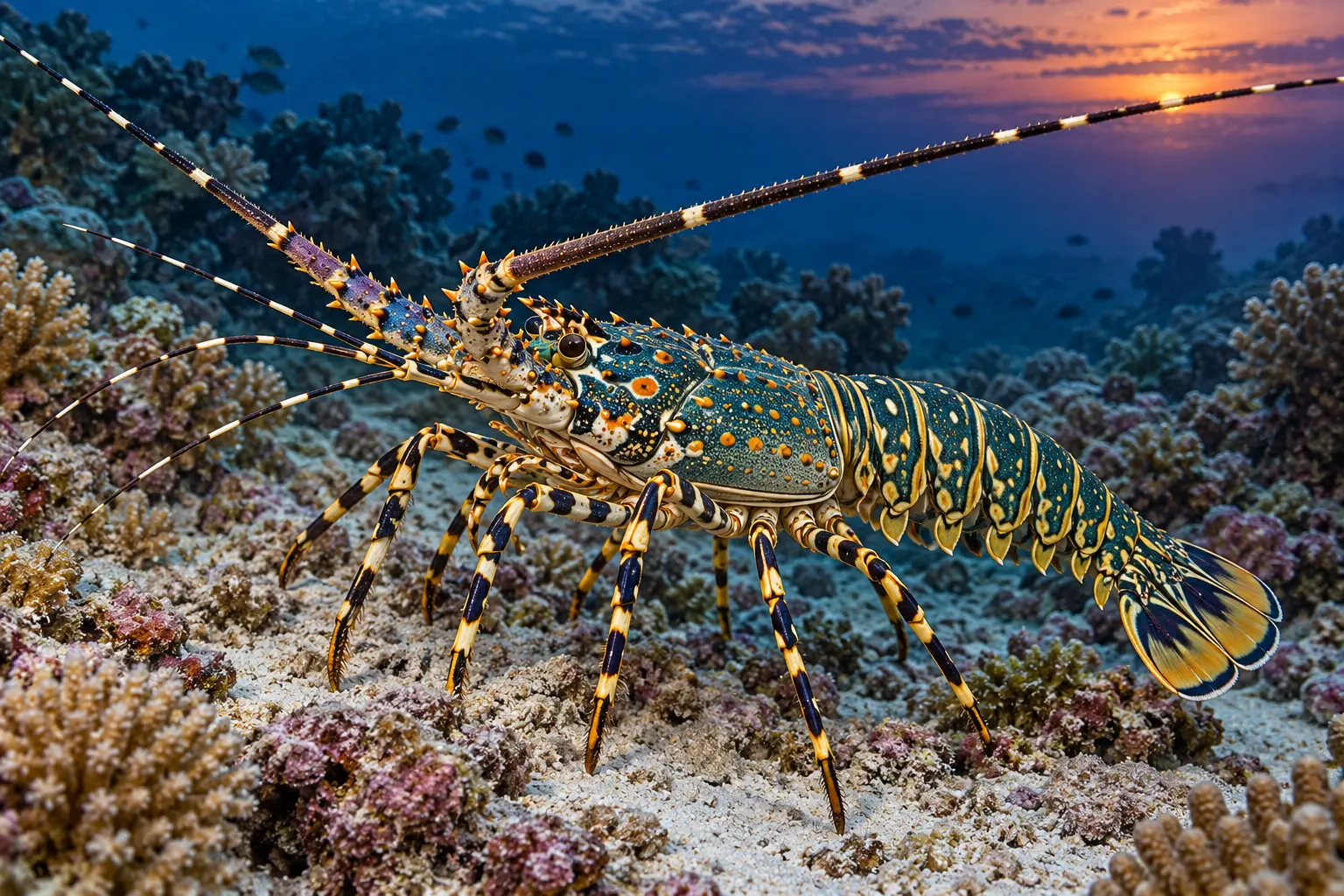
Ranges from the Red Sea and East Africa to southern Japan, the Solomons, Papua New Guinea, much of Australia, New Caledonia and Fiji. FAO records mainly coastal waters at 1–8 m, occasionally to 50 m, over sand, mud, rock, river mouths and coral reefs. [1]
One of the largest Panulirus species: FAO reports total length to about 50 cm, though 30–35 cm is more usual. Fishery measurements must specify total length versus carapace length. [1]
No enlarged claws; the spiny carapace is blue-green with yellow-orange marks, legs are strongly banded, the abdomen patterned and the tail fan broad. Two rigid, banded antennae extend beyond the body. [1–3]
Long antennae detect and repel threats, spines protect the cephalothorax and the tail fan powers a rapid backward escape. Mouthparts process shelled prey without enlarged claws. [1–3]
Behaviour and ecology
Benthic, often sheltering in crevices or reef structure by day and foraging more at night. FAO records solitary animals, pairs and occasional concentrations; density varies with shelter, food and season. [1]
Diet
An opportunistic benthic feeder that crushes molluscs, other crustaceans, worms and echinoderms and also consumes organic matter and carrion. Diet changes among larval, puerulus, juvenile and adult stages and habitats. [1,2]
Reproduction and life cycle
Females brood fertilised eggs beneath the abdomen until hatching. Transparent planktonic phyllosoma larvae pass through multiple stages, then become pueruli that swim inshore and settle before the benthic juvenile stage. [1,2]
Ecosystem role
A benthic predator and scavenger linking molluscs, small crustaceans and organic matter to predatory fish, octopuses and larger consumers. Excessive harvest can alter benthic community structure and reproductive output. [1,2]
Threats & conservation
High fishery and aquaculture value creates pressure from harvest, seed collection and reef decline. DinoJura must verify harvest area, seed legality, size and seasonal limits, health records and wild-source impacts; an old LC assessment is not proof of sustainability. [1,2,4]
SeaLifeBase records an IUCN Least Concern (LC) assessment dated 3 December 2009; its age matters in current decisions. Panulirus ornatus was not located in the CITES Appendices effective 5 March 2026. Non-listing does not replace fishery quotas, size and seasonal rules, aquatic-animal health measures or national permits. [1–4]5 sourced facts
Species in five facts
The species lacks the enlarged claws of Homarus lobsters. [1–3]
Maximum recorded total length is about 50 cm. [1]
Typical habitat is 1–8 m deep, with records to 50 m. [1]
Planktonic phyllosoma larvae precede the settling puerulus stage. [1,2]
ITIS and WoRMS accept the name Panulirus ornatus. [3]
Sources
[1] FAO Species Catalogue — Panulirus ornatus[2] SeaLifeBase — Panulirus ornatus[3] WoRMS — Panulirus ornatus[4] CITES Appendices effective 5 March 2026