
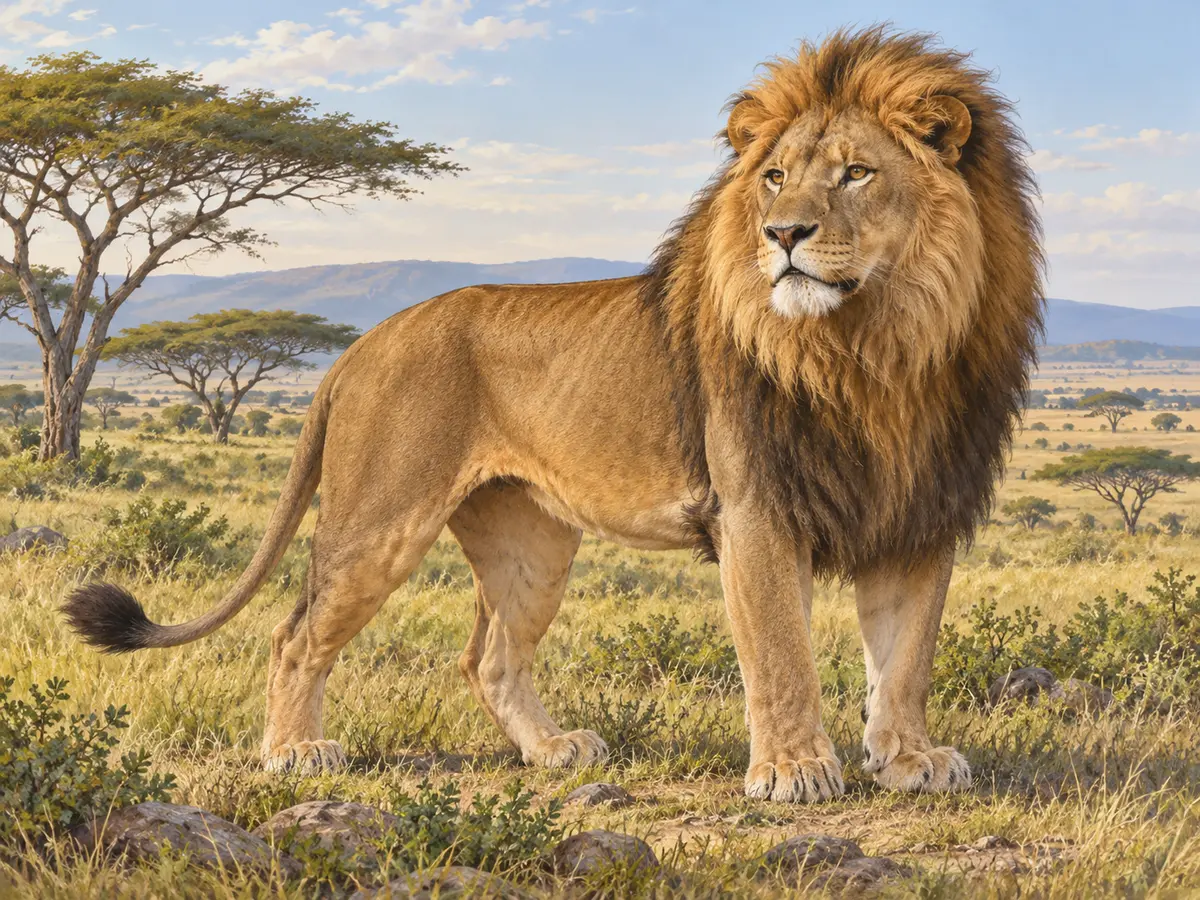
Formerly widespread across Africa, Asia and Europe, but now mainly survives in fragmented African ranges plus the Gir population of northwestern India. It uses savannas, grasslands, thorn scrub, dry woodland and some semi-desert habitats, while avoiding dense rainforest. [1–3]
Smithsonian reports shoulder height of about 1.0–1.2 m. Males reach roughly 3 m in body length and 150–250 kg; females are smaller, reaching about 2.7 m and approximately 120–179 kg. [1]
A compact powerful body, tawny coat, broad muzzle and dark tail tuft. Adult males usually carry a mane whose colour and length vary with age, genes and hormones; females lack the typical mane. Cubs have pale spots that fade with age. [1]
Powerful shoulders and forelimbs, canines and jaws restrain large prey, while tawny fur blends with dry grass. Cooperative hunting permits flanking and carcass defence; the male mane provides both visual signalling and some neck protection during conflict. [1]
Behaviour and ecology
The most social cat, forming prides from a few individuals to about 40 depending on prey. Females often remain in their natal group, cooperate in cub care and do most hunting; males defend territory and sometimes join hunts. Roars and scent marks maintain spacing among groups. [1]
Diet
Primarily hunts medium to large ungulates such as zebra and wildebeest, but takes smaller prey or carrion opportunistically. Near people, livestock predation creates conflict; management should focus on prevention, night enclosures and livelihoods rather than retaliation. [1,3]
Reproduction and life cycle
Females usually bear one to four cubs after about 3.5 months and may produce a litter roughly every two years when conditions allow. Cubs nurse for about six months but begin eating meat near three months; mortality is high from food shortage, disease and male takeovers. [1]
Ecosystem role
As an apex predator, lions shape ungulate distribution and behaviour, compete with hyenas and leopards, and leave carcasses for scavengers. Protecting lion habitat maintains large landscapes that benefit many other species. [1–3]
Threats & conservation
Habitat loss and fragmentation, prey depletion, human-lion conflict, poisoning, illegal killing and body-part trade continue to drive decline. IUCN estimates an approximately 36% range reduction across three generations; DinoJura must exclude unlawful wild sourcing, verify pedigree and origin records, and apply big-cat welfare only within proven facility capacity. [2,3]
The 2023 IUCN assessment lists the species as Vulnerable (VU) under criterion A2abcd. CITES places the Indian population in Appendix I and all other populations in Appendix II; population origin must be established for every transaction and cannot be inferred only from current place of keeping. [2–5]5 sourced facts
Species in five facts
Adult males commonly weigh about 150–250 kg. [1]
A pride may contain up to about 40 individuals when prey permits. [1]
Gestation lasts about 3.5 months. [1]
A litter usually contains one to four cubs. [1]
The Indian population is in CITES I; all other populations are in CITES II. [4,5]
Sources
[1] Smithsonian's National Zoo — Lion[2] IUCN Red List 2023 — Panthera leo[3] Panthera — Lion[4] CITES — Lion species gallery[5] CITES Appendices effective 5 March 2026