
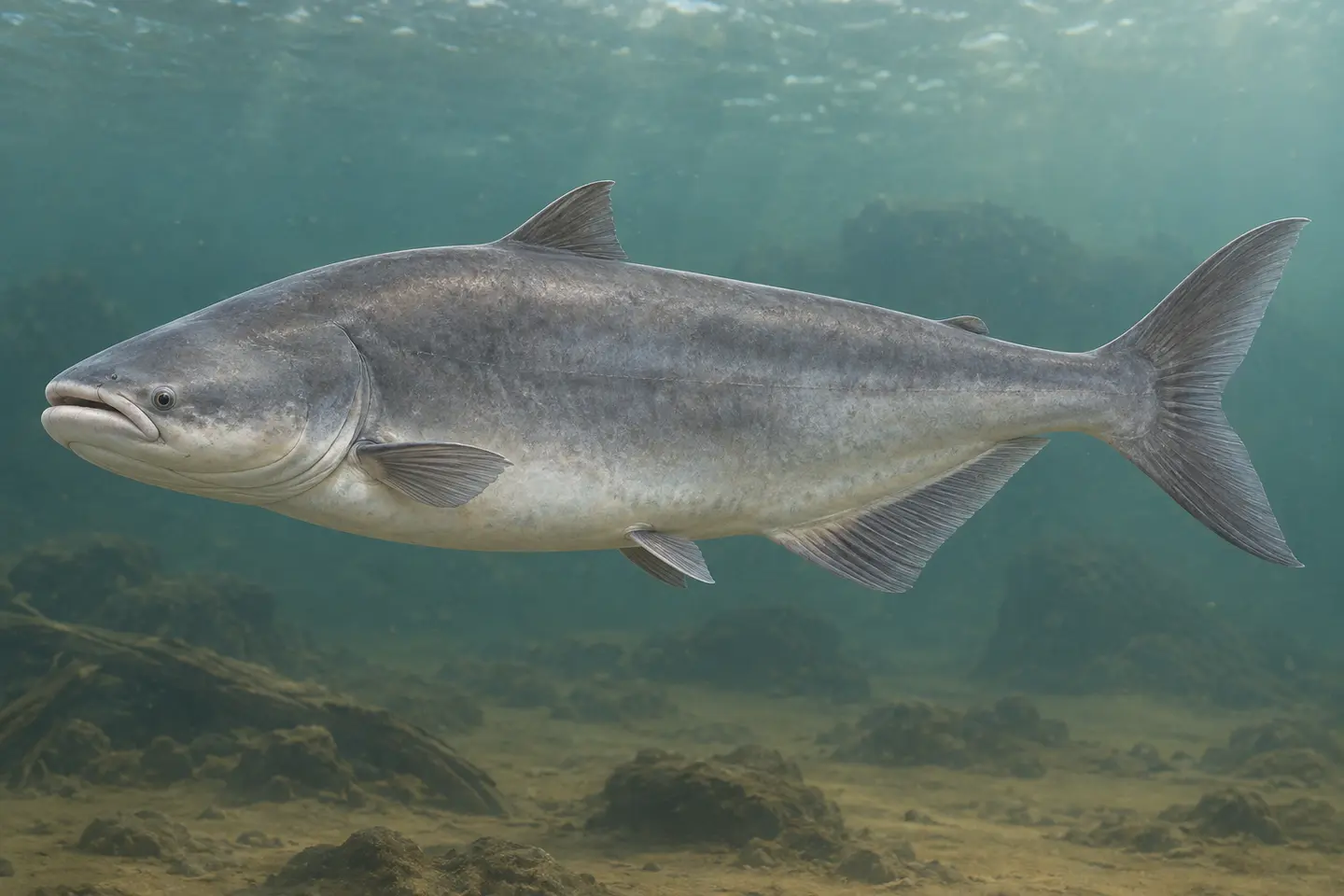
Endemic to the Mekong system, historically recorded from lower reaches to middle and upper sections used for migration and spawning. It depends on main-channel connectivity, dry-season deep pools and seasonal hydrological cues. [1–4]
Published maximum length is about 300 cm, and FishBase compiles a maximum weight near 350 kg, although modern individuals are commonly smaller. These maxima are not typical sizes for every fish. [1]
An elongated, rounded, scaleless grey-silver body with a broad blunt head, tiny eyes and grey fins. Juveniles have two barbel pairs and teeth; mandibular barbels become rudimentary and teeth and gill rakers disappear around 30–50 cm, distinguishing adults from many other pangasiids. [1]
A streamlined body and strong forked tail support main-channel movement, while great size provides momentum over distance. Ontogenetic loss of barbels, teeth and gill rakers marks an unusual ecological transition with age. [1]
Behaviour and ecology
A potamodromous river migrant. Tagging work shows movements of tens of kilometres after release, but natural routes and spawning grounds remain incompletely understood. Data from hatchery-reared releases must be distinguished from wild-population behaviour. [2,3]
Diet
Juveniles take zooplankton and small food items; adults are oriented toward algae, aquatic plants and detrital material. Wild diet data remain limited, so enormous size should not be equated with large-fish predation. [1–3]
Reproduction and life cycle
Matures late, reported in older sources at roughly 150–250 kg and at least around six years. Reproduction is tied to seasonal migration; the precise locations and conditions of natural spawning grounds remain major knowledge gaps. [2,4]
Ecosystem role
As a giant migrant it links river reaches and moves biomass and nutrients through the basin. Protecting the species requires river connectivity, bringing collateral benefits to many other migratory fishes. [2,3; ecological interpretation]
Threats & conservation
Historic overfishing, mainstream dams and barriers, altered flow, spawning-habitat loss and water-quality decline are major pressures. IUCN lists CR and CITES Appendix I; artificial propagation or stocking cannot replace habitat restoration and genetic management. [2–5]
Reviewed 20 September 2026: FishBase cites the IUCN assessment as CR; Pangasianodon gigas is in CITES Appendix I. Legal records, origin and fisheries rules in each Mekong country require separate case review.5 sourced facts
Species in five facts
Adults are nearly barbel-less, unlike many catfishes. [1]
Teeth and gill rakers disappear at roughly 30–50 cm. [1]
It is endemic to the Mekong Basin; not every giant pangasiid is Pangasianodon gigas. [1]
Published maximum length is about three metres. [1,3]
Tagging recorded a released fish moving about 60 km upstream within ten days. [2]
Sources
[1] FishBase — Pangasianodon gigas[2] FAO — migratory patterns and habitat use of Mekong giant catfish[3] Mekong River Commission — Fisheries knowledge and basin monitoring[4] FAO — fisheries management data in the Tonle Sap[5] CITES Appendices effective 5 March 2026