
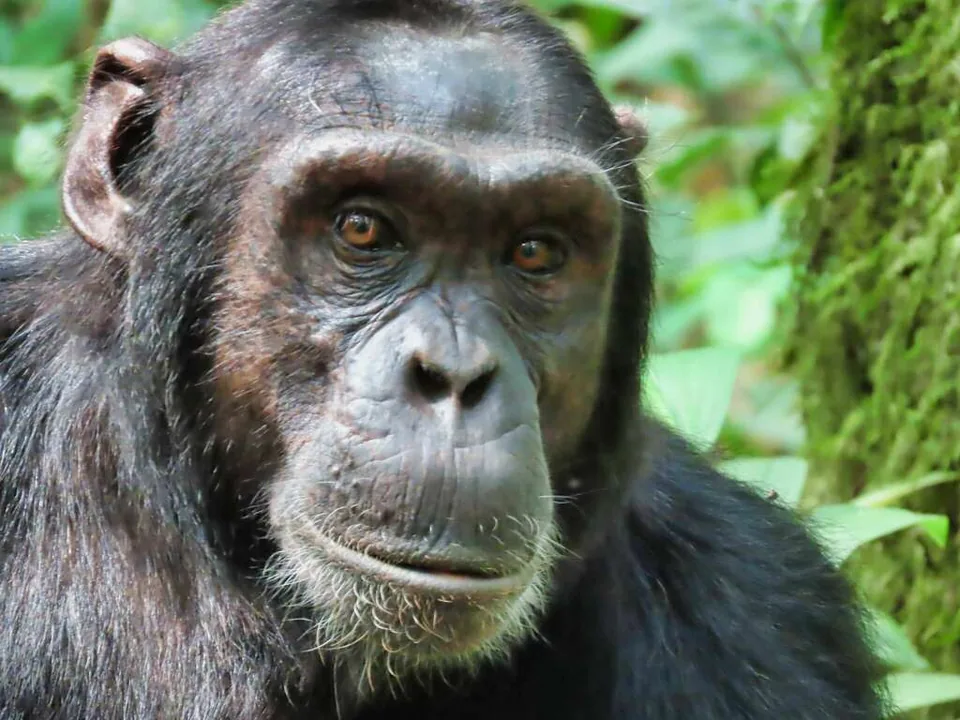
Patchily distributed from West through Central to East Africa in rainforest, montane forest, secondary growth and forest–savanna mosaics. Four commonly recognised subspecies face different regional pressures. [1,2]
Head–body length is about 64–93 cm. Wild males commonly weigh around 34–70 kg and females about 26–50 kg; measurements vary among subspecies, populations and conditions. [1]
Tailless, with arms longer than legs, long hands and a relatively short thumb, prominent ears and a sparsely haired face. Terrestrial travel is mainly knuckle-walking; hair is black-brown and may grey across the back with age. [1]
Powerful hands serve climbing and manipulation, spatial memory helps locate fruit trees, and social learning sustains community-specific tools and techniques. Behavioural flexibility does not make the species immune to forest loss or disease. [1–3]
Behaviour and ecology
Large communities split into changing small parties and reunite. Chimpanzees build sleeping nests nightly, groom to maintain relationships, coordinate foraging and transmit tool-use techniques across generations. [1,2]
Diet
Omnivorous but strongly fruit- and young-leaf-oriented, supplemented with seeds, stems, insects, eggs and small vertebrates. Diet varies by season, place and community tradition. [1]
Reproduction and life cycle
Gestation averages about 230 days and a single infant is typical. Young nurse for roughly 3–4.5 years and continue learning with the mother; interbirth intervals of about 3–6 years make population recovery slow. [1]
Ecosystem role
A large frugivore that disperses seeds while also taking insects and some vertebrates. Nesting, travel and foraging influence seed patterns and trophic relationships in forests. [1]
Threats & conservation
Declines are driven by forest loss and fragmentation, bushmeat hunting, infant trafficking, human–wildlife conflict and infectious disease. With Appendix-I status and high bidirectional disease risk, any managed-care programme demands specialised facilities, complete traceability and advanced veterinary governance. [2–4]
Reviewed 20 September 2026: IUCN records EN; Pan troglodytes is in CITES Appendix I. International commercial trade in wild specimens is generally prohibited; every transfer requires case-specific authority review.5 sourced facts
Species in five facts
Most independent individuals build a new branch-and-leaf sleeping nest. [1]
Tools and techniques can differ among communities, a form of animal culture. [1,2]
Fission–fusion organisation lets a large community divide into small foraging parties. [1]
Infants carry a white rump tuft that disappears with age. [1]
Long interbirth intervals help explain slow recovery after population loss. [1,3]
Sources
[1] Animal Diversity Web — Pan troglodytes[2] IUCN Red List species search[3] CITES Appendices effective 5 March 2026[Ảnh] iNaturalist observation 127958395 — Wairambar Rainforest, CC BY