
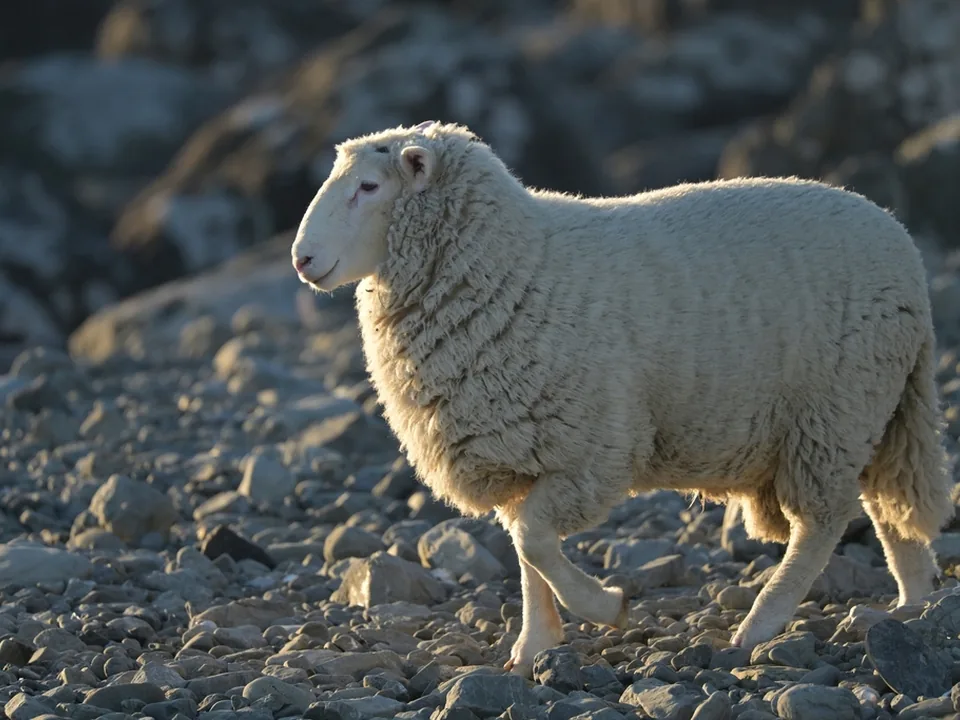
Kept worldwide from temperate pasture, mountains and semi-arid rangelands to intensive farms. This is a human-mediated distribution; shade, dry footing, water, feed and weather protection still vary with breed, age and climate. [1–3]
Animal Diversity Web summarises body length around 120–180 cm, shoulder height 65–127 cm and mass 20–200 kg. The broad range reflects breed, sex and management differences; maxima are not body-condition targets. [1]
A robust body, cloven hooves, long muzzle and coat ranging from dense wool to short hair; colour, ears, tail and horns vary greatly by breed. Rams of many breeds are horned, but either sex may be horned or polled in others. [1–3]
A multi-chambered stomach and microbes convert cellulose into usable energy, while cloven hooves support movement across varied ground. Wool, hair, fat tails and heat tolerance reflect different breeding histories and are not universal traits. [1–3]
Behaviour and ecology
Strongly gregarious, able to recognise flock mates and stressed by isolation. Flocks coordinate through spacing, posture, vocal signals and mutual monitoring; care design should allow visual contact, social access and safe retreat. [1]
Diet
A grazing ruminant that consumes grasses, browse and roughage fermented in the rumen. Diets require balanced fibre, energy, protein, minerals and water with gradual transitions; excessive concentrate raises digestive risk. [1–3]
Reproduction and life cycle
Many breeds are short-day seasonal breeders; the oestrous cycle averages about 17 days and gestation about 146–148 days. One or two lambs are usual, but litter size varies with breed, age and nutrition; newborns require prompt colostrum and thermal monitoring. [1]
Ecosystem role
Managed grazing can maintain grassland, cycle nutrients and help control vegetation; excessive stocking can cause erosion, compaction and loss of regeneration. Effects depend on stocking rate, season and habitat sensitivity. [2,3]
Threats & conservation
Management risks include infectious disease, parasites, heat, hoof problems, dietary error, inbreeding and transport welfare. DinoJura must check breed identity, flock records, health, quarantine, welfare and import rules rather than infer permission from non-CITES status. [1–4]
Domestic sheep are a domesticated taxon and do not carry a global IUCN threat category as a wild species. Ovis aries was not located in the CITES Appendices effective 5 March 2026; this does not waive quarantine, veterinary certification, welfare, breed, import or national-law requirements. [1–4]5 sourced facts
Species in five facts
Sheep are ruminants with foregut fermentation. [1]
Breed-associated mass can range from roughly 20 to 200 kg. [1]
The oestrous cycle averages about 17 days. [1]
Gestation commonly lasts about 146–148 days. [1]
Sheep are highly gregarious and isolation can be stressful. [1]
Sources
[1] Animal Diversity Web — Ovis aries[2] FAO — Sheep[3] FAO DAD-IS — Domestic Animal Diversity[4] CITES Appendices effective 5 March 2026Photo record — Christopher Stephens / iNaturalist