
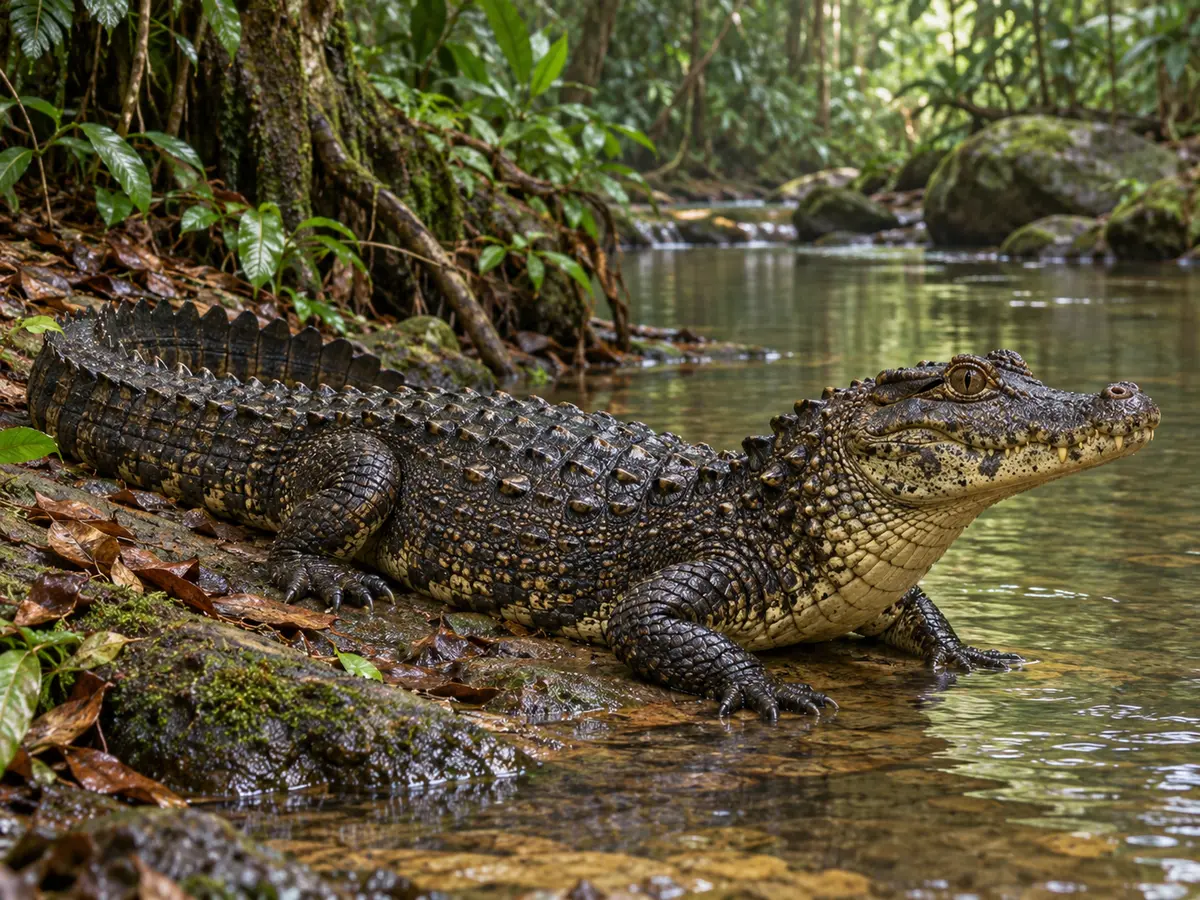
Occurs in tropical West and Central Africa, using swamps, slow rivers and streams, flooded forest margins and savanna pools. Individuals often shelter in burrows, sometimes with underwater entrances. [1]
Usually about 1.2–1.6 m long; Zoo New England reports roughly 18–32 kg. It remains a powerful predator, and “dwarf” must not be read as low space or safety requirements. [1]
Black to very dark brown with a yellowish underside, a short blunt snout and heavy bony plates over neck, back and tail. Eyes and nostrils on top of the head allow seeing and breathing while most of the body is submerged. [1]
Bony armour protects the back, neck and part of the underside; a laterally flattened tail provides propulsion and webbed feet aid swimming. Mechanical sensors around the jaws detect prey-generated water movement in low light. [1]
Behaviour and ecology
Mainly nocturnal and usually solitary, leaving shelter to forage along banks or on land after rain. By day it may hide in burrows or among roots; visual separation and refuge are important design needs. [1]
Diet
Takes fish, amphibians, crustaceans, small vertebrates and carrion opportunistically. Composition shifts with water season; managed care must control prey size, bone-mineral balance and excess energy. [1]
Reproduction and life cycle
During the wet season, females build mound nests of vegetation, commonly with about 10–20 eggs; incubation is around 85–105 days. Females guard, respond to calls and assist hatchlings from the nest, typical crocodilian parental care. [1]
Ecosystem role
A predator in small forest waters, it consumes fish, amphibians and carrion; its burrows and paths may create microhabitats. The exact role varies among catchments and water seasons. [1]
Threats & conservation
Deforestation, hunting for meat and unlawful trade are major pressures; recent trade research continues to document exploitation risks. Under Appendix I, DinoJura should consider only conservation transfers or captive origin fully validated by authorities, never seller claims in place of records. [2–4]
The IUCN Crocodile Specialist Group records the species as Vulnerable (VU), but the published assessment dates to 1996 and its age must be noted. Osteolaemus tetraspis is in CITES Appendix I; taxonomy and species limits remain under review, so records must reconcile name, population, origin and captive generation. [2,3]5 sourced facts
Species in five facts
It is among the smallest living crocodilians. [1]
Heavy bony armour extends over the neck, back and tail. [1]
Many individuals shelter in burrows connected to water. [1]
Females guard nests and assist hatchlings. [1]
The currently cited IUCN assessment dates to 1996. [2]
Sources
[1] Zoo New England — West African dwarf crocodile[2] IUCN Crocodile Specialist Group — conservation status[3] CITES Appendices effective 5 March 2026[4] PubMed — trade and conservation study (2026)