
Breeds from Europe into temperate Asia and winters in central and southern Africa. Tall deciduous woodland, especially riverine forest, is important habitat. [3]
BTO gives a reference mass of 67.5 g. Roughly blackbird-sized, its mass varies with season and condition rather than forming a universal individual standard. [1,2]
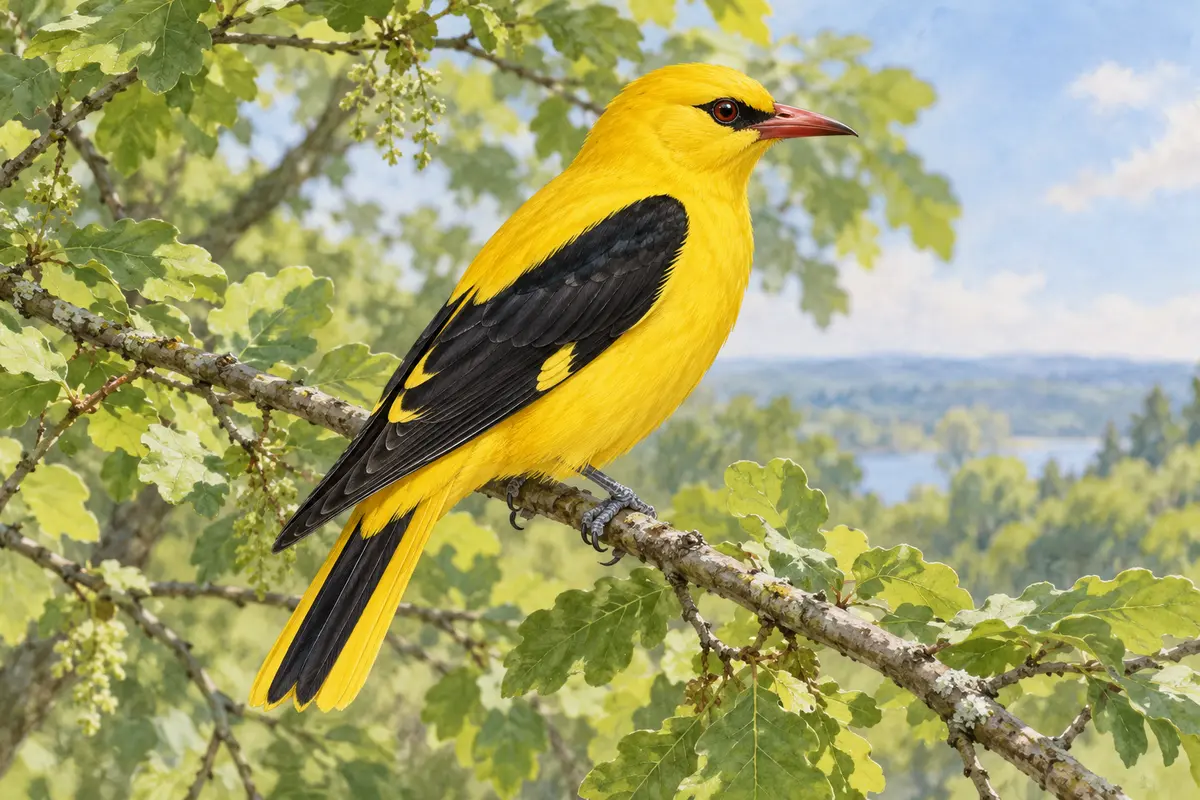
Adult males have yellow bodies, black wings and reddish-pink bills. Females and immatures are greener, with fine streaking below; yellow colour alone does not establish identity. [2,6]
Long-distance migration links temperate breeding areas with African winter quarters. Protection must consider breeding grounds, stopovers and winter habitat. [3]
Behaviour and ecology
Often feeds inconspicuously high in trees. Musical song can reveal it before it is seen, while a harsher call sounds quite different. [2,6]
Diet
Eats insects and berries according to seasonal availability, rather than being exclusively seed-eating or fruit-eating. [2]
Reproduction and life cycle
BTO records typically one brood annually, 3–4 eggs, 16–17 days of incubation and fledging about 16–17 days later. These are biological references, not a captive-breeding timetable. [1]
Ecosystem role
Its insect-and-fruit diet places it within canopy food webs. This inference does not quantify pest suppression or seed dispersal. [2]
Threats & conservation
Global LC does not exclude local loss: BTO records Britain's last confirmed breeding in 2009. Habitat retention and preventing trapping remain appropriate conservation priorities. [1]
Reviewed 20 October 2026: BTO reports IUCN Least Concern. The CITES-III entry specifies Ukraine's population, not all populations worldwide. Direct IUCN details were unavailable; CITES was cross-checked using indexed official material and the Appendices effective 5 March 2026. [1,4,5]5 sourced facts
Species in five facts
Male and female plumage differs. [6]
Song often reveals the bird before it is seen. [2]
Typical clutches contain 3–4 eggs. [1]
The species winters in Africa. [3]
CITES III specifically names Ukraine's population. [4,5]
Sources
[1] BTO — Golden Oriole[2] RSPB — Golden oriole[3] EURING/CMS — Migration Atlas[4] CITES Appendices — indexed official entry[5] Official gazette — Appendices effective 05/03/2026[6] Cornell Lab, eBird — Eurasian Golden Oriole