
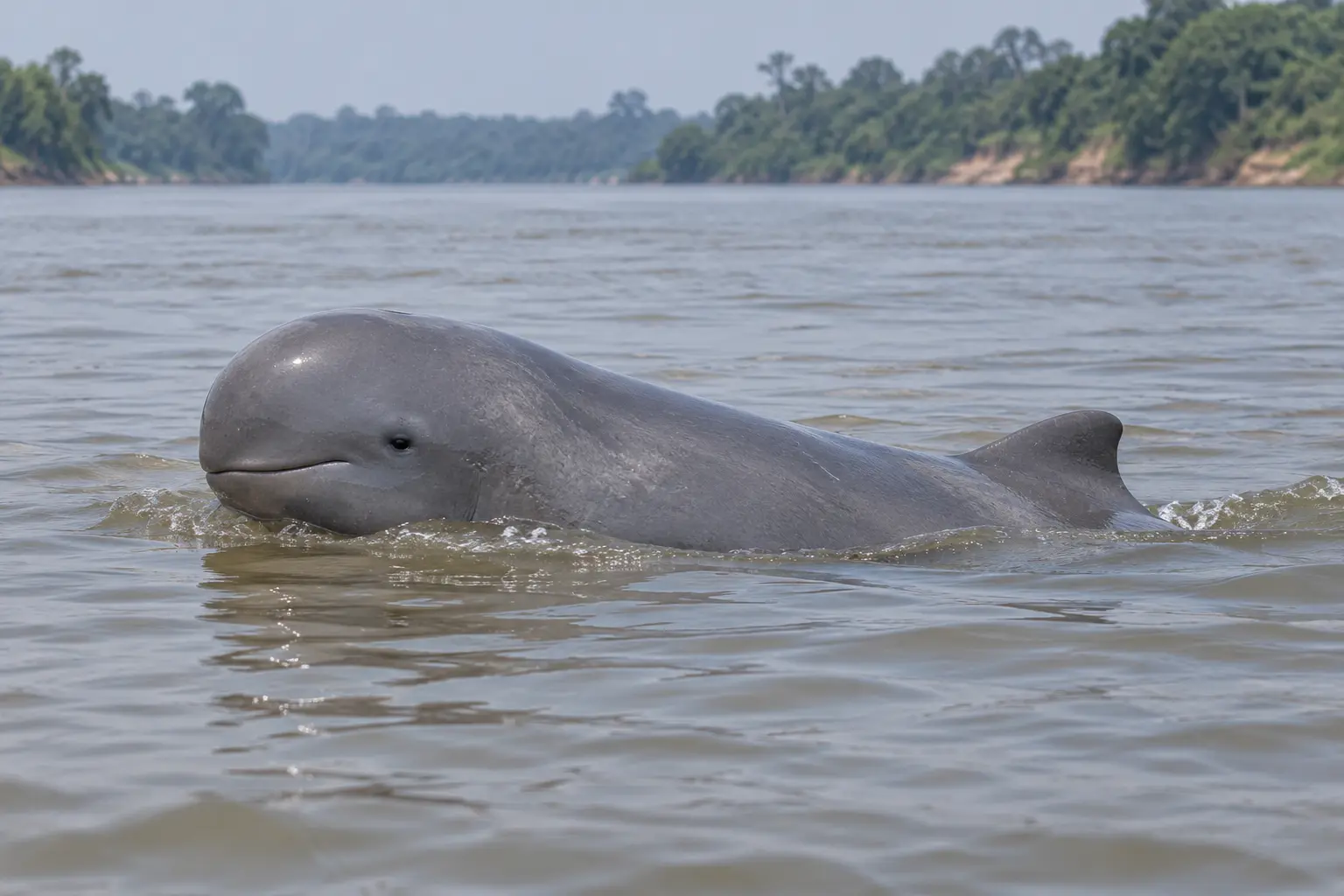
Patchily distributed in shallow bays, estuaries and coasts from South through Southeast Asia, with resident freshwater populations in three major rivers. Mekong dolphins concentrate along the Cambodia-Lao PDR reach and dry-season deep pools. [1]
Roughly 1.8–2.75 m long; WWF summarises mass at about 90–200 kg. Measurements vary with age, sex and population, so an average should not be inferred from endpoints. [1,2]
The forehead is rounded and bulbous, the short mouth forms almost no beak, the neck is more flexible than in many oceanic dolphins, and a low triangular dorsal fin sits behind mid-back. Colour is slate grey with a paler underside. [1,2]
The rounded forehead houses the melon used in echolocation; reduced cervical fusion allows flexible head movement in shallow rivers and structured margins. A low dorsal fin suits shallow, obstacle-rich water. [2]
Behaviour and ecology
Usually in small groups, it surfaces unobtrusively and may spit water during foraging or learned displays. In parts of Myanmar and India dolphins cooperate with cast-net fishers, but this local behaviour should not be generalised to every population. [2,3]
Diet
Feeds on fish, crustaceans and cephalopods according to habitat; river dolphins find prey in turbid water through hearing and echolocation. Protecting prey communities and preventing destructive fishing are as relevant as direct dolphin protection. [1–3]
Reproduction and life cycle
A single calf follows a long gestation of roughly 14 months in compiled accounts; nursing and birth intervals are prolonged. In populations numbering only tens to hundreds, loss of a breeding adult has disproportionate impact. [2]
Ecosystem role
As an upper-level predator, the dolphin reflects river continuity, fish supply and water quality. Protecting its habitat also covers deep pools, fish breeding areas and community-based tourism livelihoods. [1,2]
Threats & conservation
Gillnet entanglement is the main threat, alongside dams and altered flow, noise, pollution, prey decline and vessel collision. DinoJura does not recommend captive acquisition or sourcing; appropriate action is monitoring, safer gear, authority-led rescue and distance-regulated tourism. [1–5]
Reviewed 25 September 2026: IUCN records EN at species level, while some isolated river populations are assessed more severely. CITES Appendix I restricts international trade, but field survival chiefly depends on reducing net entanglement and protecting flow and deep pools.5 sourced facts
Species in five facts
The species includes coastal populations and several resident freshwater populations. [1]
Known river populations occur in the Ayeyarwady, Mahakam and Mekong. [1]
The dorsal fin is small and positioned behind mid-back. [2]
Entanglement in fishing gear is a critical source of mortality. [1,3]
Cooperation with fishers is a local tradition, not a behaviour of every population. [2,3]
Sources
[1] WWF — Irrawaddy dolphin[2] Animal Diversity Web — Orcaella brevirostris[3] IWC Journal — status, ecology and conservation in Malampaya Sound[4] IUCN Red List species search[5] CITES Appendices effective 5 March 2026