
Restricted to the DRC, principally closed-canopy forests in and around the Ituri region. Roads, illegal mining and conflict fragment habitat and constrain monitoring; records beyond the core range require field or genetic evidence. [1,2]
Shoulder height is about 1.5 m. Females typically weigh 225–350 kg and males 200–300 kg; sex and measurement source must be retained when comparing figures. [1]
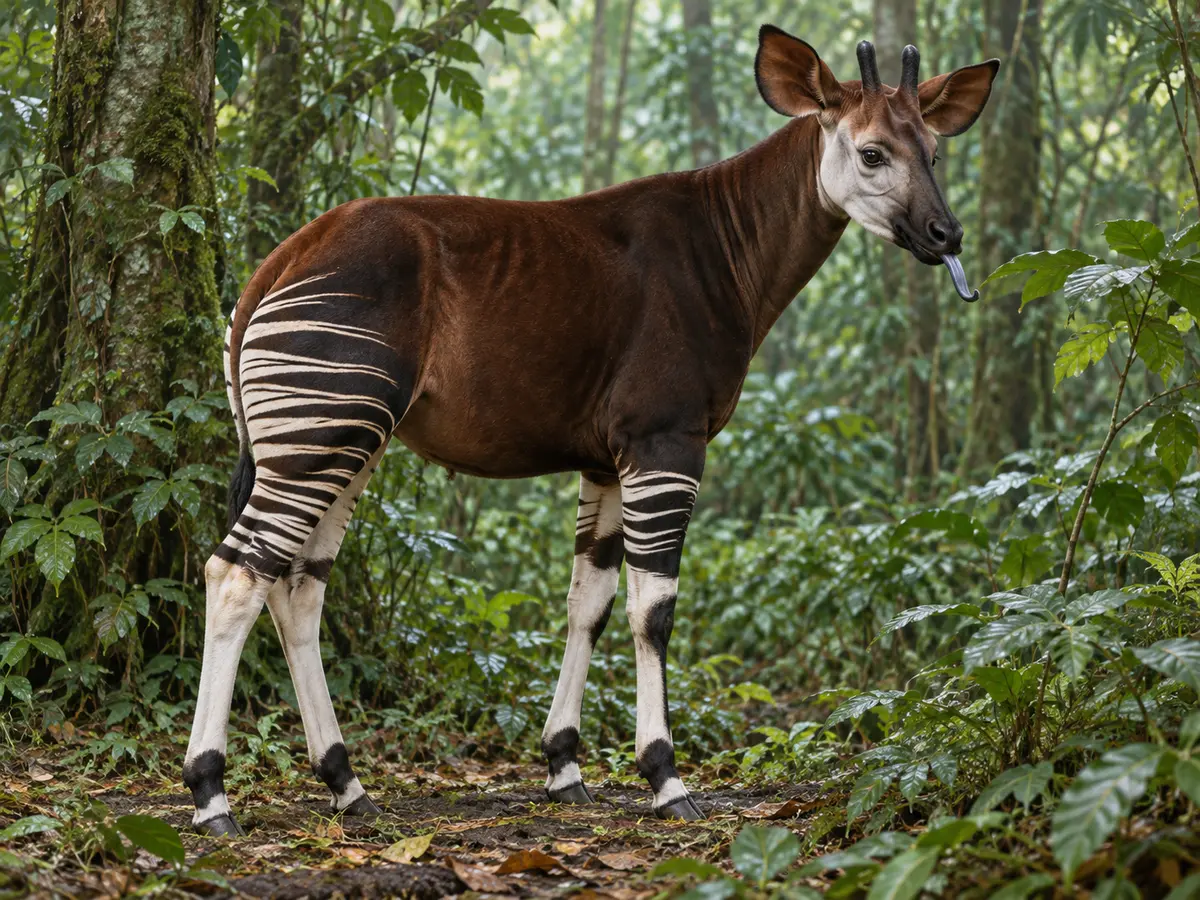
The velvety chocolate-to-reddish coat is oily and sheds rain; rump and upper legs carry horizontal white-and-black stripes, the neck is relatively short and large ears rotate independently. Males bear two short skin-covered ossicones; an okapi is not a zebra hybrid. [1]
A shorter neck and legs than the giraffe help negotiate understory obstacles; large ears locate sound, leg stripes break up the outline in dappled light and a long tongue harvests foliage. Oily hair helps repel rainforest moisture. [1]
Behaviour and ecology
Mostly solitary except for mothers with calves, and most active from afternoon into evening. Individuals use forest trails and leave foot-gland scent; infrasonic mother-calf calls have been recorded, although their function remains a research hypothesis. [1]
Diet
A ruminant browser eating leaves, buds, twigs, fruit, ferns and fungi; San Diego Zoo reports roughly 18–29 kg of food per day. The dark prehensile tongue pulls foliage, while mineral provision should be evidence-based rather than inferred solely from clay-eating. [1]
Reproduction and life cycle
Gestation lasts about 14–16 months and usually produces one calf. A newborn can stand within 30 minutes; its mother hides it in a secluded place and returns to nurse, reducing detection but making disturbance near calving areas especially risky. [1]
Ecosystem role
As a large browser, okapis create a foliage pruning line and recycle nutrients through dung. Protecting this umbrella species also retains habitat for many other Ituri forest organisms. [1,2]
Threats & conservation
Poaching, illegal mining, forest loss, roads and armed instability drive severe decline. DinoJura should not treat this as a commercial sourcing species: any rescue or transfer must be coordinated by authorities, conservation programmes and capable institutions under Appendix I. [2–4]
IUCN lists the okapi as Endangered (EN) with a decreasing trend. CITES placed it in Appendix I effective 5 March 2026 following CoP20; international commercial trade in wild-sourced specimens is tightly restricted. This does not replace national, veterinary or transaction-specific approvals. [1,3,4]5 sourced facts
Species in five facts
The okapi is the giraffe's closest living relative. [1]
Its large ears can rotate independently. [1]
Gestation lasts about 14–16 months. [1]
A birth usually produces a single calf. [1]
CITES Appendix I has applied since 5 March 2026. [3,4]
Sources
[1] San Diego Zoo Wildlife Alliance — Okapi[2] Okapi Conservation Project — Okapi[3] CITES CoP20 Proposal 4 — Okapia johnstoni[4] CITES Appendices effective 5 March 2026