
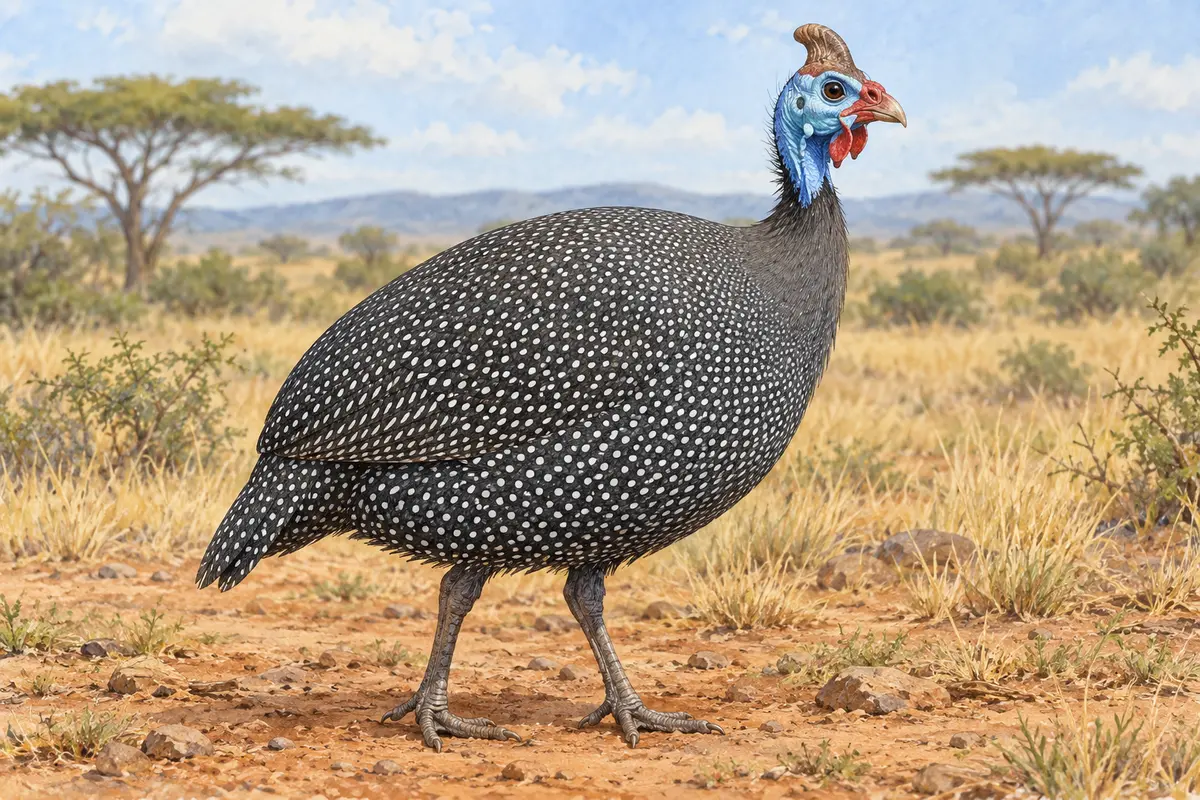
Native mainly to sub-Saharan Africa, using savanna, grassland, scrub and woodland edges with roost trees. Introduced domestic populations do not define its natural range. [3]
Zagreb Zoo reports 53–63 cm in length and roughly 1.15–1.6 kg. These are reference ranges, not mandatory weights for every domestic strain. [1]
Dark grey plumage with white spots, pale-blue bare head, red on the wattles and a casque. Unlike crested Guttera guineafowl, the helmet is not feathers; head details vary among subspecies. [3]
Strong legs support walking forage, while flight reaches elevated roosts. Running, flying and alarm calls provide complementary responses to danger. [2]
Behaviour and ecology
Walks and forages in daytime flocks, calls loudly and often runs from threats. It can nevertheless fly and commonly roosts in trees. [2]
Diet
Omnivorous: seeds, plant material, insects, larvae and snails. Eating ticks or insects does not itself demonstrate disease control at a particular site. [3]
Reproduction and life cycle
Breeding often follows rains; zoo sources report clutches of 6–12 eggs. Odense gives 26–28 days of incubation; chicks follow the hen while foraging. [1,2]
Ecosystem role
Consumes seeds and invertebrates while supplying prey within savanna food webs. This role does not justify releasing it outside its native range. [3]
Threats & conservation
LC does not guarantee security for every population. Distinguish wild origin from domestic stock, retain provenance and follow veterinary rules; this educational record establishes neither legality nor availability of any consignment. [1]
Reviewed 20 October 2026: Zagreb Zoo reports IUCN Least Concern; the direct assessment was unavailable. An earlier check of the 5 March 2026 CITES text found no species entry, but retrieval errors prevent current independent confirmation. An unlocated name is not trade permission. [1,4,5]5 sourced facts
Species in five facts
The casque is not a feather crest. [3]
It can fly despite usually walking. [2]
Flocks commonly roost in trees. [2]
The diet includes plants and animals. [3]
Clutch size is not annual egg production. [1,2]
Sources
[1] Zagreb Zoo — Numida meleagris[2] Odense Zoo — Guinea fowl[3] Animal Diversity Web — biology (erroneous size fields excluded)[4] IUCN 2018 — direct record, access restricted[5] CITES text effective 05/03/2026 — retrieval incomplete