
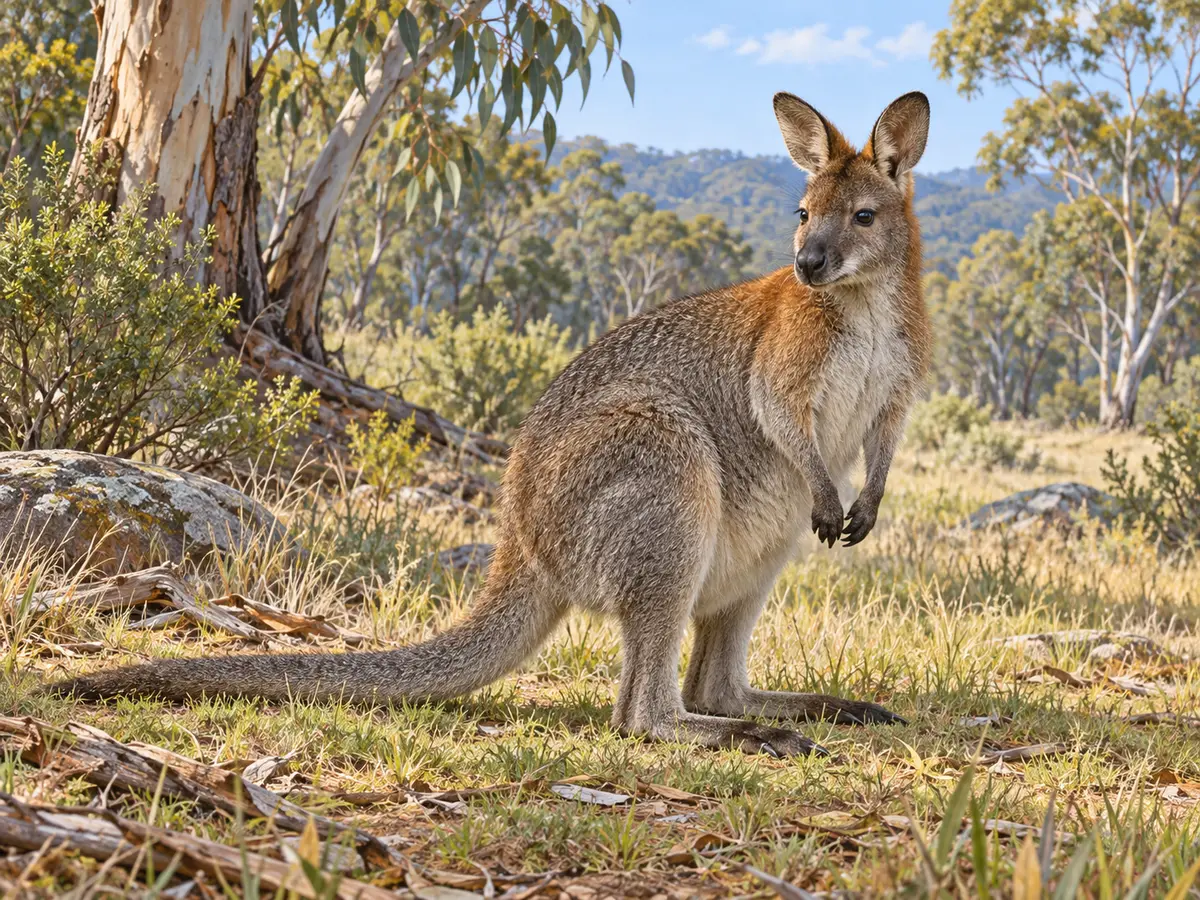
Native along eastern and south-eastern Australia and in Tasmania, inhabiting eucalypt forest, woodland, scrub and pasture edges with dense shelter. Some human-introduced populations occur outside the native range and should not be treated as natural distribution. [1–3]
Older compiled data report head-and-body length around 92.5–105 cm, a 70–75 cm tail and mass of 13.8–18.6 kg; Australian Wildlife Conservancy notes adults can exceed 20 kg and males are larger. Differences reflect sex, subspecies and source. [2,3]
Grey-brown above with a rusty-red nape and shoulders, paler underparts, long ears and dark muzzle, hands and feet; the tail is long and robust. Red colour intensity varies, so identification should also consider head, limbs, tail and locality. [2,3]
Powerful hind limbs enable efficient hopping, the tail balances and braces during slow movement, and rotating ears detect danger. The pouch allows a very small newborn to complete much of its development after birth. [2,3]
Behaviour and ecology
Mainly crepuscular and nocturnal, usually solitary but sometimes forming loose feeding groups of up to about 30. Large ears can turn independently to monitor sound; in heat, individuals lick the forearms to increase evaporative cooling. [2,3]
Diet
Feeds on grasses, herbs, leaves and shoots, and may dig for succulent roots during dry periods. Foregut fermentation processes fibrous plant food, but managed diets still require energy control and gradual feed transitions. [2,3]
Reproduction and life cycle
Usually produces one young after a gestation of about 29–30 days. The joey develops in the pouch for roughly 280 days and may suckle for 12–17 months; embryonic diapause helps the mother time the next birth. Breeding patterns differ between Tasmania and the mainland. [3]
Ecosystem role
As a grazer-browser it helps shape low vegetation and serves as prey for native predators. High densities in fragmented landscapes can create agricultural or road conflict, so ecological role and management are context dependent. [2,3]
Threats & conservation
The species remains LC but faces habitat loss and fragmentation, vehicle strike and competition with introduced herbivores; foxes and cats can take young. DinoJura must check subspecies, lawful origin, veterinary records and Australian export law rather than infer permission from CITES status. [1–5]
The Mammal Diversity Database and linked IUCN record list the species as Least Concern (LC). Current taxonomy uses Notamacropus rufogriseus, while much older biological literature uses Macropus rufogriseus. Neither name combination was located in the CITES Appendices of 5 March 2026; native-fauna, veterinary, quarantine and import law still apply. [1–5]5 sourced facts
Species in five facts
The accepted genus is now Notamacropus; much older literature uses Macropus. [1]
Compiled head-and-body length is about 92.5–105 cm. [3]
The tail measures about 70–75 cm in compiled data. [3]
Gestation lasts about 29–30 days. [3]
A single joey commonly remains in the pouch for about 280 days. [3]
Sources
[1] Mammal Diversity Database — Notamacropus rufogriseus[2] Australian Wildlife Conservancy — Red-necked wallaby[3] Animal Diversity Web — Macropus rufogriseus[4] IUCN Red List — Notamacropus rufogriseus[5] CITES Appendices effective 5 March 2026