
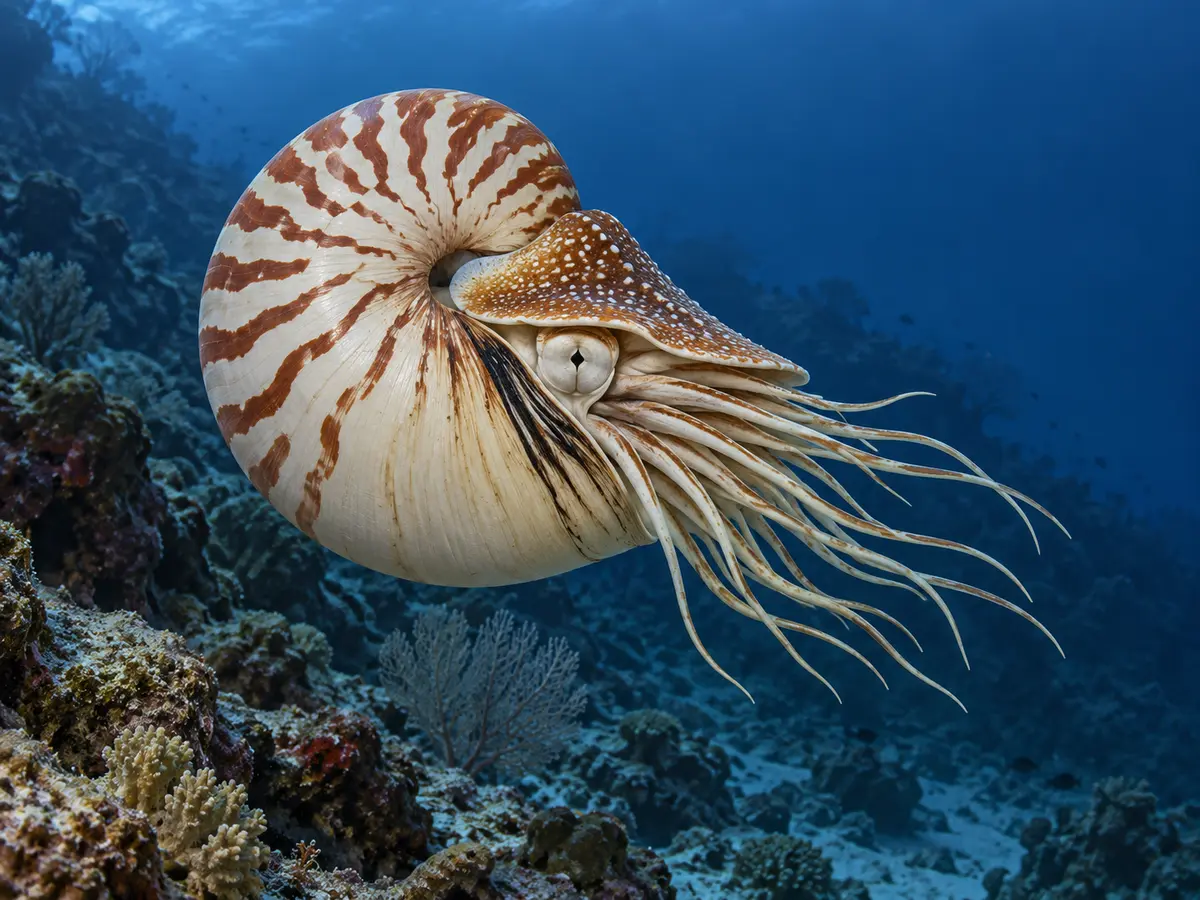
Occurs in the Indian and western Pacific oceans, mainly along deep tropical reef slopes and oceanic islands. Populations are often small and isolated by deep water and temperature limits, with very limited capacity to cross open ocean. [1,2]
NOAA gives a typical adult shell width of about 5–9 inches, or 13–23 cm, and mass of at least about 0.9 kg. Population measurements vary, and souvenir-shell size cannot establish exact origin or age. [1]
A planispirally coiled cream-white shell with reddish-brown outer stripes; the aperture holds a fleshy hood, pinhole-type eyes and many slender suckerless tentacles. Internal chambers visible in cut shells are not a feature that should ever be checked by damaging a live animal. [1–3]
A siphuncle connects shell chambers and regulates gas-fluid balance for buoyancy, while the hyponome provides jet propulsion. More than 90 suckerless tentacles are chemically sensitive, and the hood can cover soft tissues when the animal withdraws. [1,2]
Behaviour and ecology
Moves by jet propulsion, often along reef slopes and shifting depth between day and night for refuge and feeding. Chemoreceptors on the tentacles detect food odours; pinhole eyes form simple images suited to dim conditions. [1,2]
Diet
Hunts or scavenges fish, crabs, lobsters and other animals, tearing food with a sharp beak. It is an opportunistic predator-scavenger; managed diets require nutritional analysis, water-quality control and feeding observation rather than a single fish-only ration. [1,2]
Reproduction and life cycle
Sexes are separate, growth is slow and maturity comes late at roughly 10–15 years. Females produce few large eggs that each require at least a year to develop; this slow life history makes populations recover poorly after overharvest. [1,2,4]
Ecosystem role
As both predator and scavenger it transfers nutrients along reef slopes and is prey for sharks, bony fish and octopuses. Population isolation means losses at one island are unlikely to be replenished quickly from elsewhere. [1,2,4]
Threats & conservation
Harvest for souvenir, jewellery and inlay shells is the principal threat; slow growth, low reproduction, late maturity and limited movement create exceptional sensitivity. Any sourcing must exclude undocumented wild shells or animals, verify Appendix-II and national rules, and demonstrate specialised deep-marine system capacity. [1,2,4,5]
DinoJura did not locate a current IUCN assessment for Nautilus pompilius and therefore records Not Evaluated (NE), without converting research descriptions of vulnerability into an IUCN category. In the United States, NOAA has listed the species as Threatened under the ESA since 2018; that is a national legal status. The family Nautilidae is in CITES Appendix II. [1–5]5 sourced facts
Species in five facts
Adult shells are commonly about 13–23 cm wide. [1]
The species has more than 90 tentacles, all without suckers. [1]
Sexual maturity is late, at roughly 10–15 years. [1]
Each egg requires at least one year to develop. [1]
Reported lifespan is commonly 15–20 years or more. [1]
Sources
[1] NOAA Fisheries — Chambered Nautilus[2] NOAA Fisheries — ESA status review report[3] World Register of Marine Species — Nautilus pompilius[4] PLOS ONE — Nautilus at risk[5] CITES Appendices effective 5 March 2026