
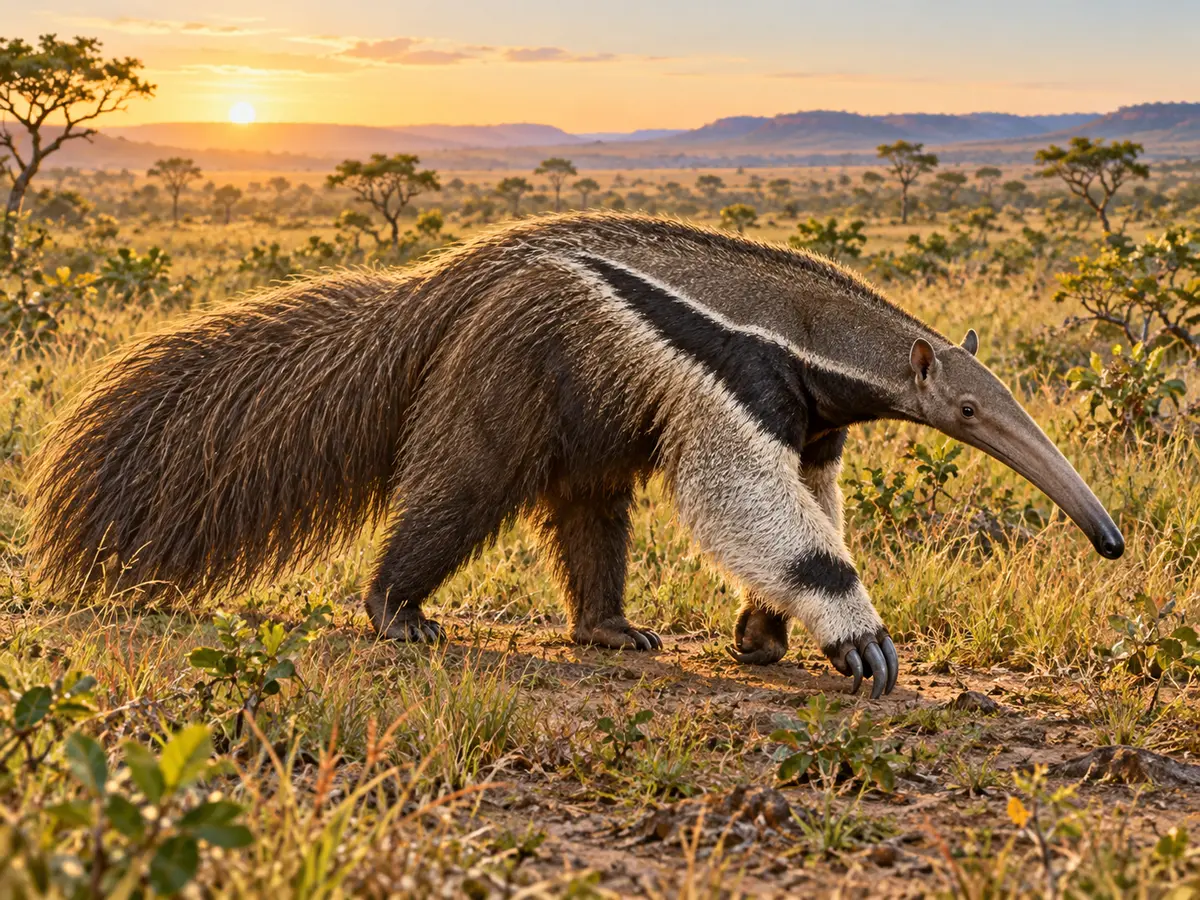
Ranges from southern Central America through much of South America to northern Argentina, although it has disappeared from parts of its former range. It uses Cerrado, grassland, savanna, wetland, dry forest and humid forest, often relying on a mosaic of feeding and resting cover. [1,3,5]
Smithsonian reports a total nose-to-tail length of about 1.8–2.4 m; ADW gives a 1.0–1.2 m head-and-body length plus a 0.65–0.9 m tail. The bushy tail contributes much of the total, so length cannot be converted directly into mass. [2,3]
An extremely long snout, small head, rounded ears, grey-brown coat and white-edged black band from chest to shoulder are diagnostic. Huge curved foreclaws are protected by knuckle-walking. The shaggy tail is not prehensile, unlike those of climbing tamanduas. [2,3]
It lacks teeth but combines a long snout, specialised tongue muscles and sticky saliva to collect tiny prey. Foreclaws open hard nests while knuckle-walking protects their tips; the heavy tail blankets the sleeping body and disrupts its outline. [2,3,5]
Behaviour and ecology
Mostly solitary, walking over large foraging areas and shifting activity with temperature and disturbance. At rest it curls in a ground depression or cover and drapes its tail over the body; when cornered it may rear and defend itself with the foreclaws. [3,5]
Diet
Specialises on ants and termites, opening part of a nest with its claws and inserting a narrow saliva-coated tongue into tunnels. It visits many colonies and feeds briefly, limiting exposure to defensive insects. Managed diets are specialised formulas, not a single insect substitute. [2,3,5]
Reproduction and life cycle
Usually one young is born after roughly six months; endocrine monitoring in managed animals recorded 171–183 days. The infant rides on its mother's back, its stripe blending with hers, and remains dependent for months. Low reproductive output slows population recovery. [3,6]
Ecosystem role
As a specialised predator of ants and termites, it influences social-insect populations and creates small openings in nests and soil while foraging. It usually does not destroy an entire colony, allowing the food source to recover. [3,5]
Threats & conservation
Habitat conversion, extreme wildfire, roadkill, hunting and free-ranging dogs cause mortality; slow reproduction compounds losses. DinoJura must verify captive origin, Appendix-II documents, specialised nutrition and soft-ground space before any transfer. [1,4,5]
IUCN lists Myrmecophaga tridactyla as Vulnerable (VU) in its 2025 assessment. The species is in CITES Appendix II: international trade is not absolutely prohibited, but requires legal origin, permits and an appropriate non-detriment finding. VU is not evidence that animals are available or lawful to trade. [1,4]5 sourced facts
Species in five facts
The Giant anteater has no teeth. [2,3]
It knuckle-walks to protect its large foreclaws. [2,3]
Total length including the tail can reach about 2.4 m. [2]
The young usually rides on its mother's back for months. [3,6]
The 2025 IUCN assessment retains the species as VU. [1]
Sources
[1] IUCN Red List 2025 — Myrmecophaga tridactyla[2] Smithsonian's National Zoo — Giant anteater[3] Animal Diversity Web — Myrmecophaga tridactyla[4] CITES Appendices effective 5 March 2026[5] Mammalian Species — Myrmecophaga tridactyla[6] Knott et al. — reproductive endocrinology