
Breeds across most of Europe and Asia to Alaska, Greenland and North Africa; northern populations migrate to warmer regions. Occurs on riverbanks, open fields, mudflats, farms, streets and roofs. [1,3]
Adults are usually about 16.5–19 cm long, with the tail contributing nearly half the silhouette; mass is roughly 17–25 g depending on sex and season. [3]
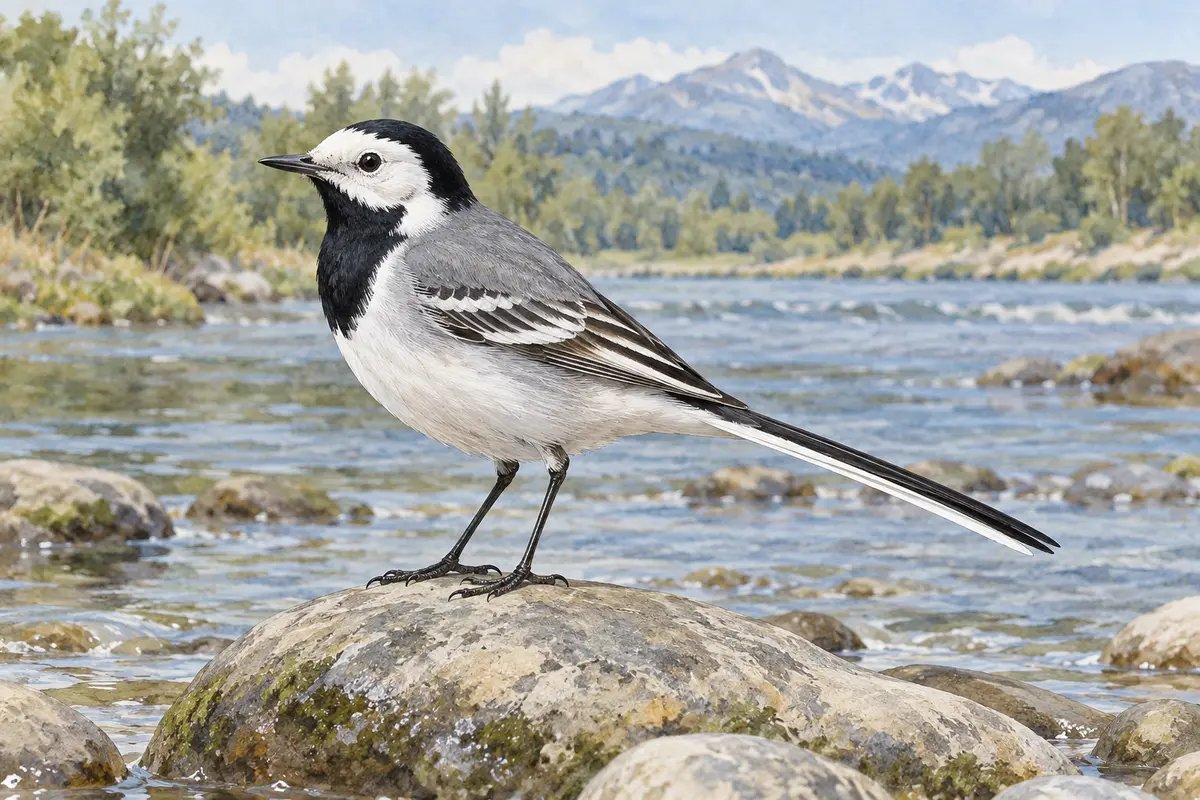
Slender, with a fine black bill, grey back, white face, black crown and bib, white underparts, and a very long black tail edged white. It lacks the yellow belly of Grey Wagtail. [3]
Relatively long legs aid running on open ground, the fine bill takes insects and the long tail assists balance during turns; plumage varies among subspecies but retains strong black-white contrast. [3]
Behaviour and ecology
Walks and runs after insects while constantly bobbing the tail, and also sallies after aerial prey. Outside breeding it may roost communally by the hundreds in reeds or buildings. [1,3]
Diet
Feeds mainly on small terrestrial and aquatic invertebrates, including flies, beetles, larvae and small crustaceans, with occasional seeds. [1,3]
Reproduction and life cycle
Builds a cup nest in rock crevices, banks, walls, bridges or buildings. BirdLife reports 3–8 eggs; family-level data indicate about 10–15 days' incubation and care by both wagtail parents. [1,4]
Ecosystem role
Consumes many insects around wetlands, farms and towns and is prey for raptors and small mammals. Its presence reflects food availability, not automatically clean water. [1,3]
Threats & conservation
Not globally threatened, but river engineering, pesticides, loss of nesting cavities and disturbance of roosts can reduce local populations. Retaining microhabitats and reducing chemicals are practical actions. [1]
Reviewed 22 October 2026: BirdLife/IUCN lists Motacilla alba as LC. The name was not located in the CITES Appendices effective 5 March 2026; capture, keeping and transport remain subject to wildlife and veterinary law. [1,2]5 sourced facts
Species in five facts
The name wagtail reflects its continual tail-bobbing. [3]
Northern populations migrate farther than temperate ones. [1]
Nests are often in natural crevices or human structures. [1,4]
BirdLife records clutches of 3–8 eggs. [1]
One recorded individual lived nearly 10 years. [4]
Sources
[1] BirdLife DataZone — Motacilla alba[2] CITES — Appendices valid from 5 March 2026[3] Oiseaux-Birds — White wagtail[4] University of Michigan ADW — Motacillidae