
Rainforests of New Guinea, nearby islands and Australia's Cape York Peninsula. Taxonomy remains under study; several northern populations are often separated as Morelia azurea.
Adults are commonly around 1.2–1.8 m long, with a relatively slender body, strong tail and head clearly distinct from the neck.
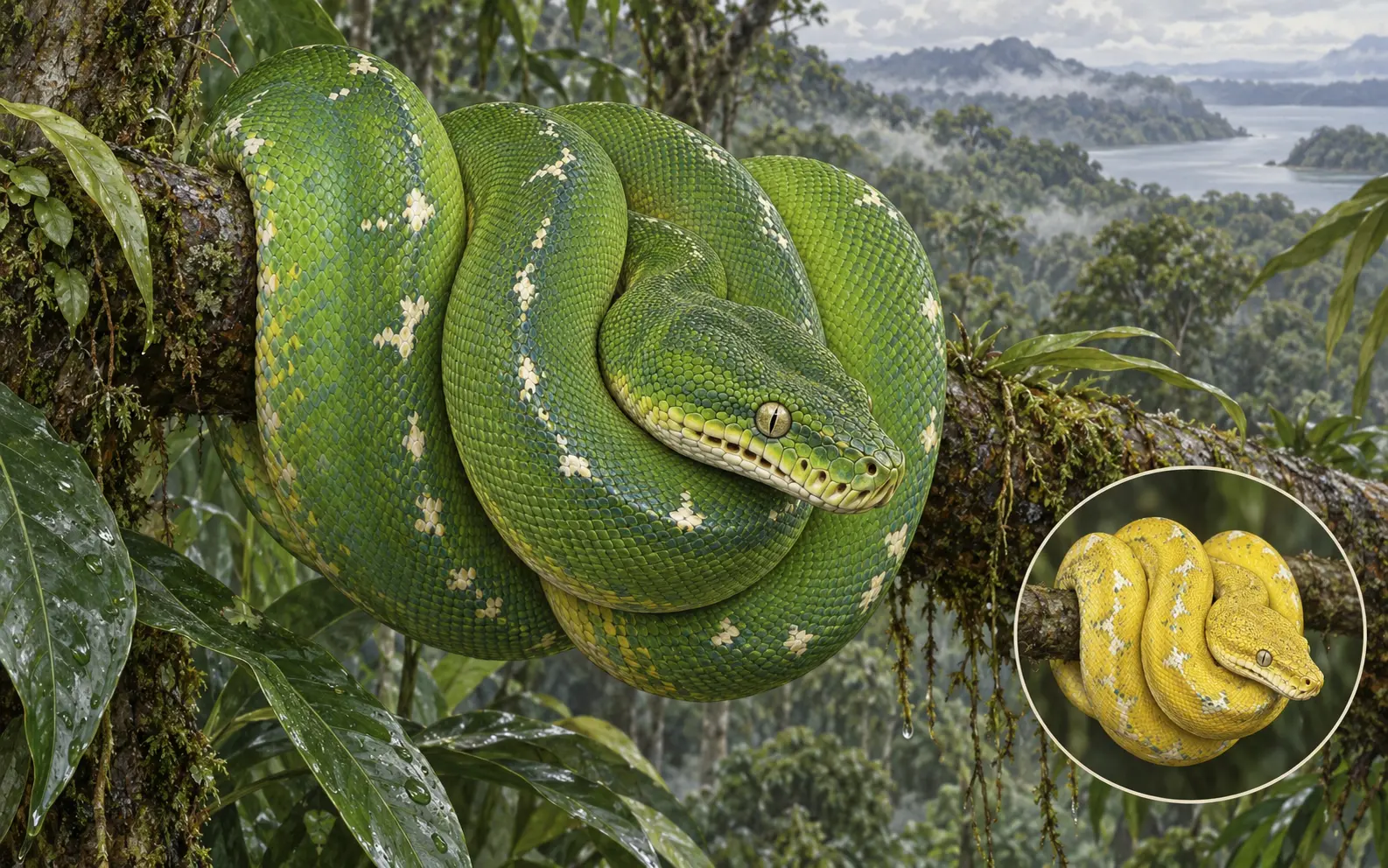
Adults are usually green with white or yellow dorsal markings; juveniles may be lemon-yellow or brick-red. Labial heat pits, vertical pupils and long recurved teeth are characteristic.
Heat-sensitive pits detect warm prey in low light, while a strong tail and body support branch movement. Age-related colour change may reflect shifts in habitat use and visual signalling.
Behaviour and ecology
Arboreal, largely nocturnal and ambush-oriented. It characteristically drapes body loops over a branch, resting the head between coils for rapid strikes.
Diet
Takes small vertebrates including mammals, birds and sometimes reptiles. Diet shifts with size and microhabitat; it should not be described simply as a bird specialist.
Reproduction and life cycle
Oviparous; females coil around the clutch and generate heat through muscular contractions during incubation. Clutch size varies from several to a few dozen with female size.
Ecosystem role
A mid-level canopy predator that helps regulate small vertebrates and, when young, provides prey for larger predators.
Threats & conservation
IUCN lists the species as LC globally, but collection and trade can affect local populations. CITES Appendix II regulates trade; captive-origin evidence is especially important given past wild collection pressure.
IUCN/CITES status was checked on the profile date; re-verify before any legal or transaction decision.5 sourced facts
Species in five facts
Juvenile colour often differs sharply from adult colour—an ontogenetic change.
Its saddle-like coils provide stability on branches.
Pits in the lip scales detect thermal radiation from prey.
Females brood eggs by coiling around the clutch.
Older literature may use Chondropython viridis, now treated as a synonym.
Sources
ITIS — Morelia viridisReptile DatabaseIUCN Red List searchCITES Checklist