
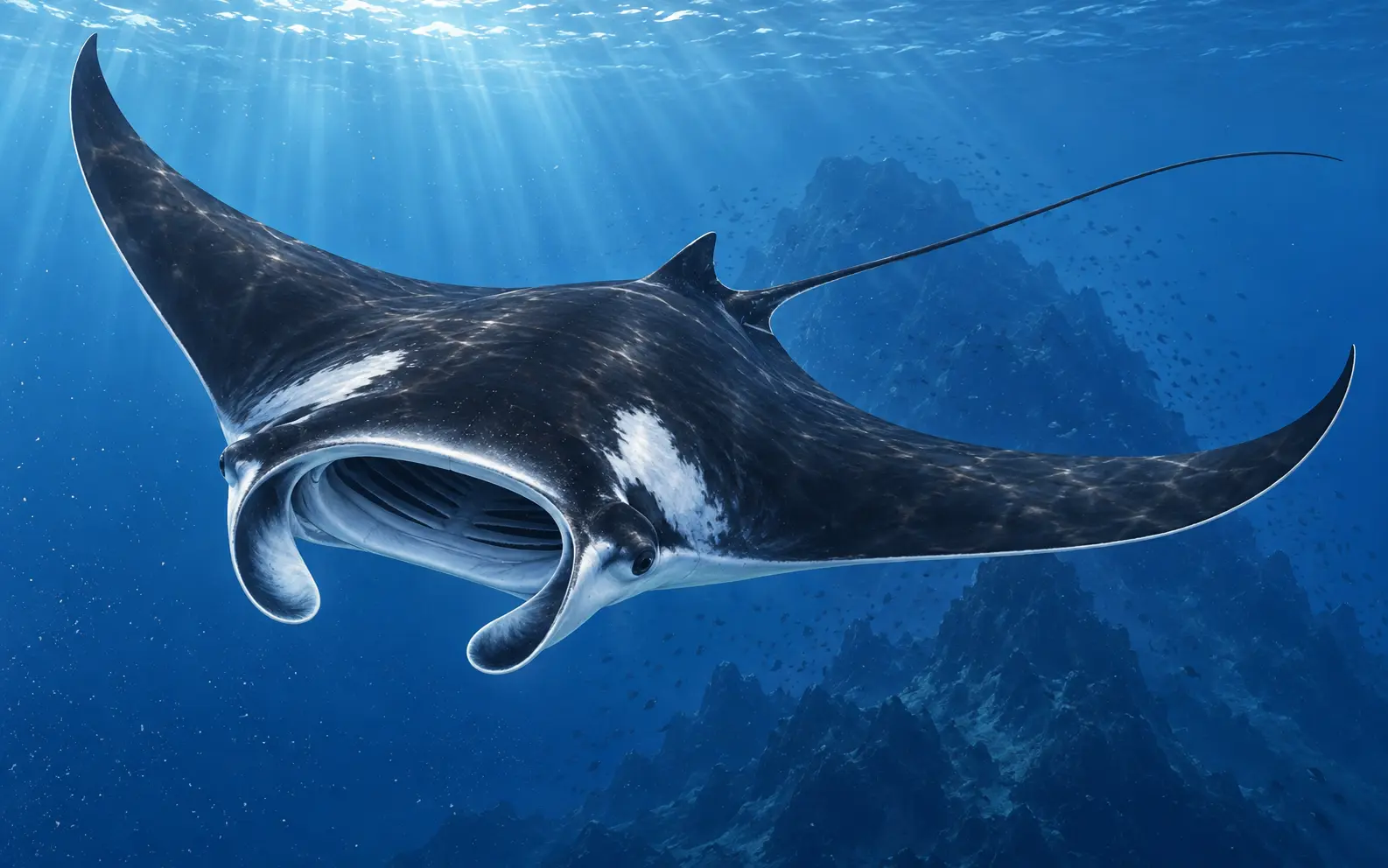
Occurs in tropical, subtropical and warm-temperate oceans, often around oceanic islands, seamounts, upwellings and plankton concentrations. Individuals can move across national boundaries, making conservation dependent on international coordination. [1,2]
Disc width can reach about 7.9 m and mass about 2,400 kg according to NOAA, although most observed animals are smaller than those maxima. Size should be recorded as disc width rather than relying on tail length. [1]
A very broad diamond-shaped disc, terminal front-facing mouth, paired cephalic lobes, five gill slits per side and a trailing tail identify the form. The dark back commonly has pale shoulder patches, while unique ventral markings can identify individuals but require care to distinguish reef mantas. [1]
Large pectoral fins generate efficient lift for long travel, cephalic lobes control feeding flow, and the gills support both respiration and prey retention. The tail lacks a functional sting like many other rays; large size and continuous swimming suit an oceanic life. [1]
Behaviour and ecology
Often solitary or aggregating at feeding grounds, cleaning stations and courtship sites. It may barrel-roll while feeding, form chains with other mantas and dive deeper than 1,000 m; movement closely follows seasonal ocean productivity. [1]
Diet
Filters zooplankton and small schooling fish by opening the cephalic lobes, swimming water through the mouth and retaining prey on gill-filter structures. Traded 'gill plates' are structures involved in filtration, not separate accessory gills. [1,2]
Reproduction and life cycle
Fertilisation is internal; embryos develop in the uterus and receive uterine secretions after using yolk. Females commonly produce one pup after roughly a year of gestation, with 2–3 years or more between births, giving populations very low recovery capacity. [1,2]
Ecosystem role
Mantas move plankton-derived biomass across water layers and indicate highly productive ocean sites. Aggregation sites also support wildlife tourism, but only when vessel movement, approach distances and animal contact are controlled. [1,2]
Threats & conservation
Targeted fishing for gill plates, net and line bycatch, vessel strikes, pollution and climate change are major threats. With one pup only every few years, even low adult mortality can drive decline; priorities are bycatch reduction, aggregation-site protection and trade traceability. [1–3]
Reviewed 28 September 2026: the IUCN assessment published in 2020 lists the species as Endangered (EN), and CITES regulates the genus Mobula in Appendix II. Appendix II is not an absolute ban, but international trade must be legal, sustainable and permitted; fisheries and national protection rules apply separately.5 sourced facts
Species in five facts
Disc width can reach about 7.9 m. [1]
NOAA reports a lifespan potentially reaching about 45 years. [1]
The species can dive deeper than 1,000 m. [1]
Females commonly produce only one pup after a long reproductive cycle. [1,2]
CITES regulates the genus Mobula under Appendix II. [3]
Sources
[1] NOAA Fisheries — Giant manta ray[2] IUCN Red List — Mobula birostris (2020)[3] CITES Appendices effective 5 March 2026