
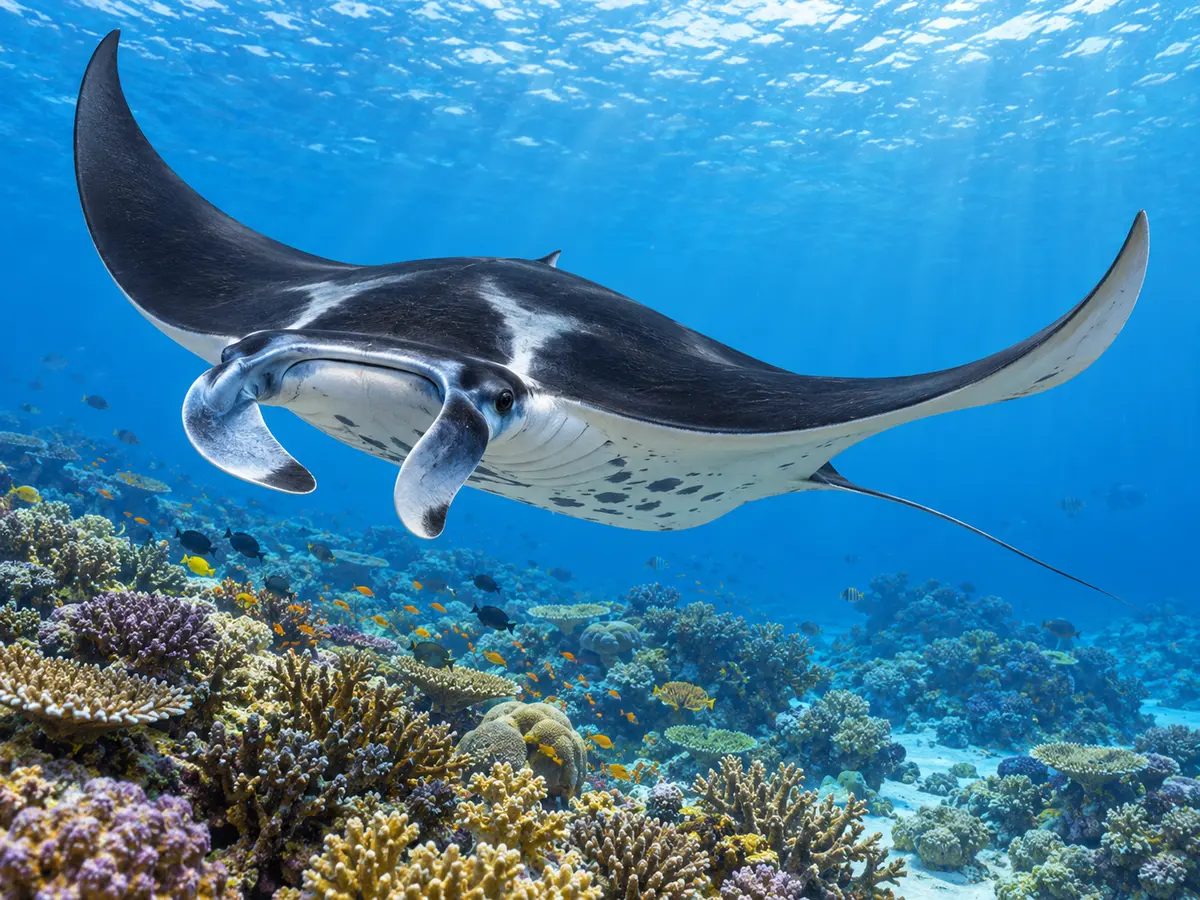
Widely distributed in tropical and subtropical Indian and western Pacific waters, with some eastern Atlantic records. It commonly uses coastal reefs, oceanic islands, lagoons and plankton-rich upwelling or aggregation sites. [1,2]
Commonly encountered individuals span about 3–3.5 m across the disc; the Australian Museum reports a largest recorded width just over 5 m. Disc width is measured wingtip to wingtip, not as body length. [3]
A very broad diamond-shaped disc, paired cephalic lobes, front-facing terminal mouth and slender stingless tail are diagnostic. Pale shoulder patches usually create a Y-shaped division dorsally, while ventral spot patterns identify individuals. [2–4]
Large pectoral fins generate lift like underwater wings; cephalic lobes direct feeding flow and gill filters retain small prey. Dark-above, pale-below countershading aids concealment, while persistent belly markings enable photo-identification. [2–4]
Behaviour and ecology
Can show strong site fidelity while moving among feeding, cleaning and reproductive areas. Rays glide alone or aggregate where plankton concentrates, form feeding chains and sometimes breach; behaviour varies with tides and seasons. [2,6]
Diet
Filters zooplankton and small organisms by directing water through the mouth and gill-filtering structures; cephalic lobes concentrate the flow. Large size does not mean eating large fish, and feeding in managed care is a specialised challenge. [1,2]
Reproduction and life cycle
Aplacental viviparous; research in Mozambique found about one year of gestation and normally a single pup, with twins rare. Long birth intervals and late maturity make population recovery exceptionally slow. [1,5]
Ecosystem role
As a mobile planktivore moving between pelagic water and coastal reefs, the species connects marine productivity hotspots. Cleaning stations support interactions with small fishes, and manta presence can support wildlife tourism when disturbance is controlled. [2,6]
Threats & conservation
Targeted fisheries for gill plates, bycatch, line entanglement, vessel strike, unmanaged tourism and habitat degradation are major risks. With extremely slow reproduction, even limited extra mortality matters; exhibition is appropriate only for exceptionally specialised, legally compliant large marine facilities. [1,2]
IUCN lists Mobula alfredi as Vulnerable (VU) in its 2022 assessment. The genus Mobula is included in CITES Appendix II. This profile uses the current name Mobula alfredi; older literature may use Manta alfredi. Appendix II requires traceable origin, permits and non-detriment findings, not unrestricted trade. [1,2,5]5 sourced facts
Species in five facts
The Reef manta ray has no venomous tail spine. [2,3]
The largest recorded specimen exceeded 5 m in disc width. [3]
The dorsal shoulder patches usually form a Y-shaped division. [2]
Ventral spot patterns allow individual photo-identification. [2,4]
The species usually produces one pup after about a year of gestation. [5]
Sources
[1] IUCN Red List 2022 — Mobula alfredi[2] Manta Trust — Mobula alfredi species guide[3] Australian Museum — Mobula alfredi[4] WoRMS — Mobula alfredi taxonomy[5] Marshall & Bennett 2010 — reproductive ecology[6] Peel et al. 2019 — movement and residencyCITES Appendices effective 5 March 2026