
Ranges from Central America through much of tropical South America to northern Argentina. Habitats include flooded forest, swamps, wooded river and lake margins, mangroves and lowland wetlands. [1–3]
Roughly 50–56 cm long, with a robust body and shorter legs than many open-country ibises. This describes the species and is not an individual condition standard. [2,3]
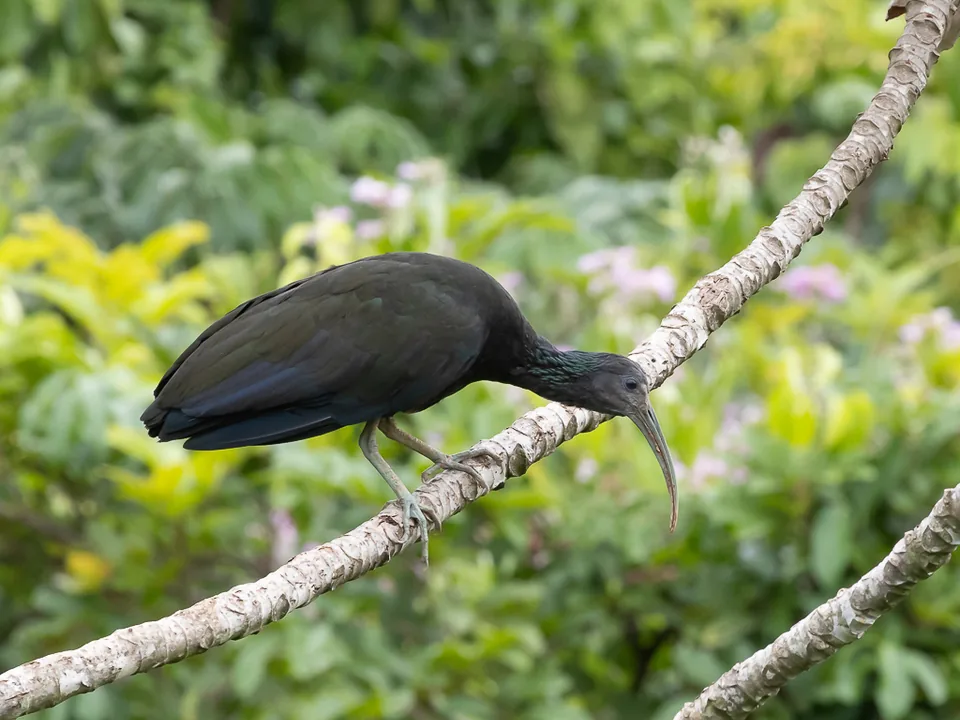
It appears nearly black at distance but shows green, bronze and purple gloss in light; the bill is long and decurved and the legs blue-grey. A stocky, short-legged form and forest setting separate it from the slimmer, more open-country glossy ibis. [2,3]
A long curved bill probes mud and leaf litter where prey is hidden; long toes support movement over soft margins. Iridescent feathers change appearance with viewing angle without pigment change. [2,3]
Behaviour and ecology
Often solitary or in pairs, active especially near dawn and dusk and roosting in trees. A loud call aids detection in dense forest; social data do not justify assuming that large managed flocks are appropriate. [2,3]
Diet
Probes mud and leaf litter for insects, crustaceans, worms, small fish, frogs and other aquatic prey. Composition varies with season and waterbody; managed diets require variety, mineral control and good water quality. [2,3]
Reproduction and life cycle
Builds a stick nest in a tree or tall shrub near water. Reviewed general sources are not sufficiently consistent for one fixed clutch or incubation value across the range; population-specific records are needed. [1,2]
Ecosystem role
A mid-level predator in forest wetlands, it links aquatic and terrestrial food webs and helps regulate invertebrates, small fish and amphibians. [1–3]
Threats & conservation
The species has a broad range but depends on wooded wetlands; riparian clearing, drainage, pollution and hunting can cause local declines. LC status does not remove lawful-origin or welfare requirements. [1,4]
BirdLife/IUCN lists the species as Least Concern (LC). Mesembrinibis cayennensis was not located in the CITES Appendices effective 5 March 2026; this does not replace wild-bird protection, origin controls, quarantine or national permits. [1,4]5 sourced facts
Species in five facts
Dark plumage shows a strong green-bronze sheen in light. [2,3]
It is more often seen singly or in pairs than in large flocks. [2,3]
The curved bill probes for prey in mud and leaf litter. [2,3]
Habitats include flooded forest and mangroves. [1]
Its loud call often reveals the bird before it is seen. [2]
Sources
[1] BirdLife DataZone — Green Ibis[2] Cornell Birds of the World — Green Ibis[3] eBird — Green Ibis[4] CITES Appendices effective 5 March 2026Photo record — iNaturalist 331023220, CC0