
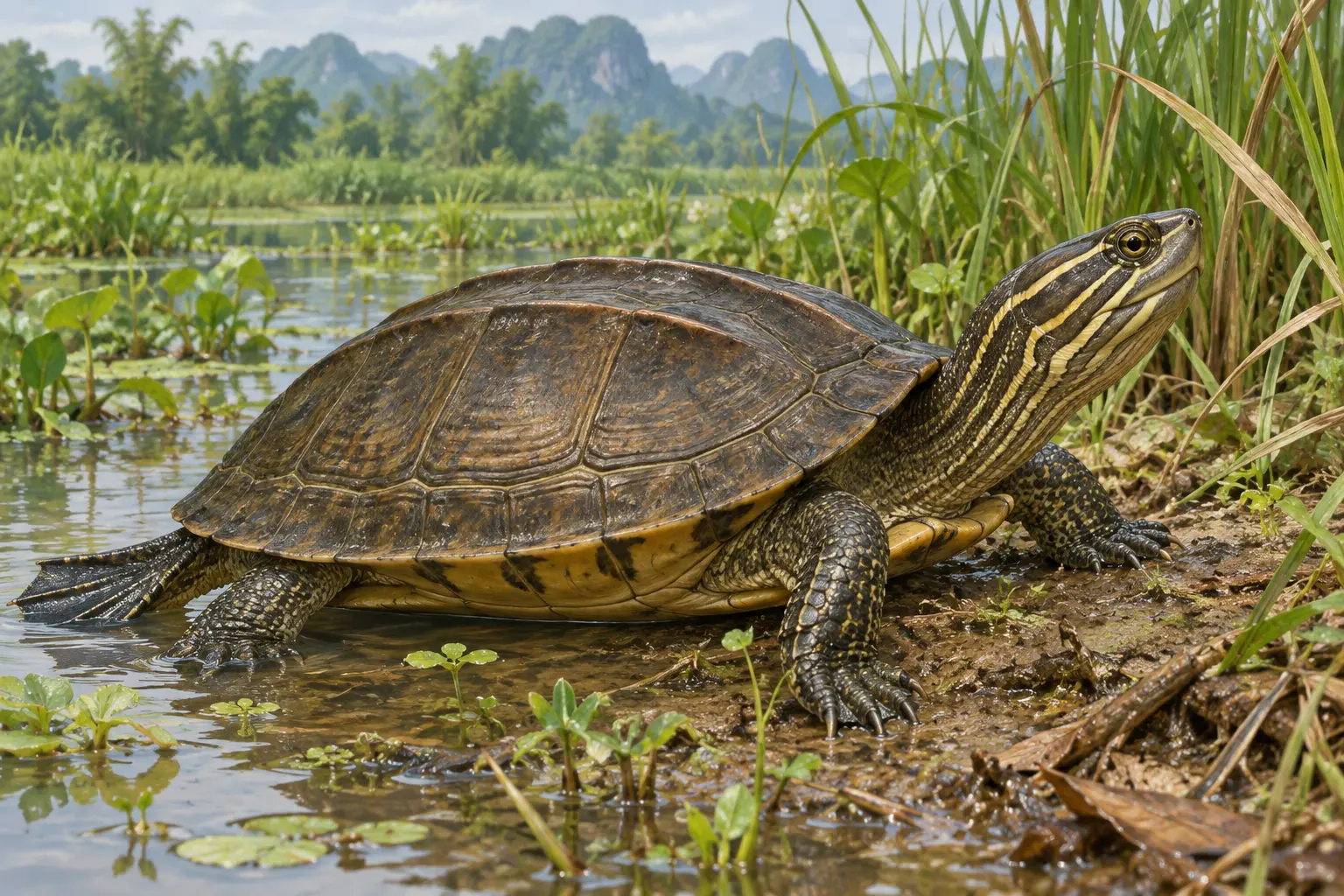
The natural range is extremely restricted in lowland central Vietnam, associated with ponds, marshes, flooded fields, canals and slow water. Much habitat has been converted; surviving coordinates should not be publicised while collection risk remains high. [1–3]
Large individuals may approach roughly 25–30 cm in carapace length, with females generally larger than males. Wild measurements remain scarce, so managed-care values should not automatically represent wild populations. [3]
The elongated dark-brown carapace has three low keels; an olive-dark head carries three to four yellow stripes per side, and the yellow-orange plastron bears large dark blotches. Colour alone is unsafe because captive hybrids may look intermediate. [1,3]
Webbed feet aid swimming while strong claws support terrestrial movement and digging. The elongated shell suits densely vegetated water, and dark colour with head stripes breaks up the outline in turbid water and shade. [1,3]
Behaviour and ecology
Semi-aquatic, moving among shallow water, muddy banks and waterside vegetation; it may bask but retreats quickly when disturbed. Wild behavioural data are very limited, so captive observations must be separated from natural-history conclusions. [1,3]
Diet
Omnivorous, taking aquatic vegetation, fruit, invertebrates, snails and other animal matter opportunistically. Managed diets require variety, energy control and mineral balance; foods readily accepted in captivity do not alone define the wild diet. [1]
Reproduction and life cycle
Eggs are laid on land, and females may produce several small clutches in suitable seasons. Hatchling sex is temperature-influenced, so conservation breeding should record incubation temperature, humidity, parentage and sex outcome rather than hatch count alone. [1,3]
Ecosystem role
The species links aquatic and terrestrial food webs by consuming plants, snails, insects and organic matter, while eggs and young support predators. Its protection also conserves rapidly disappearing lowland wetlands. [1,2]
Threats & conservation
Collection for food and trade, wetland loss and hybridisation risk in managed populations are severe pressures. Suggested actions are genetic studbooks, separation by verified taxon and lineage, continuous provenance, anti-theft security and no release outside an authority-approved conservation programme. [1–4]
Reviewed 24 September 2026: IUCN records CR; current research confirms transfer to CITES Appendix I in 2019. Some older biological accounts still say Appendix II, so legal records must use the current Appendices and case-specific Vietnamese law checks. [1–4]5 sourced facts
Species in five facts
It is a Vietnamese endemic, not a generic name for pond turtles. [1,2]
Each side of the head usually bears three to four yellow stripes. [1,3]
eDNA can detect species traces in water without capturing a turtle. [1]
The species was transferred to CITES Appendix I in 2019. [1,4]
Incubation temperature can influence hatchling sex. [3]
Sources
[1] Environmental DNA — Detecting Mauremys annamensis in central Vietnam (2026)[2] IUCN Red List assessment — Mauremys annamensis[3] The Reptile Database — Mauremys annamensis[4] CITES Appendices effective 5 March 2026