
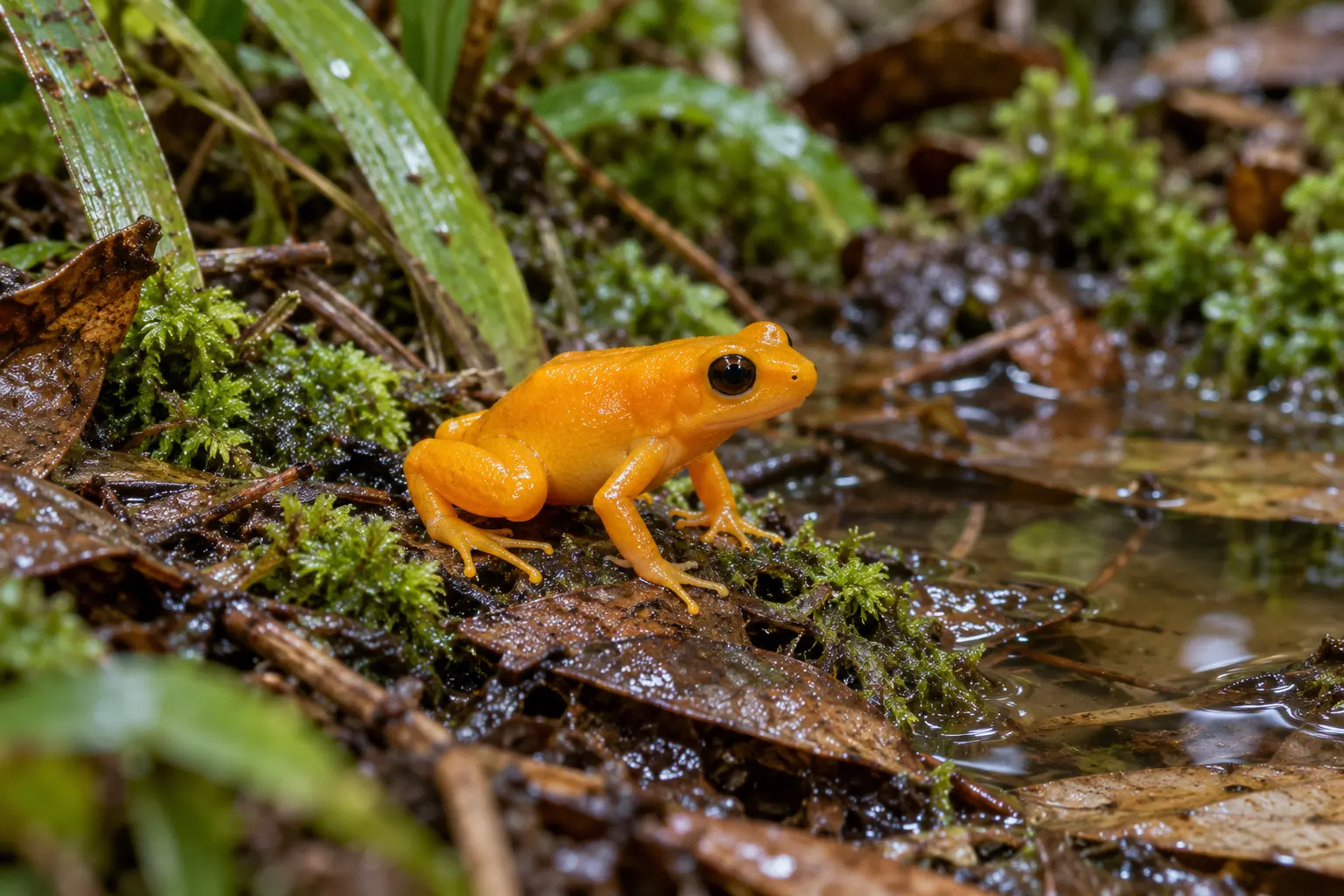
Known from the Torotorofotsy area and Andromena Forest along the Samarirana River at about 920–960 m in central-eastern Madagascar. It occupies upland wet swamp forest, among leaf litter, moss and vegetation near seasonal shallow pools. [1,3]
Smithsonian reports a length of about 2.5 cm. Females are generally larger and rounder than males, but sexing should combine size, calls and reproductive traits rather than colour alone. [1]
A tiny smooth-skinned frog, uniformly lemon-yellow, gold or orange, with dark eyes and without the enlarged toe pads of tree frogs. It can resemble other yellow-orange Mantella; lawful locality and morphological or genetic evidence may be needed. [1,3,4]
Bright aposematic colour warns predators of chemical defence, and daytime activity makes the signal conspicuous. Eggs develop on moist ground beside water, avoiding some aquatic egg predators, while rain transfers tadpoles into pools. [1,2]
Behaviour and ecology
Diurnal and group-living; Smithsonian reports groups often containing roughly two males per female. Males call after heavy rains to attract mates and defend small calling spaces. [1]
Diet
Feeds on tiny insects and arthropods including termites, ants, fruit flies and leaf-litter prey. Defensive alkaloids are accumulated from the wild diet; captive frogs should not be assumed to have wild-type toxicity. [1,2,4]
Reproduction and life cycle
Breeding begins after the first heavy seasonal rains. Females lay 20–60 white eggs in leaf litter, moss or beneath bark near water; after about two weeks tadpoles hatch and wriggle or wash into pools, metamorphosing after roughly 70 days. [1]
Ecosystem role
A predator of tiny arthropods and chemically defended prey, linking leaf-litter food webs to higher trophic levels. Dependence on small swamp systems makes it sensitive to hydrological change and forest quality. [1–3]
Threats & conservation
Its tiny range is threatened by agriculture, logging, fire, settlement, mining, introduced species and collection. DinoJura should consider only documented captive-bred animals, never treat colour as proof of origin, and comply with Appendix II plus Malagasy and Vietnamese law. [1–5]
IUCN moved Mantella aurantiaca from Critically Endangered (CR) to Endangered (EN) in the 2020 assessment; this assessment change does not mean threats have disappeared. Mantella is in CITES Appendix II. Any transaction requires lawful captive-origin evidence, chain of custody and appropriate permits. [1–5]5 sourced facts
Species in five facts
Body length is only about 2.5 cm. [1]
The species has a very small range in central-eastern Madagascar. [1,3]
Reported clutches contain about 20–60 eggs. [1]
Smithsonian records metamorphosis after roughly 70 days. [1]
IUCN has assessed the species as Endangered (EN) since 2020. [2]
Sources
[1] Smithsonian's National Zoo — Golden mantella frog[2] IUCN — 60 years of Red List conservation action[3] AMNH Amphibian Species of the World — Mantella aurantiaca[4] Animal Diversity Web — Mantella aurantiaca[5] CITES Appendices effective 5 March 2026