
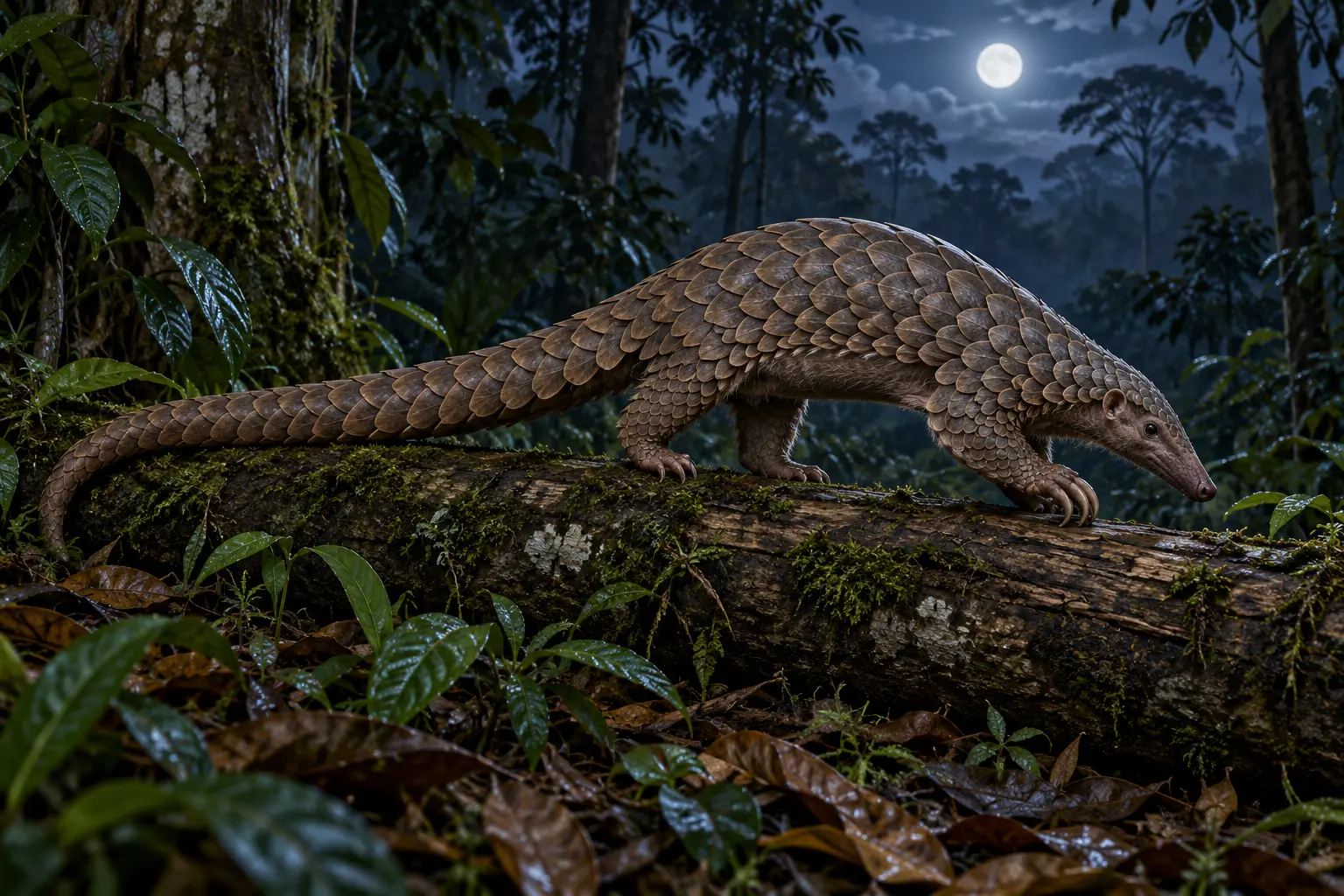
Recorded from Brunei, Cambodia, Indonesia, Laos, Malaysia, Myanmar, Singapore, Thailand and Viet Nam. It uses primary and secondary forest, scrub, plantations and sometimes areas near settlements, but a broad historic range does not imply present abundance. [1,2]
Total length is commonly about 75–121 cm, including a 35–56 cm tail; recent research describes a typical mass around 4–7 kg, though larger animals occur. Measurement method and body components should be recorded. [1,3]
Large dark-brown scales cover the back and outer limbs while sparse hair covers the belly; the head is narrow, tongue long, ears small and foreclaws curved. Compared with the Chinese pangolin, it has fewer scale rows across the back, shorter foreclaws and a longer, more slender tail. [2,4]
Overlapping keratin scales form flexible armour; powerful muscles close the scale edges around the soft underside. Foreclaws, narrow snout, long tongue and keen smell form a system for exploiting social insects, while the long tail aids climbing. [2,4]
Behaviour and ecology
Nocturnal, solitary and active both on the ground and in trees, using the tail for support. When threatened it rolls into a ball so scales cover the soft body—a defence effective against many predators but not humans. [1,2]
Diet
Specialises on ants and termites, opening nests with claws and inserting a long sticky tongue; it has no teeth. Rescue care is extremely difficult because diet, digestion, stress and foraging are specialised; the species should not be acquired as a routine display animal. [1,2,5]
Reproduction and life cycle
Sunda pangolins usually bear one young after roughly 6–7 months of gestation; females reach reproductive maturity toward the end of their first year according to the IUCN SSC Pangolin Specialist Group. Young ride on the mother’s back or tail base. [2]
Ecosystem role
Predation connects the species to ant and termite dynamics, while digging mixes and aerates soil locally. Popular insect-consumption figures should not be applied to every individual because energy needs, season and habitat vary. [1,2]
Threats & conservation
Hunting for meat and scales, cross-border trafficking and forest loss are principal threats. The 2019 IUCN assessment inferred an approximately 80% decline over three generations; this is a global assessment inference, not a direct count in every country. [1,5]
Reviewed 2 October 2026: IUCN lists the species as Critically Endangered (CR), assessed in 2019; CITES lists Manis javanica in Appendix I. International commercial trade in wild specimens is generally prohibited; rescue, research or conservation transfers still require CITES-authority and national-law confirmation. [1,4,5]5 sourced facts
Species in five facts
Pangolin scales are keratin, the same principal protein found in human nails. [4]
The Sunda pangolin has a longer tail and is more arboreal than the Chinese pangolin. [2]
It has no teeth and captures prey with a long sticky tongue. [2,4]
A litter usually consists of a single young. [2]
The species is in CITES Appendix I, the strictest international trade-control tier. [5]
Sources
[1] IUCN Red List 2019 assessment — Manis javanica[2] IUCN SSC Pangolin Specialist Group — Sunda pangolin[3] Home ranges and activity patterns of Sunda pangolins in Viet Nam[4] Singapore AVS — Identifying pangolins[5] CITES Appendices effective 5 March 2026