
Native to tropical rivers and estuaries from eastern Pakistan through South and Southeast Asia to northern Australia and the western Pacific. Aquaculture has moved it beyond its native range; escapees require treatment under local law and ecological-risk assessment. [1–4]
FAO reports males reaching about 320 mm total length and females about 250 mm; another manual gives maxima near 33 and 29 cm respectively. Source differences show why method, sex and stock should accompany any measurement rather than relying on one absolute figure. [1,2]
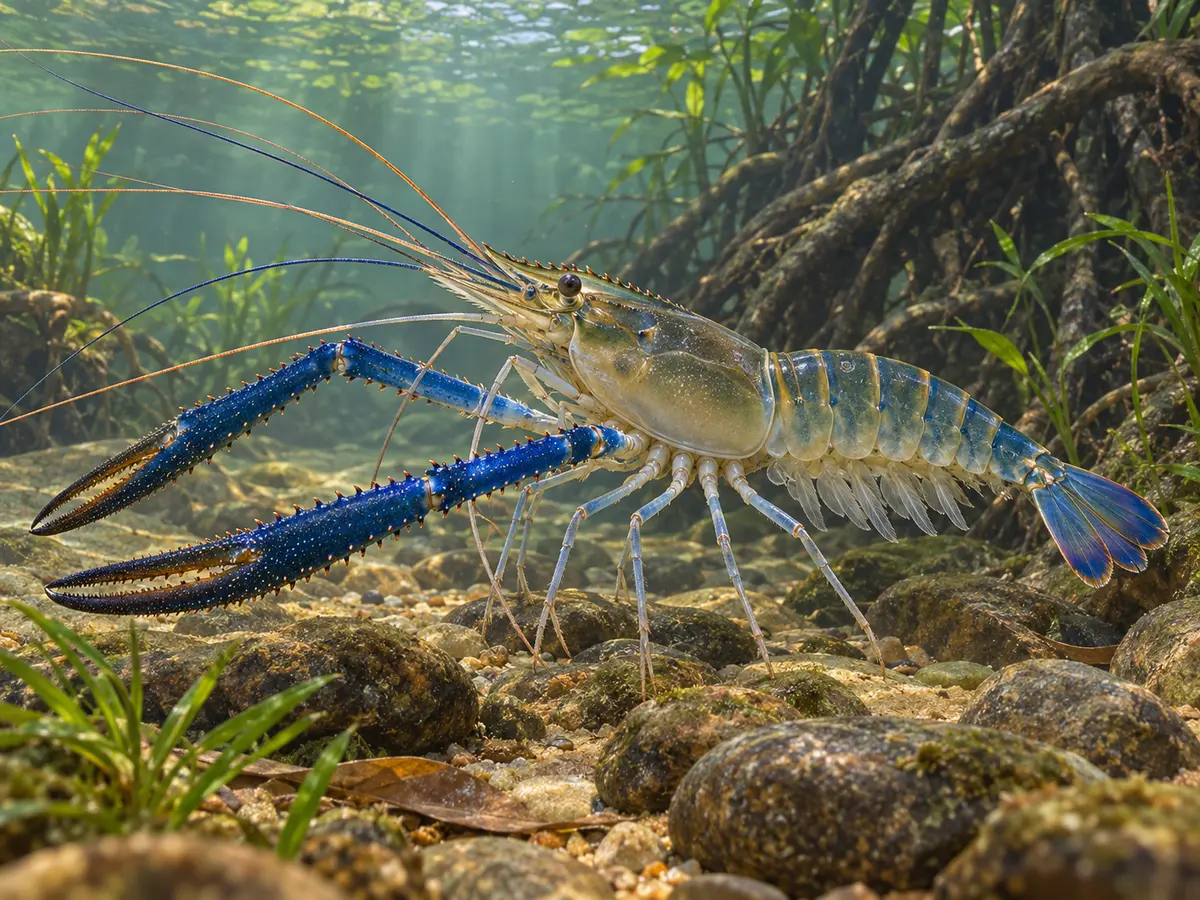
The body may be greenish-brown, grey or blue, with a toothed rostrum and five pairs of walking legs; the first two pairs are chelate. In adult males the second pair becomes extremely long and may bear large blue claws; the abdomen has six segments, swimmerets and a tail fan. [1,2]
Stage-specific salinity tolerance links estuaries with fresh water. Long claws serve competition and food handling; gills exchange gases but work only with adequate oxygen, stable water quality and intact surfaces. [1,2]
Behaviour and ecology
Benthic, foraging and sheltering around substrate, roots, rocks and submerged structure. Males form three social-size morphotypes—small male, orange-claw and blue-claw—and their hierarchy influences growth across the group. [1]
Diet
Larvae consume zooplankton, worms and crustacean larvae; postlarvae and adults are omnivores taking algae, plants, molluscs, insects, worms and crustaceans. In culture, excess feed and high density can rapidly degrade water quality. [1]
Reproduction and life cycle
Females carry eggs beneath the abdomen for about three weeks, with fecundity ranging from roughly 5,000 to 100,000 eggs depending on size. Egg-bearing females move downstream to brackish water; larvae pass through 11 stages before metamorphosing into postlarvae that migrate back into fresh water. [1]
Ecosystem role
As a benthic omnivore it recycles organic matter and acts as both predator and prey in river-estuary food webs. Outside the native range, farm escapes may compete, transmit pathogens or alter communities, so release is inappropriate. [1,3,4]
Threats & conservation
Dams and altered flows can sever migration between rivers and estuaries; pollution, harvest and habitat degradation create local pressure. In culture, poor water, crowding and weak hygiene increase disease. DinoJura should require traceable stock, quarantine, suitable testing and escape control. [1–5]
A public IUCN summary from 2013 lists the species as Least Concern (LC), but DinoJura could not verify a newer current assessment page and therefore states the age of the evidence. Macrobrachium rosenbergii was not located in the CITES Appendices of 5 March 2026; fisheries, veterinary, quarantine, biosecurity and alien-species rules still apply. [1–5]5 sourced facts
Species in five facts
Males can reach about 320 mm in total length. [1]
The life cycle includes eleven larval stages. [1]
Larvae require brackish water before postlarvae return to fresh water. [1,3]
Females may carry roughly 5,000–100,000 eggs depending on size. [1]
Males occur in small-male, orange-claw and blue-claw morphotypes. [1]
Sources
[1] FAO — Cultured Aquatic Species: Macrobrachium rosenbergii[2] FAO — Farming freshwater prawns: biology[3] IUCN Species 55 — freshwater biodiversity summary[4] U.S. Fish & Wildlife Service — Giant River Prawn risk summary[5] CITES Appendices effective 5 March 2026