
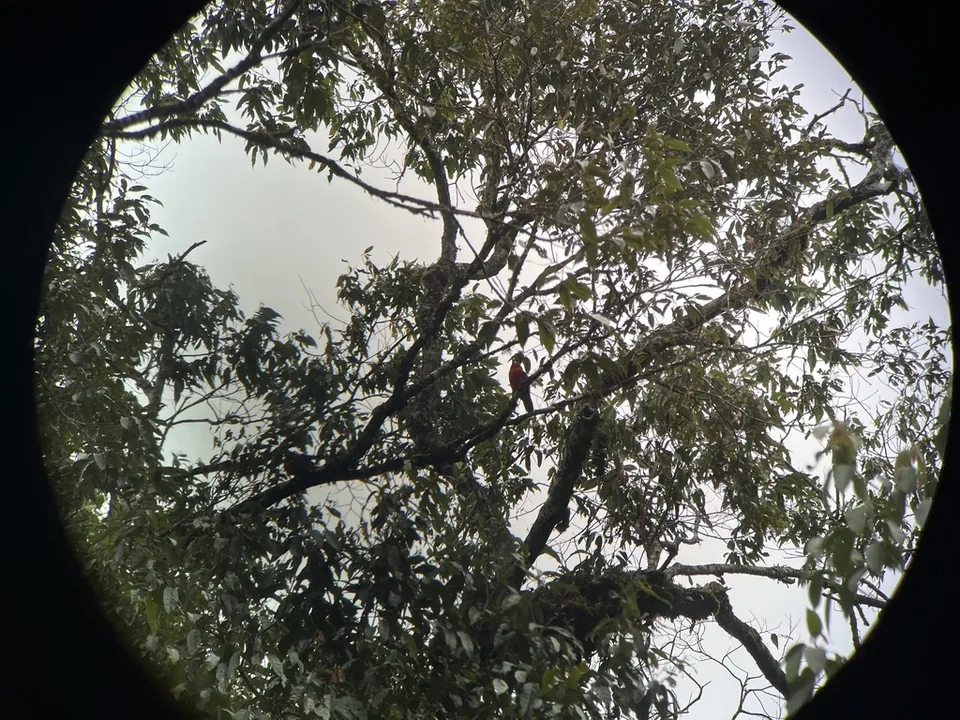
Native to Seram and possibly still present on Ambon; introduced to Buru. It uses montane and submontane primary and secondary forest, some lowland forest and cultivated areas, often around 600–1,000 m. Island populations should not be treated as interchangeable for provenance management. [1,2]
About 28 cm long and around 235 g according to World Parrot Trust. These are species-level figures, not values for all lories; individual condition requires keel-muscle assessment, weight trend and veterinary examination. [2]
Adults are red with black forehead, lores and crown, bordered behind by purple; wings are green, thighs violet-blue, the red tail has a darker tip and the bill is orange. The upper-breast yellow band varies; juveniles have a brown bill and brown eyes. [2]
Brush-like papillae at the tongue tip increase surface area for nectar and pollen; the curved bill manipulates fruit, flowers and seeds. Red-green plumage breaks up in canopy light at close range, while calls maintain contact across layered forest space. [2,3]
Behaviour and ecology
Usually seen in pairs, less often groups, and may be territorial. It stays high in tall trees, remaining quiet and shy while feeding or resting but becoming conspicuous and noisy over the canopy. Social management therefore requires individual compatibility assessment rather than assuming large-flock housing. [2]
Diet
In the wild it takes fruit, nectar, pollen, berries and rattan seeds. Its specialised tongue collects liquid foods, but this does not justify a sugar-water-only diet; managed nutrition must be balanced, hygienic and frequently renewed. [1,2]
Reproduction and life cycle
Wild breeding-season data remain limited. World Parrot Trust reports two elliptical eggs and fledging at about 11 weeks from managed-care sources; these should not be converted into fixed rules for every wild population. [2]
Ecosystem role
Moving among flowering and fruiting trees, lories may carry pollen and disperse some seeds while consuming canopy resources. The exact role needs study on Seram; quantitative data from other lory species should not be transferred uncritically. [1,2]
Threats & conservation
Trapping for the cage-bird trade and forest loss linked to logging and energy or infrastructure development are cited pressures. DinoJura should consider only lawful, traceable captive origin with Appendix-II records and disease screening; a 'captive-bred' claim needs parent-generation and facility evidence. [1,2,4]
BirdLife/IUCN lists the species as Endangered (EN); World Parrot Trust reports an estimate of 500–5,000 mature individuals and a rapid decline. It is covered by the Psittaciformes Appendix-II listing; every transaction still requires taxonomy, origin, permit, quarantine and national-law checks. [1,2,4]5 sourced facts
Species in five facts
It is a small-range endemic of the southern Moluccas. [1,2]
A brush-tipped tongue helps collect nectar and pollen. [2]
The yellow breast band varies among individuals. [2]
World Parrot Trust reports a two-egg clutch. [2]
The species is covered by an order-level CITES Appendix-II listing. [4]
Sources
[1] BirdLife DataZone — Purple-naped Lory[2] World Parrot Trust — Purple-naped Lory[3] ITIS — Lorius domicella[4] CITES Appendices effective 5 March 2026Photo record — Donna Belder / iNaturalist 382982574