
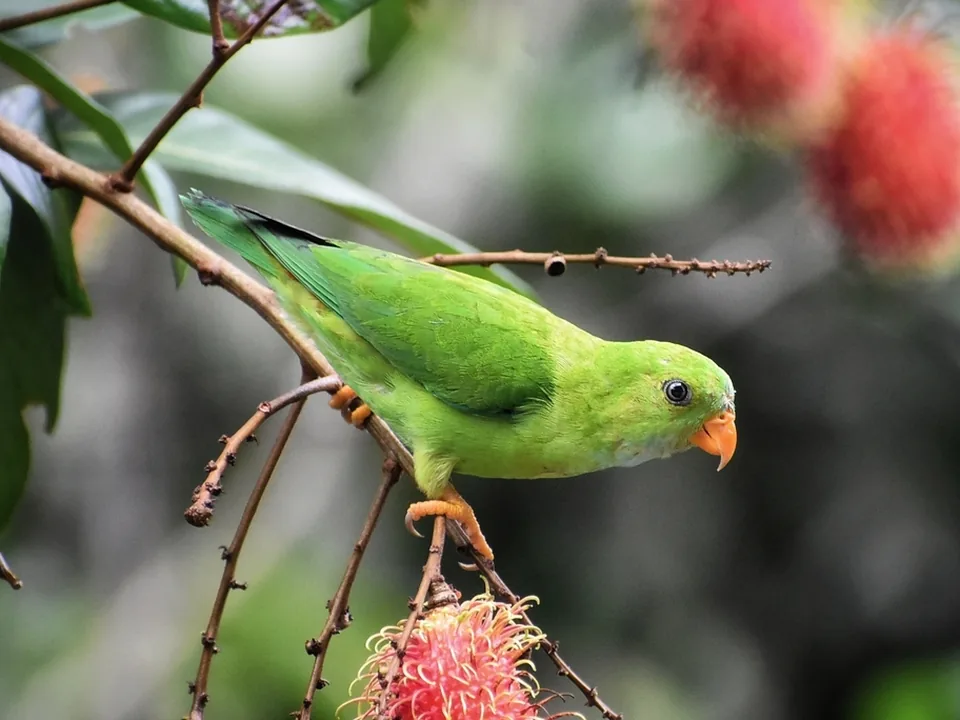
Ranges from the Indian subcontinent through Myanmar, Thailand, Laos, Cambodia and Vietnam. It uses evergreen and deciduous forest, forest edges, orchards, plantations and other tree-rich landscapes with flowering and fruiting resources. [1–3]
About 14 cm long, compact-bodied and very short-tailed compared with many parrots. Small size does not imply low activity needs: it is a fast, agile canopy flier. [2,3]
Plumage is mainly green with paler underparts, a red rump and upper-tail coverts, and an orange-red bill. Adult males have a blue throat; females usually have a green throat, so a bird without blue may be female or immature. [2,3]
Two-forward, two-back toes and a curved bill form a climbing and food-handling grip that also enables inverted hanging. A small body, pointed wings and short tail aid rapid turns through foliage. [2,3]
Behaviour and ecology
Diurnal, often in pairs or small groups, and climbs with bill and feet. It may feed, perch and sleep upside down; this is normal biology rather than a sign of collapse. [2,3]
Diet
Feeds on soft fruit, seeds, buds, flowers and nectar and may visit fruiting orchards. Managed diets require botanical variety and controlled sugar and energy, not reliance on fatty dry seed. [2,3]
Reproduction and life cycle
Nests in tree cavities; compiled accounts commonly report 2–4 white eggs. Breeding season varies geographically and with food, so one calendar should not be applied across the range. [2]
Ecosystem role
By visiting flowers and fruiting trees, it participates in pollination and seed-dispersal networks, although its contribution varies with food type and whether seeds are destroyed or swallowed. [1–3]
Threats & conservation
A broad range supports its current LC status, but loss of cavity trees and flowering-fruiting resources and trapping can cause local pressure. Appendix II requires DinoJura to verify captive origin and the full permit chain before any transaction. [1,4]
BirdLife/IUCN lists the species as Least Concern (LC). Loriculus vernalis falls within the Psittaciformes spp. listing in CITES Appendix II; international trade still requires appropriate origin records, permits and non-detriment findings. LC does not mean unrestricted collection or trade. [1,4]5 sourced facts
Species in five facts
It is among the parrots known to sleep upside down. [2,3]
Its short tail distinguishes it from many sympatric long-tailed parrots. [2]
Adult males show a blue throat patch. [2,3]
The bill and feet work together in climbing and food handling. [2]
The species occurs naturally in Vietnam. [1]
Sources
[1] BirdLife DataZone — Vernal Hanging-parrot[2] Cornell Birds of the World — Vernal Hanging-Parrot[3] eBird — Vernal Hanging-Parrot[4] CITES Appendices effective 5 March 2026Photo record — Devika M B, iNaturalist 291182096, CC BY