
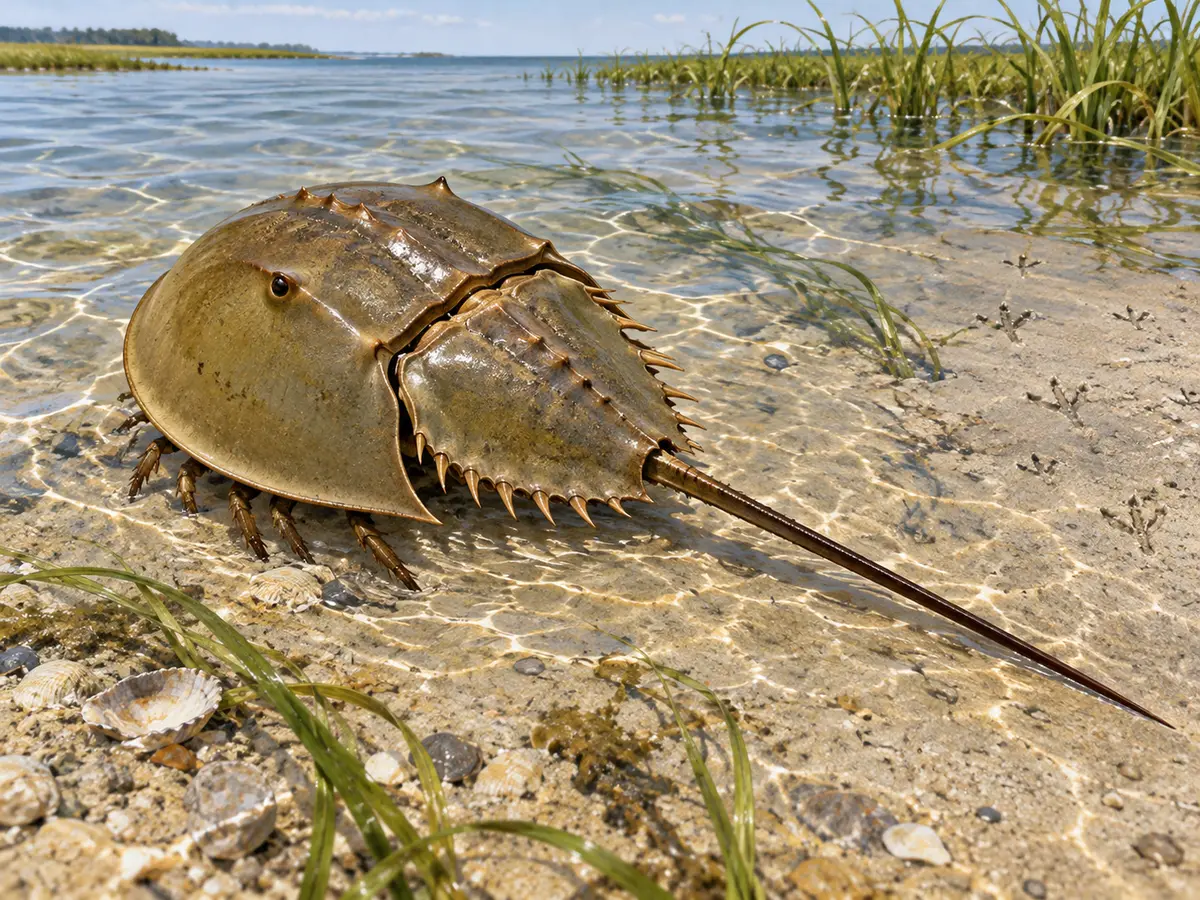
Ranges along the North American Atlantic coast from Maine to the Yucatán Peninsula and Gulf of Mexico, using estuaries, shallow bays and coastal shelf waters. Juveniles occupy intertidal flats near spawning beaches while older animals move into deeper water. [2]
The largest mature females may reach about 60 cm including the tail and 4.8 kg; males are typically 25–30% smaller. Size varies geographically, so maxima should not be applied to every population. [2]
The body consists of a horseshoe-shaped prosoma, a segmented opisthosoma with lateral spines, and a long pointed telson. Dorsal colour is usually olive-brown; lateral compound eyes are only part of a multi-eye visual system. The telson is not a venomous stinger. [2,3]
A hard shell protects the appendages, legs both move and process food, book gills exchange gases and the telson steers and rights the body. Copper-based haemocyanin makes the blood blue; its clotting response to endotoxin underpins LAL testing. [1–3]
Behaviour and ecology
Adults aggregate on sandy beaches at high tides around new and full moons to spawn. The tail acts as a rudder and lever to right the animal after waves overturn it; animals should not be lifted by the tail because injury can result. [1,2]
Diet
Feeds on marine worms, molluscs and other benthic invertebrates; food is macerated between the bases of the walking legs before reaching the mouth. Juveniles exploit smaller organic particles in sediment. [1,2]
Reproduction and life cycle
A female buries clusters of about 4,000 eggs in sand and may spawn repeatedly, producing 100,000 or more eggs. Larvae hatch in roughly two to four weeks and moult as they grow; egg and larval mortality are high although adults can live beyond 20 years. [2]
Ecosystem role
Horseshoe crabs rework sediment while feeding and spawning; eggs feed more than 20 migratory bird species as well as fish, turtles and crustaceans. Harvest management must therefore consider the wider food web, not only adult crab abundance. [1,3]
Threats & conservation
Spawning-beach loss, bait harvest, biomedical bleeding, pollution and shoreline change create regionally variable pressures. DinoJura should not treat absence from CITES as free trade: any collaboration must follow local quotas or bans, prioritise non-harvest alternatives, trace the supply chain and assess welfare. [1–5]
The IUCN SSC specialist group confirms the Atlantic horseshoe crab as Vulnerable (VU); the underlying assessment is dated 17 February 2016 and should be read with newer regional data. Limulus polyphemus was not located in the CITES Appendices effective 5 March 2026; this does not replace state or national quotas, harvest bans and permits. [1,4,5]5 sourced facts
Species in five facts
Horseshoe crabs are closer to spiders and scorpions than true crabs. [1,3]
The tail steers and rights the animal; it is not a stinger. [1,2]
Blue blood contains copper-based haemocyanin. [1]
A female may lay 100,000 or more eggs. [2]
The eggs support more than 20 migratory bird species. [1,3]
Sources
[1] NOAA Ocean Service — Are horseshoe crabs really crabs? (updated 23 September 2026)[2] U.S. Fish & Wildlife Service — Atlantic Horseshoe Crab[3] NOAA Fisheries — 10 Incredible Horseshoe Crab Facts[4] IUCN SSC Horseshoe Crab Specialist Group[5] CITES Appendices effective 5 March 2026