
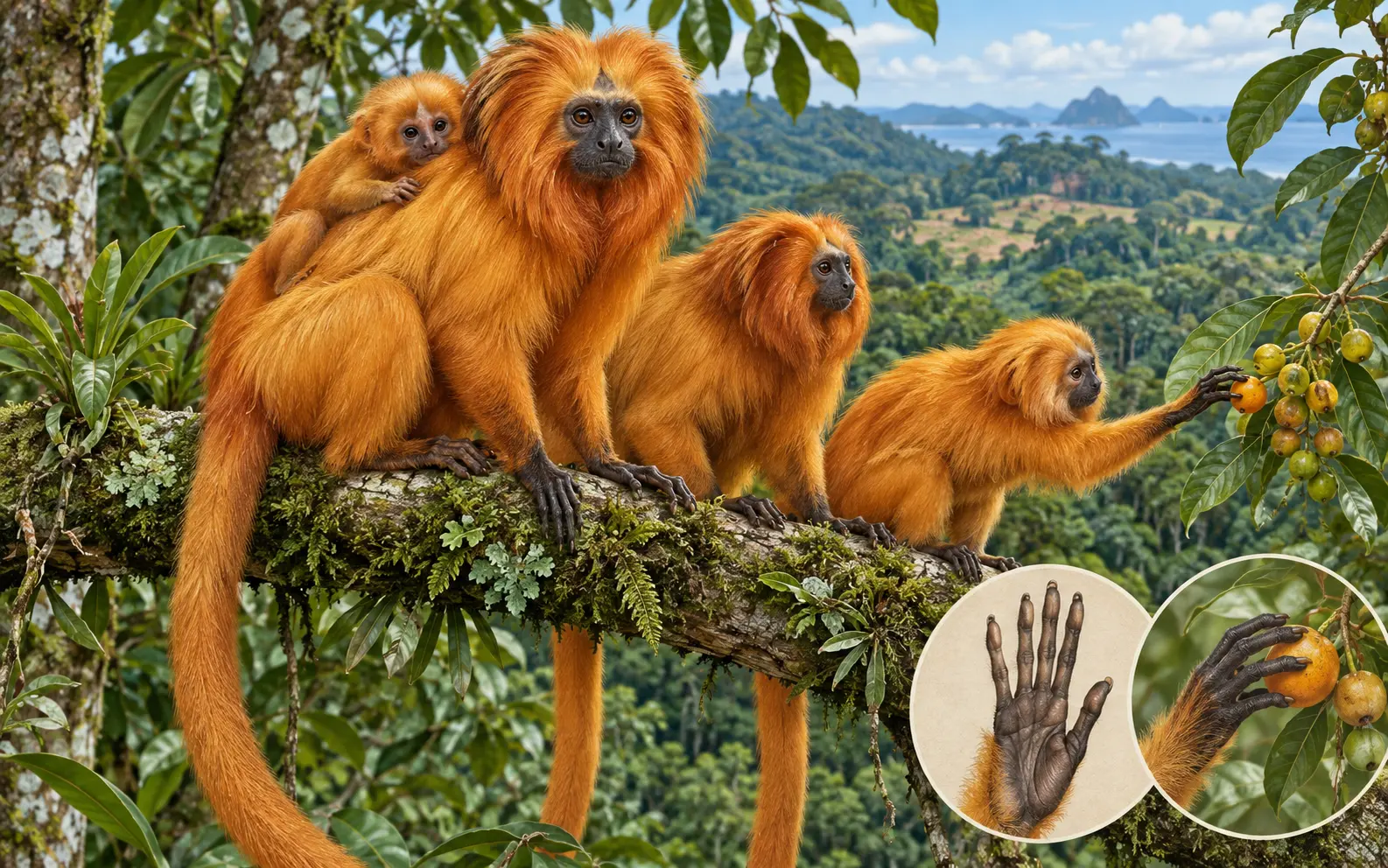
Now restricted to lowland forest fragments in Rio de Janeiro, including reserves and private land; forest corridors determine movement between groups.
Body length about 20–36 cm, tail 32–40 cm and mass roughly 0.5–0.7 kg. Sexes are similar in size.
Long golden to reddish-gold coat, with a mane concealing the ears around a dark, nearly bare face. Narrow hands and long claw-like nails probe crevices.
Long digits and claw-like nails expand access to hidden insects; cooperative care helps a female raise twins that are heavy relative to her body.
Behaviour and ecology
Lives in territorial family groups and communicates with varied calls. Tree cavities are used for sleeping and predator avoidance.
Diet
Feeds on fruit, insects, spiders, nectar and small animals, using long fingers to extract prey from bark, bromeliads and crevices.
Reproduction and life cycle
Groups usually have one breeding female; gestation is about four months and twins are common. Males and other group members carry, protect and feed infants.
Ecosystem role
Consumes fruit and disperses seeds, supporting forest regeneration, while insect foraging links multiple microhabitats.
Threats & conservation
IUCN lists it as EN; forest fragmentation, urbanisation and diseases such as yellow fever still threaten populations. CITES Appendix I strictly limits international trade.
IUCN/CITES status was checked on the profile date; re-verify before any legal or transaction decision.5 sourced facts
Species in five facts
The species appears on Brazil's 20-real banknote.
Twins are a common reproductive outcome.
The whole group helps care for infants.
Claw-like nails differ from the flat nails of many primates.
Reintroduction from managed breeding contributed to recovery.
Sources
Smithsonian National ZooSave the Golden Lion TamarinIUCN Red List searchCITES Checklist