
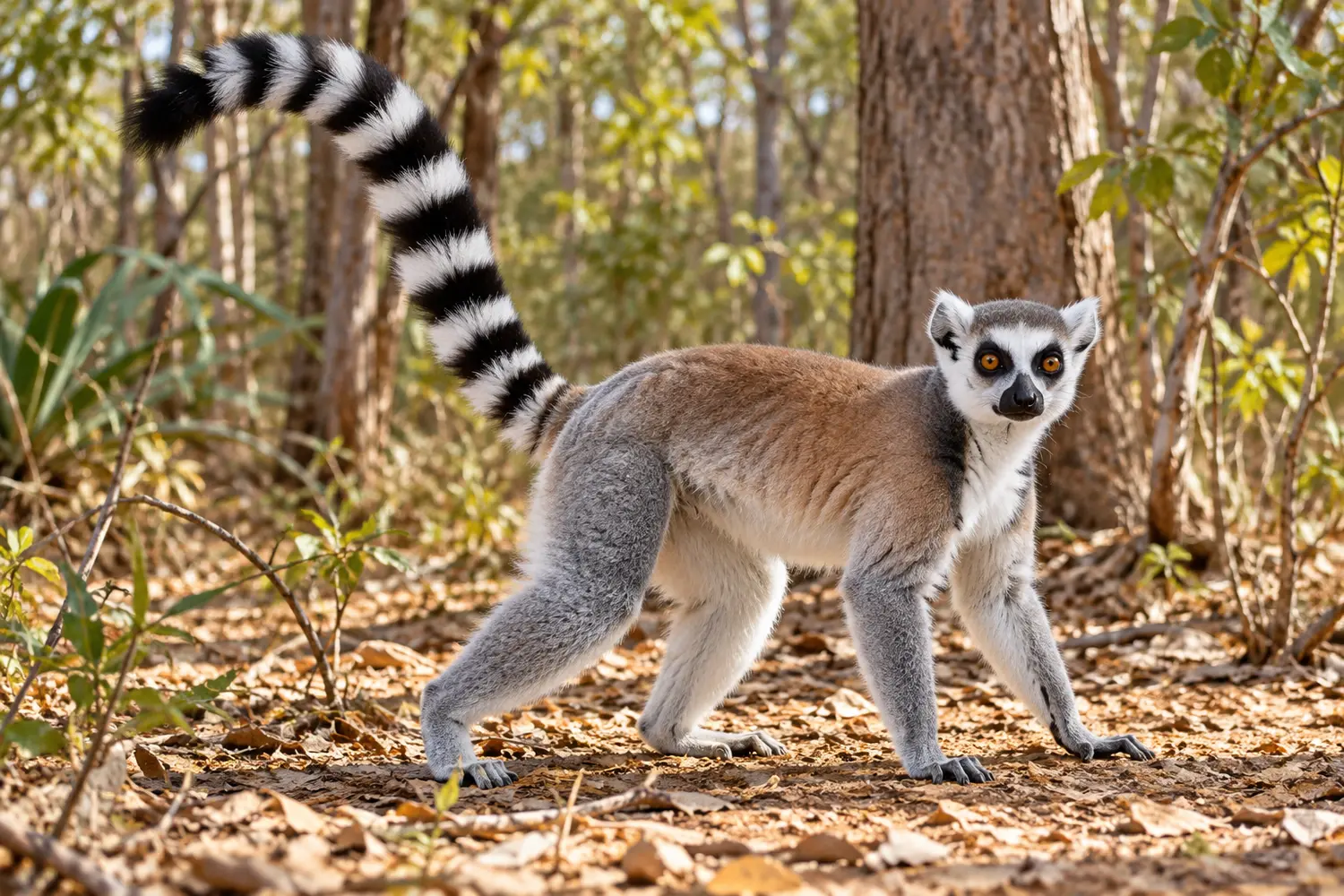
Lives in southern and south-western Madagascar in gallery forest, dry deciduous forest, spiny scrub and rocky areas. Use of varied habitats does not protect it from fragmentation and loss of food trees. [1–3]
Head-body length is about 39–46 cm, the tail may reach roughly 56–63 cm, and adults commonly weigh around 2–3 kg. The long tail is used for signalling and balance, not as a grasping limb. [1,2]
A grey to rosy-brown back, white underside and face, black triangular eye patches and black nose accompany exactly 13 alternating tail bands. The sexes look similar, so coat colour alone does not establish sex. [1]
Lower incisors and canines form a toothcomb for grooming, assisted by a toilet claw. A sunning posture exposes the sparsely furred underside to absorb heat before foraging. [1,2]
Behaviour and ecology
Lives in troops of 3–25, with females dominant and raised tails acting as visual flags during travel. Scent marking, alarm calls, sunning and grooming maintain social relationships. [1]
Diet
Consumes fruit, leaves, flowers, herbs, insects and occasionally small vertebrates; tamarind is important in many areas. Dietary proportions change strongly by season and habitat. [1–3]
Reproduction and life cycle
Breeding is seasonal; gestation lasts about 4.5 months and usually produces one infant late in the dry season, though twins can occur under favourable conditions. Infants first cling ventrally, then ride dorsally and wean at about 5–6 months. [1]
Ecosystem role
Fruit eating and daily travel can disperse seeds, while leaf and insect consumption links the species to dry-forest food webs. Troops are also prey for fossas, raptors and snakes. [1–3]
Threats & conservation
Deforestation, fire, grazing, logging, hunting and the pet trade reduce and isolate populations. The species is not a pet; managed programmes require appropriate troop structure, pedigrees and a recognised conservation plan. [1,3,4]
Reviewed 29 September 2026: IUCN lists the species as Endangered (EN), and CITES includes Lemuridae in Appendix I. Familiarity in managed collections does not indicate a secure wild population or reduce provenance, welfare or permit requirements.5 sourced facts
Species in five facts
The tail has exactly 13 alternating black and white bands. [1]
The species spends about 40% of its activity time on the ground. [1]
Females hold social dominance within troops. [1]
A troop may travel up to roughly 6 km in a foraging day. [1]
CITES regulates Lemuridae under Appendix I. [4]
Sources
[1] Smithsonian's National Zoo — Ring-tailed lemur[2] Duke Lemur Center — Ring-tailed lemur[3] IUCN Red List species search[4] CITES Appendices effective 5 March 2026