
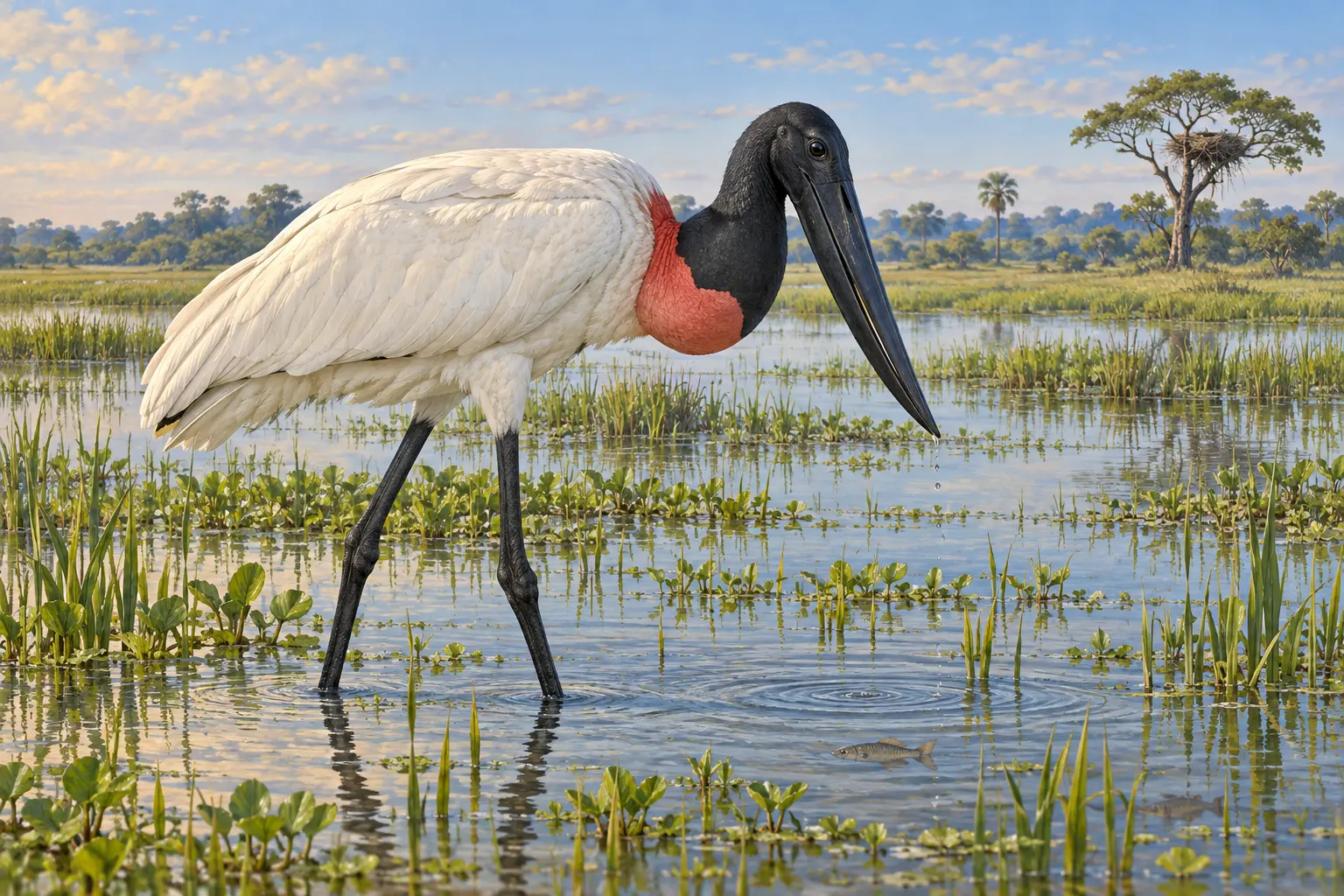
Occurs from Mexico through Central America across much of South America, especially in large wetlands such as the Pantanal. It forages in marshes, mudflats, flooded grasslands and shallow rivers; large nests are often high in isolated or prominent trees. [1,2]
Animal Diversity Web reports height up to about 1.15 m, mass up to 8 kg, an average wingspan near 2.6 m and a bill reaching 30 cm. Males are generally larger; these are reference ranges, not standards for every individual. [2]
Adults have white plumage, long black legs, a bare black head and upper neck, red-pink lower-neck pouch and massive black bill. Juveniles are greyer and browner; bill shape and the neck band help separate the species from other large storks. [1,2]
Long legs permit wading, the massive bill handles diverse prey and broad wings support soaring. A bare head and neck reduce feather fouling when scavenging or reaching into water and mud. [2]
Behaviour and ecology
Diurnal, feeding alone or in groups and moving with water levels and prey availability. Breeding pairs communicate with bill clattering, and birds use thermal soaring to reduce the cost of long-distance travel. [2]
Diet
Takes fish, molluscs, insects and amphibians, with small reptiles, mammals and carrion also recorded. The huge bill probes, grasps or seizes prey in shallow water and mud. [2]
Reproduction and life cycle
Builds a large stick nest high in trees; both parents construct, incubate and care for young. Clutches of two to five eggs, averaging about three, are reported; young fledge at roughly 100–110 days and the full breeding effort spans many months. [2]
Ecosystem role
A large wetland predator that helps regulate fish, amphibians and small animals, while scavenging recycles organic material. Its large nests may provide structure used by other organisms after abandonment. [2]
Threats & conservation
Wetland drainage, conversion, loss of nest trees, disturbance and hunting drive local declines despite the global LC category. Any transfer must exclude commercial wild origin, satisfy Appendix I controls and carry clear breeding and chain-of-custody records. [1–4]
Reviewed 4 October 2026: BirdLife/IUCN lists the species as Least Concern (LC), while CITES places Jabiru mycteria in Appendix I. LC describes global extinction risk and does not relax CITES controls; international commercial trade in wild specimens is generally prohibited and any exception requires authority confirmation. [1–4]5 sourced facts
Species in five facts
Average wingspan is reported at about 2.6 m. [2]
The bill may reach about 30 cm. [2]
Both parents incubate eggs and care for the young. [2]
Young may require roughly 100–110 days to fledge. [2]
CITES lists the species in Appendix I even though IUCN currently records LC. [1,3,4]
Sources
[1] BirdLife DataZone — Jabiru[2] Animal Diversity Web — Jabiru mycteria[3] IUCN Red List search — Jabiru mycteria[4] CITES Appendices effective 5 March 2026