
Ranges from north-eastern India, Nepal and Bangladesh through Myanmar, Thailand, Laos, Cambodia and Viet Nam to north-western Peninsular Malaysia. It uses deciduous dipterocarp forest, bamboo, grassland, secondary forest and low- to mid-elevation evergreen forest. [1,2]
Straight carapace length can reach about 36 cm, although many adults are smaller than this maximum. Size, mass and shell form vary with sex, age and population. [1]
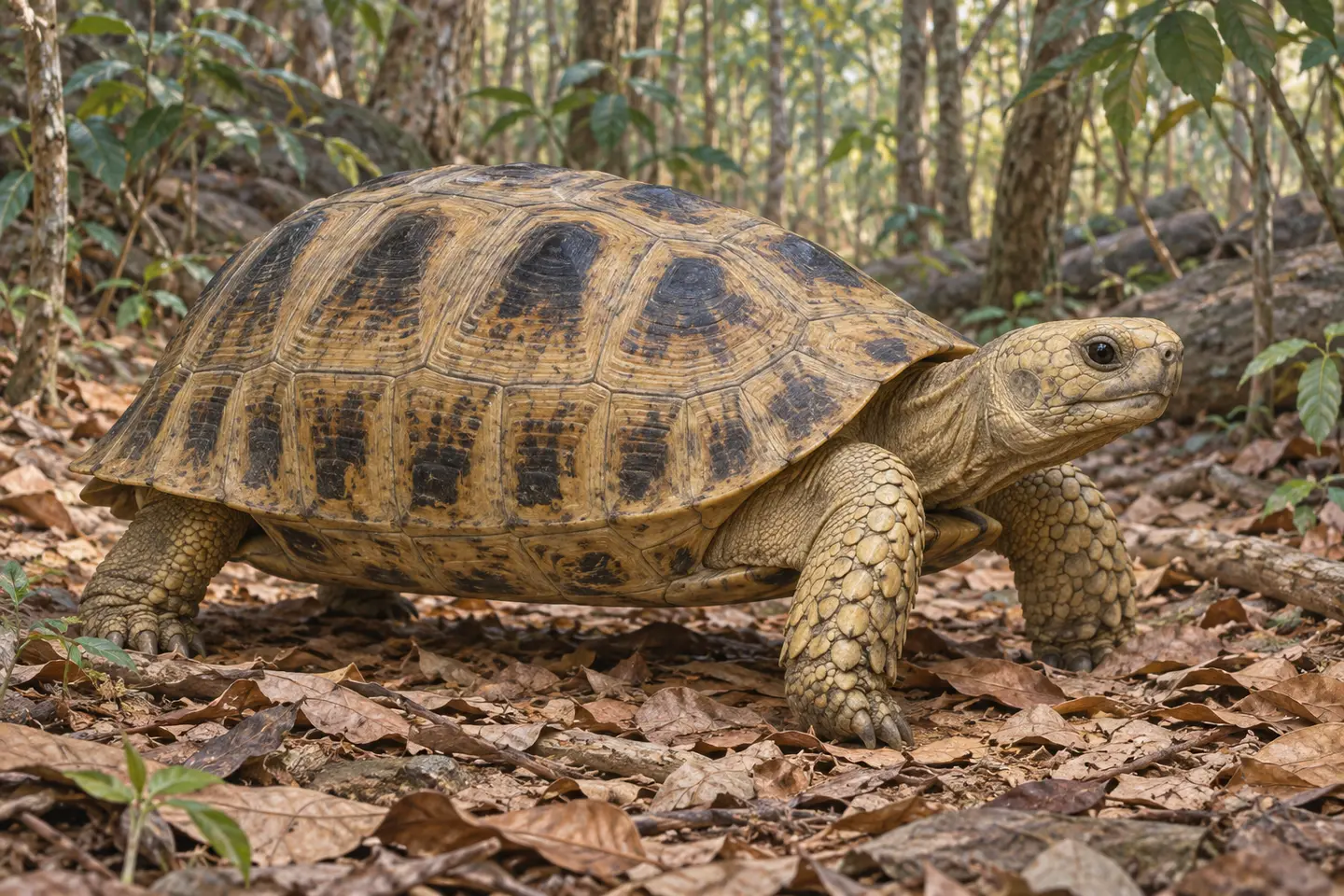
The elongated, relatively low shell is yellow-brown with dark centres on the scutes; head and forelimbs may be cream-yellow. Adult males commonly have a concave plastron and longer tail, while facial colour can differ between sexes in the breeding season. [1,2]
A strong shell protects the body, columnar limbs traverse forest ground and yellow-brown colour blends with dry litter. Use of several forest types supports a broad range but cannot offset slow recovery under heavy harvest. [1,2]
Behaviour and ecology
Terrestrial, often sheltering in leaf litter, thickets or cover during hot, dry conditions. Activity increases in humid weather; daily and seasonal rhythms depend on local climate and should not be generalised from one locality. [1]
Diet
A generalist omnivore biased toward plant matter—fallen fruit, leaves, shoots, flowers and fungi—while also taking invertebrates or carrion. A varied wild diet does not justify a sugar-rich or animal-protein-heavy captive ration. [1]
Reproduction and life cycle
Courtship and mating generally begin with the rains. Clutches of up to about ten eggs are laid toward the end of the wet period, and hatchlings commonly emerge at the start of the next rainy season, tying reproduction closely to seasonality. [1]
Ecosystem role
By eating fruit and fungi, moving seeds across the forest floor and redistributing nutrients—and by taking carrion and invertebrates—the species participates in both dispersal and decomposition pathways. [1; ecological interpretation]
Threats & conservation
IUCN attributes severe decline to habitat loss, fragmentation and burning plus collection for food, traditional medicine and trade. CITES Appendix II regulates international trade; a “captive-bred” claim is meaningful only when supported by lawful records. [1,3,4]
Reviewed 20 September 2026: IUCN displays CR, from an assessment published in 2019; CITES lists Testudinidae spp. in Appendix II, including Indotestudo elongata. Conservation status does not replace transaction-specific origin, permit and Vietnamese-law checks.5 sourced facts
Species in five facts
The name elongata refers to the lengthened shell form. [2]
No subspecies is currently recognised by the Reptile Database. [2]
Reported maximum straight carapace length is about 36 cm. [1]
A clutch may contain up to about ten eggs. [1]
Viet Nam lies within the confirmed native range. [1,3]
Sources
[1] IUCN/SSC TFTSG — Indotestudo elongata species account[2] The Reptile Database — Indotestudo elongata[3] IUCN Red List species search[4] CITES Appendices effective 5 March 2026