
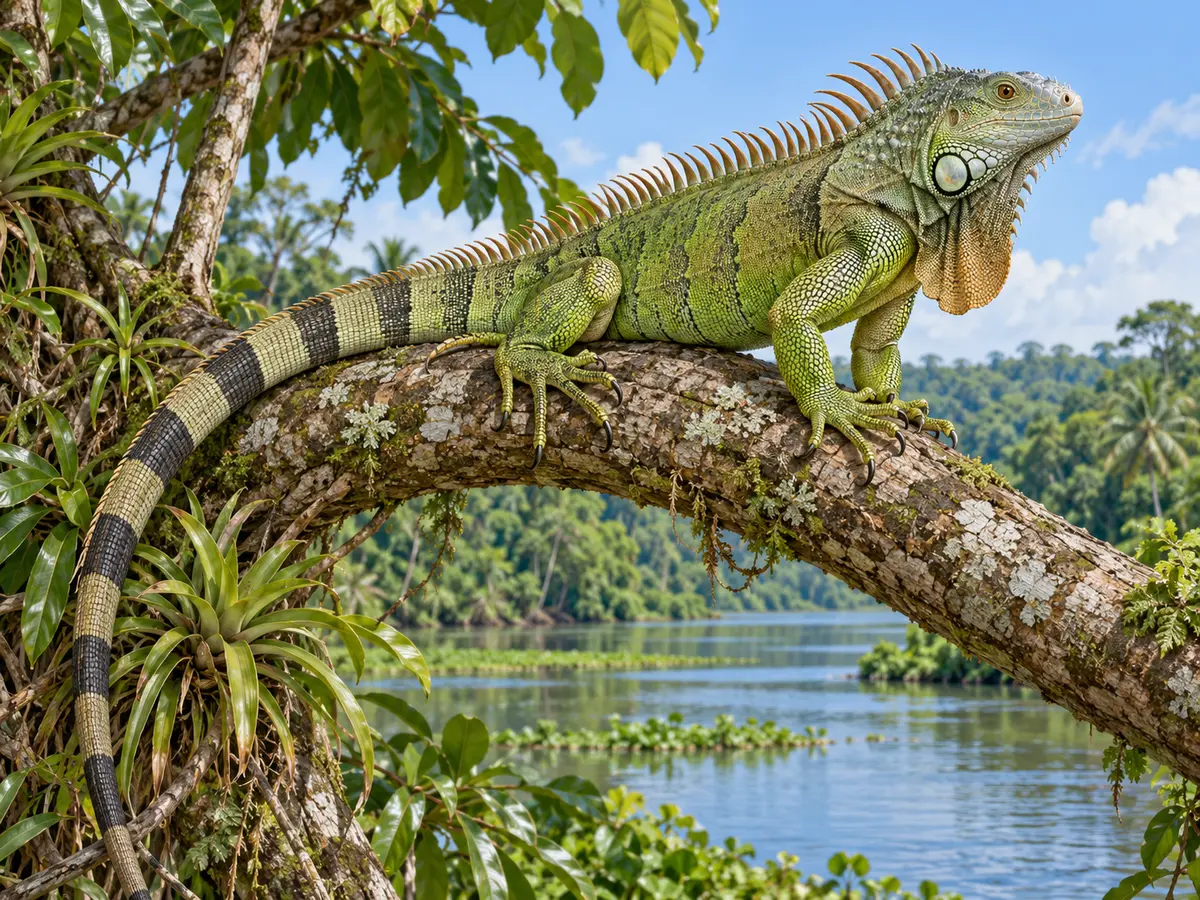
Native from Mexico through Central America, the Caribbean and much of northern and central South America to Paraguay and southeastern Brazil. It occupies forest, river margins, wetlands, coasts and modified landscapes with trees and water, and has been introduced to Florida, Hawaii and elsewhere. [1–4]
ADW reports adults commonly at 4–6 kg, some near 8 kg, and total length approaching 2 m, much of it tail. Size varies with sex, population and body condition; maxima are not husbandry targets. [2]
A hanging dewlap, spines from neck to tail base, a large rounded scale below the ear and a tapering dark-banded tail are key traits. “Green” does not describe every animal: colour may be green, olive, brown or orange with age, sex, season, temperature and population. [2–4]
The dewlap supports signalling and heat exchange; the parietal eye detects overhead light changes; hindgut microbes support a fibrous diet. Long claws grip branches, the powerful tail balances and defends, and strong swimming aids escape. [2,3]
Behaviour and ecology
Diurnal and arboreal, spending substantial time basking for thermoregulation and digestion. Males communicate and defend sites with head bobs, dewlap displays and colour change; when threatened they may jump into water, dive, tail-whip or shed part of the tail. [2,3]
Diet
Adults feed mainly on leaves, flowers and fruit, with hindgut microbes breaking down cellulose. Juveniles may take more insects or eggs and opportunistic animal feeding is recorded, but this does not make the species dependent on a high-animal-protein diet. [1–3]
Reproduction and life cycle
Breeding occurs in the dry season and females excavate nest burrows. ADW reports a usual clutch of 10–30 eggs, while IUCN synthesises 9–71 with means near 35 in most studied populations; incubation is about 90–120 days with no direct post-laying care. [1,2]
Ecosystem role
Fruit feeding disperses some seeds, while eggs, juveniles and adults feed many predators. In introduced areas, dense populations can affect vegetation, infrastructure and native wildlife, so captive animals must never be released. [2,3]
Threats & conservation
Harvest for food, leather and pets has reduced some populations, alongside habitat loss. In care, inadequate UVB and heat, poor diet, confined space and metabolic disease are major risks. DinoJura must verify species, captive origin, CITES, veterinary and invasive-species rules at destination. [1–5]
IUCN assessed the species as Least Concern (LC) on 16 March 2018, with an amended version published in 2022; CITES places Iguana spp. in Appendix II. A globally widespread species may still decline locally and become invasive beyond its native range; Appendix II still requires lawful provenance and permits. Reviewed 6 October 2026. [1–5]5 sourced facts
Species in five facts
Total length can approach 2 m, much of it tail. [2]
The species swims strongly and may dive to escape predators. [2,3]
Hindgut microbes help break down cellulose. [2]
Clutches are synthesised at 9–71 eggs depending on population and female size. [1]
Iguana spp. are listed in CITES Appendix II. [5]
Sources
[1] IUCN Red List — Iguana iguana[2] Animal Diversity Web — Iguana iguana[3] Florida Fish and Wildlife — Green iguana[4] Reptile Database — Iguana iguana[5] CITES Appendices effective 5 March 2026