
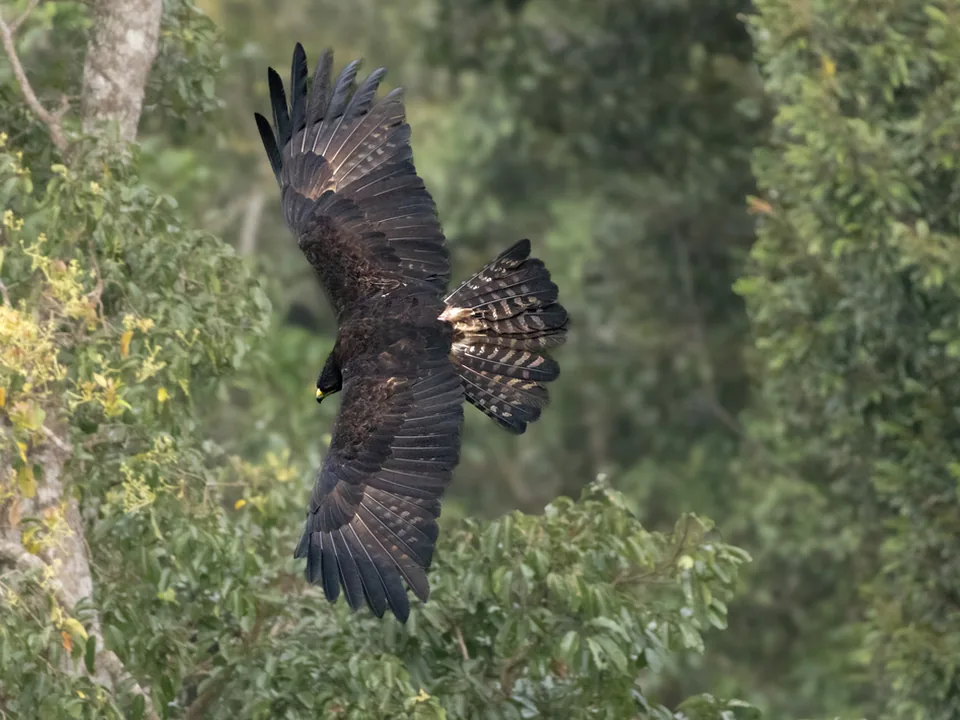
Ranges from the Indian subcontinent and Himalayas through southern China to South-East Asia, the Malay Peninsula and parts of the Sunda region. It uses evergreen and montane forest, edges and wooded hills with canopy continuity; BirdLife rates its forest dependency as high. [1–3]
Length is roughly 65–80 cm and wingspan commonly about 150–180 cm; females average larger than males, as in many raptors. Despite broad flight surfaces the body is relatively slender, with slightly V-held wings and a long tail for canopy manoeuvring. [2,3]
Adults are nearly all black with a yellow cere and feet and dark-brown eyes. From below, the small head, long tapered wings and deeply splayed primary fingers form a useful combination; juveniles are browner with streaking on the head and underparts. [2,3]
Broad, low-loading wings support slow flight without rapid height loss, while the long tail steers through canopy airspace. Long, relatively flexible toes reach into nests, and forward-oriented vision helps locate targets among leaves. [2,3]
Behaviour and ecology
Usually solitary or paired, it sails slowly just above the canopy and banks to inspect gaps in foliage. Long feet and toes allow it to remove eggs or nestlings, sometimes lifting an entire small nest from a branch. [2,3]
Diet
Takes eggs and nestlings, as well as small adult birds, squirrels, bats, lizards, frogs and other small mammals depending on place. Nest-raiding is characteristic, but the species should not be described as an egg-only specialist. [2,3]
Reproduction and life cycle
Pairs build a large stick nest high in a forest tree and may reuse or add to it across seasons; breeding timing varies geographically. Clutches are small, usually one and sometimes two, so loss of adults or nest trees can have prolonged local effects. [1–3]
Ecosystem role
As a canopy predator it influences nesting success and populations of small vertebrates. Its forest dependence means occurrence also reflects aspects of canopy structure and continuity. [1–3]
Threats & conservation
Forest loss and fragmentation, loss of nest trees, trapping and conflict with bird keepers can create pressure. DinoJura should consider only traceable lawful origin, Appendix-II documentation, veterinary screening and safe flight facilities; LC does not imply low risk for every population. [1,4]
BirdLife/IUCN lists the species as Least Concern (LC) with a decreasing trend; BirdLife estimates an 18.3% decline in tree cover within its mapped range. It falls under the CITES Appendix-II order-level listing; every transaction needs current taxonomy, origin and permit checks. [1,4]5 sourced facts
Species in five facts
It often flies slowly just above the canopy while searching for nests. [2,3]
Long toes can remove eggs or nestlings from nests. [2,3]
Adult plumage is almost entirely black. [2]
BirdLife rates the species as highly forest-dependent. [1]
The species is covered by an order-level CITES Appendix-II listing. [4]
Sources
[1] BirdLife DataZone — Black Eagle[2] Cornell Lab eBird — Black Eagle[3] Avibase — Ictinaetus malaiensis[4] CITES Appendices effective 5 March 2026Photo record — sunnyjosef / iNaturalist 328928094